“Now I’m so in mode to just emote until my throat is hoarse
‘Cause they wouldn’t recognize a trailblazer until the road is torched
So if you follow me, beware, my accounts are probably jaded. Maybe a characteristic of the underappreciated…”
–Sa-Roc1
Occasionally events happen that cut so deep emotionally one wonders where it stems from. And when it happens again and again, the thought forms as to why.
This article is going to take a look at the relationships of power and privilege across fellow affinity organizations, specifically the relationship between both Seattle based entities Climbers of Color and Queer Mountaineers2. As everyone has seen, there was a statement issued by the Queer Mountaineers discussing an issue with their white led and majority white participant organization plagiarizing an application form from Climbers of Color (see end of article for specific questions plagiarized). Let’s dive in to see why this is harmful not only to the individuals of color involved in the original application creation, but also the ripple effect on queer people of color as well as the general affinity space at large.

I would love to be able to say that this is the first time an organization has plagiarized work from Climbers of Color as an organization. It is not. The first instance was recorded back in December of 2020. Let’s begin with a look at the general affinity landscape of Seattle, WA around that time.
2020: what a year! Mainstream “awakenings” about the value of Black life; “insight” into Asian struggle; and “realizing” we are an ableist society with the onset of COVID. And all of these, of course, are in quotation marks because even though these were main topics in society, really nothing has changed all that much. And for Climbers of Color (CoC) it was nothing that new: CoC had looked around and saw these structural barriers to the outdoors for people of color even back in 2017. People of color (POC) outdoor programming started about 2017/2018 and POC climb nights in local gyms in 2019. Far before a lot of affinity groups in the area were heavily involved, CoC was indeed doing the work.
To be clear, CoC was not the only affinity group in the Seattle area of course. Of note, She Rocks PNW3 (2017) and Seattle Queer Climbers4 (2017) were also visionaries who saw a need for inclusive spaces involving women and queer people. But before CoC, to my knowledge, there were no groups who specifically focused on people of color or queer people of color. Both She Rocks PNW and Seattle Queer Climbers are white led and majority white participants and have been for a long time. This is not inherently a negative thing; but this left an entire affinity demographic without an organized gathering space or sense of community. (Also of note is the African American Alpine Club5 (2018), but it appears they are more of an enjoyment of climbing rather than organizing spaces. And that’s fair.)
Before we dive into the complex and more timely relevant issue of plagiarism from the Queer Mountaineers in this present day; let’s first talk about plagiarism, what it is, and what constitutes stealing of work.

In most private and public schools in the US, we are taught to not plagiarize. Plagiarism is defined as “the practice of taking someone else’s work or ideas and passing them off as one’s own.”6 I could not have said it better myself, Google.
Therefore, in 2020 CoC had an established mission and was acting on it. The mission on the website7 at the time read as such: “Climbers of Color is a Washington State non-profit that aims to promote diversity, equity and inclusion in the climbing and mountaineering community by developing leaders of color. To accomplish its mission, Climbers of Color provides supportive mentorship, technical training and access to key resources including gear and scholarships.”
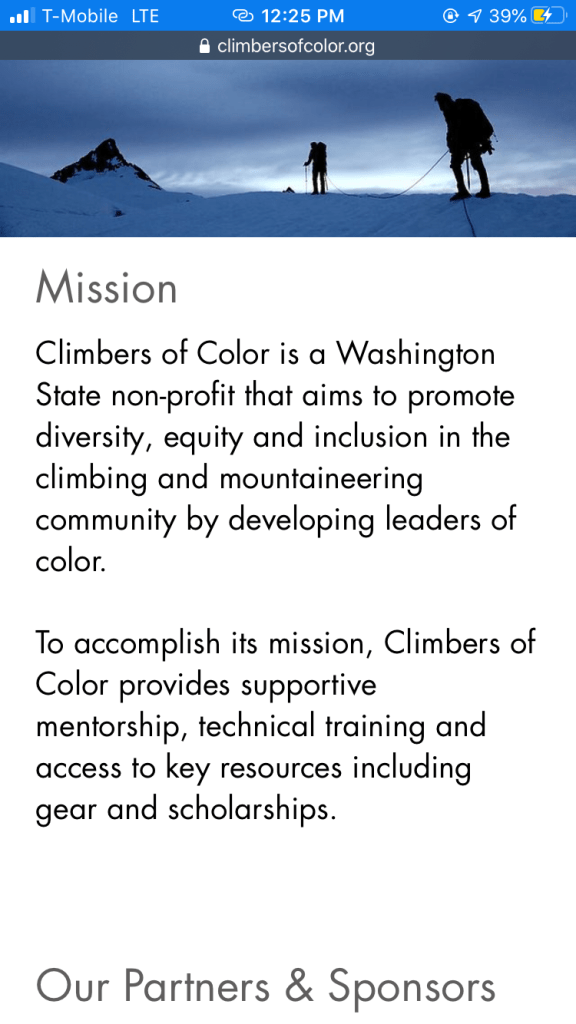
Unfortunately it came to light that another organization (which was not very old at the time and ceases to exist today) known as the Queer Climbers Coalition (QCC) had decided they liked the mission statement so much that they wanted the exact same one.
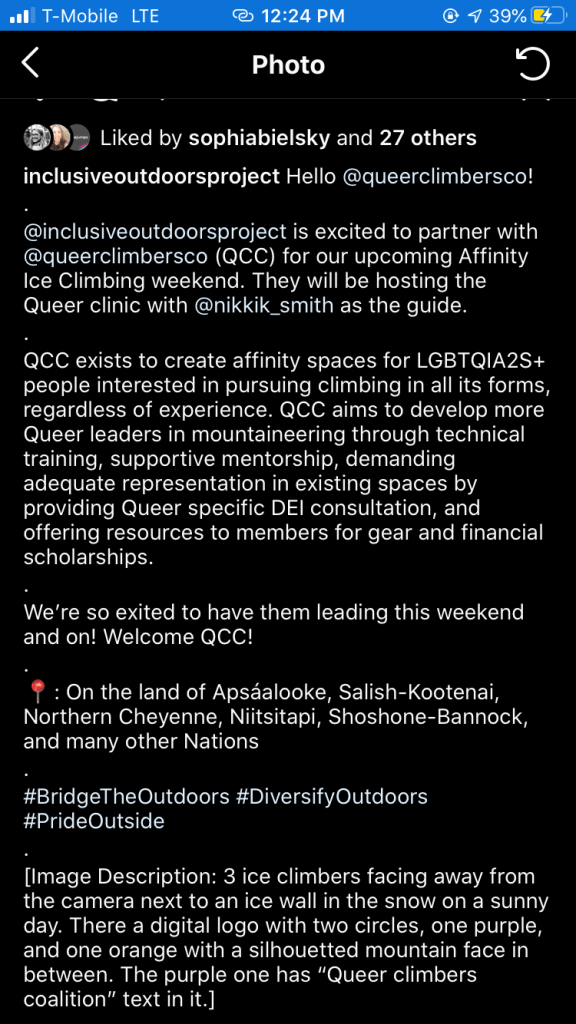
“QCC exists to create affinity spaces for LGBTQIA2S+ people interested in pursuing climbing in all its forms, regardless of experience. QCC aims to develop more Queer leaders in mountaineering through technical training, supportive mentorship, demanding adequate representation in existing spaces by providing Queer specific DEI consultation, and offering resources to members for gear and financial scholarships.” This was a more expanded version of their mission statement, however, upon investigation on the Inclusivity Outdoors Project website8 (no longer available for viewing as the page has been edited), the exact same mission statement as CoC was present with “people of color” having basically been replaced by “LGBTQIA2S+” and/or “Queer”.
This was all handled quietly behind closed doors at the time: there were no public statements and only a quick apology. They were reminded that although inspiration may come from us, it is inappropriate to have obviously copied the statement in such an obvious fashion. The mission statement for CoC was written by a queer non binary person of color who deserves more respect than straight up theft. And of course, CoC had a lot of grace and simply asked them to change it to become more of their own statement.
The increasing saturation of affinity groups in the US have meant everyone is still attempting to find their voice. And a larger organization with strong convictions such as CoC can be seen as an example of how to delicately and precisely word things to be expressed (due to extended operating time). However, there is a fine line between taking inspiration and making something their own and just straight up stealing it for their own devices. Especially since that work and effort was done by people of color, which we will talk more about later.
Plagiarism in academic spaces has always been a hot topic and frowned upon. It could be anything from a student plagiarizing from an expert in a subject to an expert plagiarizing from a student. In the first example, eventually the student would get caught because if the subject matter expert’s work is well known enough, the reviewing entity/entities would notice it and call it out. However, the balance of power is shifted when it is a subject matter expert taking from a student who had original work. It may never be found out that the student’s work was plagiarized because the person in power to take that work is the subject matter expert with resources and notability.
Plagiarism also plays into power, as we talked about above with a student and subject matter expert example. I have talked about power on this blog before; as power plays into race relations, gender, and general society playing off these identities many times over. In this case, how is power contributing to the issue of a white led organization stealing from a people of color led and participant organization?

First and foremost we have to think about balances of resources. From observation alone I can say that by and far white led affinity groups have access to more resources (funding, opportunities, etc) than POC led organizations. And this is not a phenomenon in Seattle alone. “In FY2021, 36% of nonprofits received more than half of their funding in unrestricted funds, including general operating support. Unrestricted funding is critical for most nonprofits; it lets them decide how to spend their funds to best support their work. Forty-one percent of white-led nonprofits received 50% or more unrestricted funds in FY2021 as compared to 26% of BIPOC-led organizations.”9 Unrestricted funds take trust: trust that some companies are not willing to give. The stereotype that Black and Brown people are more shifty and less responsible with money, or hell, even less capable of knowing what their community needs to thrive is alive and well in the non profit sector. This is, of course, due to companies being made up of the general society and usually well off white cis gender leadership who fall prey to the same racial programming the US is known for.
“White-led nonprofits were also more likely to receive corporate donations in 2021—71% vs 58% for BIPOC-led nonprofits. They were also more likely to have revenue from sales (23% for white-led organizations; 11% for BIPOC-led organizations), from the federal government, excluding PPP (46% of white-led organizations; 32% of BIPOC-led organizations) and from investment income (33% white-led vs 16% BIPOC-led).”10 After long years of putting in countless hours of work; after 4 years CoC is just now starting to see more solid funding. If CoC were a white led organization, would the financial landscape have looked different? According to the study cited here, it most likely would have been. Nonprofits serving or led by people of color get less funding than similar groups led by white executive directors11 is also an article that leads us to believe this would also be the case. The reasons can range anywhere from racism to industry connections. “…[M]any donations are based on connections. Leaders of color traditionally have fewer relationships with influential organizations and people. And breaking into the philanthropy community is difficult because new leaders often lack the bandwidth and experience to cultivate relationships with potential funders…This funding gap is also fueled by racial biases—whether intentional or not. And the vast majority of family foundations don’t use diversity, equity, and inclusion strategies and goals to guide their giving.”12 Yup. White supremacy13 plain and clear with reports now to back it up. And the worst part is: when potential funders see plagiarized and uncited work on white led organizations’ websites, not only are they getting the credit for it but now they are literally potentially profiting off that stolen work through donations.
This is something I have noticed in the industry: white led organizations getting so much support/funding and mainstream publicity for their DEIJ work, even when they are just starting out. And some would express that “white racial justice leaders are experts at performative allyship.”14 But how does it translate to when an affinity group for LGBTQIA2S+ enters the picture?

Well, we still do have to look at race. There is no question that people of the LGBTQ community experience discrimination, violence, and injustice day in and day out. And this gets even more intense when considering race (as everything always does in a racist society such as ours). Should there be special considerations as a white person when running an LGBTQ affinity group? “When liberal whites fail to understand how they can and/or do embody white supremacist values and beliefs even though they may not embrace racism as prejudice or domination (especially domination that involves coercive control), they cannot recognize the ways their actions support and affirm the very structure of racist domination and oppression that they wish to see eradicated.” — Bell Hooks15
White people doing any sort of DEIJ work are prone to fall back on their racial social programming. And that programming states that the bodies/work/existence of people of color, most notably Black people, belong to white people and can be taken without consent or question. THAT is how it has been and THAT is what organizations like Climbers of Color are actively fighting.
And yet unfortunately, as an organization whose labor is from Black and Brown people we have fallen victim to this exact disgusting philosophy multiple times from white affinity organizers who are attempting to organize their LBGTQ community. They enter into the work without realizing how race still plays the leading role in relation to work and intellectual property.
Specifically for Black people: walking around in general society where white people (and in some cases, non black people of color) touch our bodies without consent like our hair, have taken free labor through the use of enslaving us, and the violence to our bodies is an especially relevant reality that hits close to home anytime something is taken without consent. I’m not saying all the community organizing should fall on Black and Brown people because we walk around in this reality: it shouldn’t. However, this is something white led affinity organizations need to be versed in: race and race relations. And if need be structuring internal policy to ensure this widely accepted societal behavior does not continue.
I am definitely not saying the LGBTQ community does not experience these things. However, I am saying that just like in my article When the Minority Becomes the Majority, there needs to be special consideration to the demographics within your organization that are a minority. And in this case, it is anyone not white in an LGBTQ group. By the Queer Climbing Coalition and the Queer Mountaineers stealing work, they have basically signaled to all their POC members, potential members, and POC affinity groups that they subscribe to the same societal guidelines of exploiting POC labor. For free, without consent, and without acknowledgement that they did not do the work. Well done: you are perpetuating the same systems that have driven the need for affinity organizations to exist in the first place.
This time, there was a conversation followed by a public apology16 from Queer Mountaineers.
“To our community, Climbers of Color community, our shared communities, and the public,
We would like to address a serious mistake that has been made.
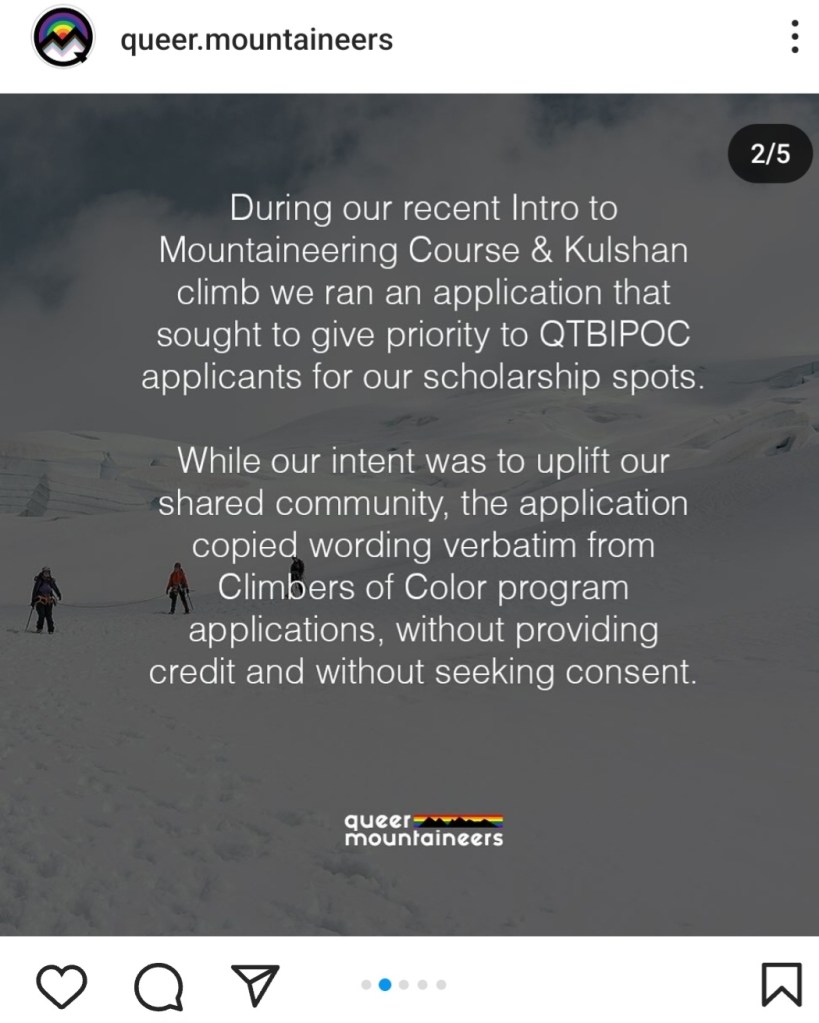
During our recent Intro to Mountaineering Course & Kulshan climb we ran an application that sought to give priority to QTBIPOC applicants for our scholarship spots. While our intent was to uplift our shared community, the application copied wording verbatim from Climbers of Color program applications, withou providing credit and without seeking consent.
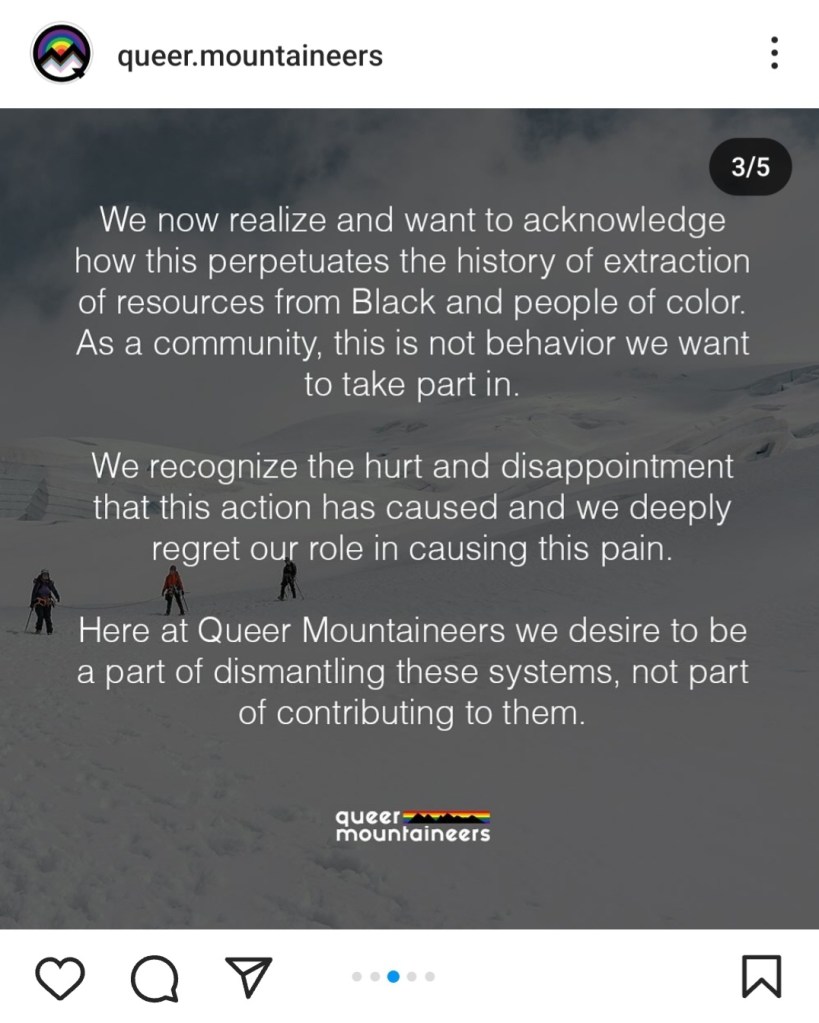
We now realize and want to acknowledge how this perpetuates the history of extraction of resources from Black and people of color. As a community, this is not behavior we want to take part in. We recognize the hurt and disappointment that this action has caused and we deeply regret our role in causing this pain. Here at Queer Mountaineers we desire to be a part of dismantling these systems, not part of contributing to them.
Moving forward, we are committed to making amends and taking action to prevent such a misstep from occurring again. We have met with Climbers of Color leadership, we have taken down the application, will be starting from scratch for any future offerings, and will be implementing a peer review process.
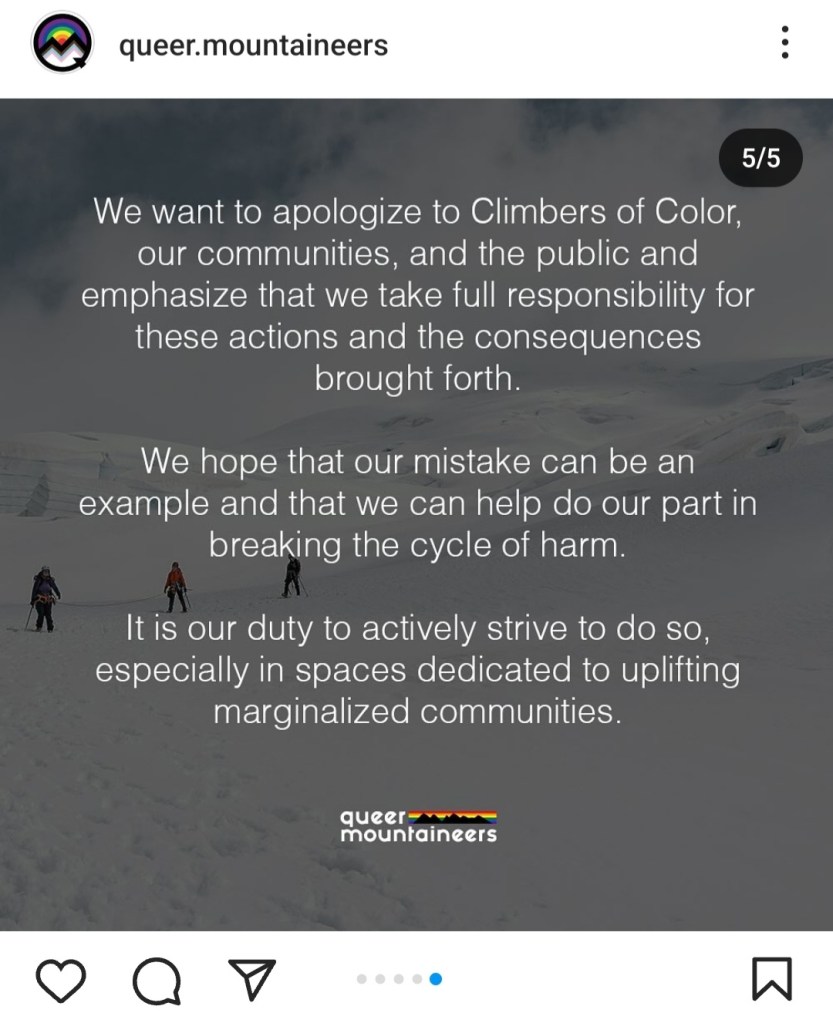
We want to apologize to Climbers of Color, our communities, and the public and emphasize that we take full responsibility for these actions and the consequences brought forth. We hope that our mistake can be an example and that we can help do our part in breaking the cycle of harm. It is our duty to actively strive to do so, especially in spaces dedicated to uplifting marginalized communities.
Sincerely,
QM Leadership Team”


The public acknowledgement of this is something that needed to happen. It is also equally notable that they did not approach us to make the application, nor approach to pay us for our time to consult on this topic. We cannot go around pretending these situations do not happen, because they do and so many people are negatively affected by it. For me personally, I was one of the people who edit this application every year to hone and change it based on the experience of the previous year and/or the current situations in society affecting people of color. It’s work. And it’s my work: as a Black woman whose ancestors were enslaved it hit very close to home for me. A wound that is as deep as my bones, if not deeper. What are we doing in these affinity spaces if not questioning our practices of, well, EVERYTHING especially if you are a white person?
The impact of this is huge and inadvertently personal. How do we move forward sharing resources and knowledge while it is equitable to all involved? The inherent power that white led organizations have the privilege of holding is infuriating to POC led organizations such as Climbers of Color as it upholds the same systems we are sadly captive to. And even more disappointing when we are exploited. We can only hope these affinity organizations as well as funding entities do the educational work on DEIJ topics to do better in the future.
Affinity groups need to work together because we are stronger together. But we also have to do the work to understand and support one another for the sake of society at large and for the sake of ourselves.

| Climbers of Color Application | Queer Mountaineers Application |
| Info taken from our Toprope and Mountaineering Leadership 1 applications. |  |
 |  |
 |  |
 |  |
 | |
From our ML1 Application: |  |
 |  |
 |  |
 |  |
- “Options” Youtube, uploaded by Sa-Roc 21 May 2021, https://www.youtube.com/watch?v=mSzEJ0ZHWqU
2. “Our Team” Queer Mountaineers, https://www.queermountaineers.com/our-team, 11 Aug 2023
3. “She Rocks-Seattle” http://www.sherocks-pnw.org/ 11 Aug 2023
4. “Seattle Queer Climbers” https://www.instagram.com/seattlequeerclimbers/?hl=en 11 Aug 2023
5. “African American Alpine Club” https://www.instagram.com/africanamericanalpineclub/?igshid=NTc4MTIwNjQ2YQ%3D%3D 11 Aug 2023
7. “About Climbers of Color” https://www.climbersofcolor.org/about 11 Aug 2023
8. “Partnerships-Inclusive Outdoors Project” https://www.inclusiveoutdoorsproject.com/partnerships 11 Aug 2023
9. Non Profit Finance Fund. “2022 Survey: A Focus on Racial Equity” https://nff.org/2022-survey-focus-racial-equity 07 Aug 2023
10. Non Profit Finance Fund. “2022 Survey: A Focus on Racial Equity” https://nff.org/2022-survey-focus-racial-equity 07 Aug 2023
11. Mirae, Kim and Li, Bo. “Nonprofits serving or led by people of color get less funding than similar groups led by white executive directors” https://theconversation.com/nonprofits-serving-or-led-by-people-of-color-get-less-funding-than-similar-groups-led-by-white-executive-directors-194981 07 Aug 2023
12. Wade, Vangela M. “The funding gap between Black- and white-led organizations is clear—and alarming” https://racetolead.org/the-funding-gap-between-black-and-white-led-organizations-is-clear-and-alarming/ 07 Aug 2023
13. Tomkin, Anastasia Reesa. “How White People Conquered the Nonprofit Industry” https://nonprofitquarterly.org/how-white-people-conquered-the-nonprofit-industry/ 07 Aug 2023
14. Tomkin, Anastasia Reesa. “Unpacking the False Allyship of White Racial Justice Leaders” https://aninjusticemag.com/unpacking-the-false-allyship-of-white-racial-justice-leaders-a84119d5a1cd 07 Aug 2023
15. Tomkin, Anastasia Reesa. “Unpacking the False Allyship of White Racial Justice Leaders” https://aninjusticemag.com/unpacking-the-false-allyship-of-white-racial-justice-leaders-a84119d5a1cd 07 Aug 2023
16. Queer Mountaineers https://www.instagram.com/p/CwRIHRsLhXH/?igshid=NjIwNzIyMDk2Mg== 23 Aug 2023
 Rock Rose Blog, LLC
3 thoughts on “Deep in the Bones: An Issue of Plagiarism”