
This article is also available as a video podcast on Spotify
A continuation of the Hidden Figures in POC spaces collection in which stories by Black people are shared about their experiences in affinity spaces.
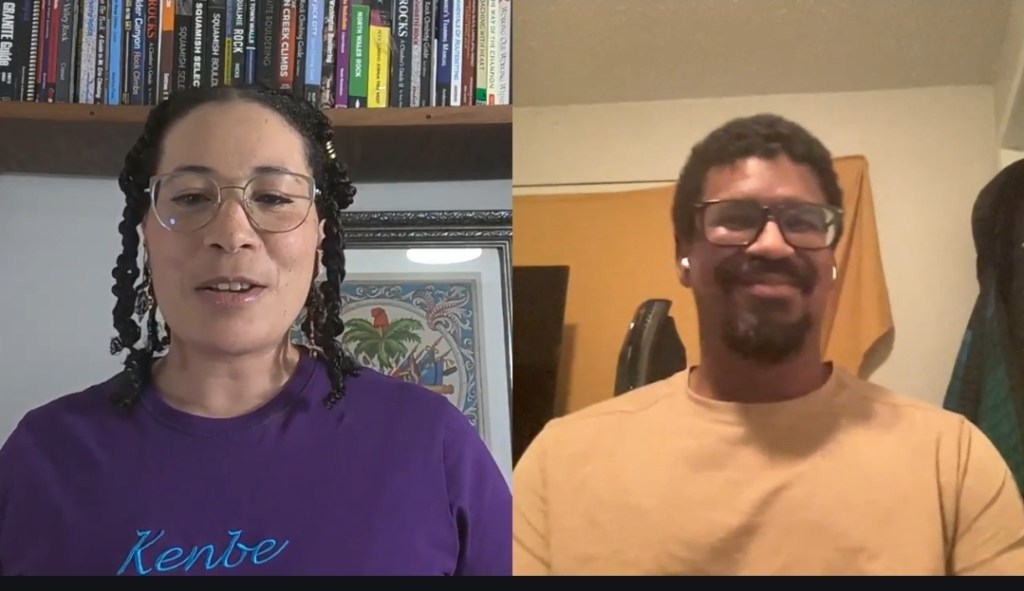
This episode, listen to Eric Ballentine speak on their experience in Climbers of Color and Queer Mountaineers. We chat about being Black in these spaces as well as hearing a different angle on the Queer Mountaineers’ plagiarism from Climbers of Color in 2023.
Chat took place Feb 2024
Crystal (she/her)
Rock Rose Blog. Climbing, BIPOC, and policy.
Crystal (she/her)
Alright, thanks for joining. If you want to tell me your name, pronouns if you’d like to share, and any affinity groups that you are affiliated with.
Eric (they/them)
Yeah. My name is Eric Ballentine. I go by they, them pronouns. I’m affiliated with Queer Mountaineers. I’m affiliated with Climbers of Color. Both of those positions are as volunteer. And then in my full-time job, I am a program manager for Minority Veterans of America.
Crystal (she/her)
Oh, very cool. That’s your regular nine to five then. And you do all this volunteering outside of that, outside of your 40 hour.
Eric (they/them)
Correct.
Yeah.
Crystal (she/her)
Nice. What capacity do you interact with these groups? Any specific titles?
Eric (they/them)
Yeah, so with Climbers of Color, I’m a climb night host. So I host a climbing group on the second Thursday of every month at Bellevue Edgeworks. And then with Queer Mountaineers, I also host a QT BIPOC climb Night at Momentum in Seattle.
Crystal (she/her)
Oh nice.
And how long have you been involved with each group?
Eric (they/them)
Yeah, I just had my year anniversary with Climbers of Color. I had my very first climb night a year ago in January. And then I will be with Queer Mountaineers for a year in April.
Crystal (she/her)
Congratulations.
Congratulations. So you’ve been at this a while then, the volunteering, the organizing, you’ve been in it.
Eric (they/them)
Thank you. Yeah, a little bit.
Yeah.
Crystal (she/her)
What originally drew you to affinity groups? And then further, what drew you to these specific affinity groups in the area?
Eric (they/them)
Yeah, I tried climbing a long time ago with another veteran organization. I did it for a couple of weeks. It was really cool. I was really broke back then, so it was just not something that I could really afford. And a friend of mine actually had introduced me to Climbers of Color, probably around 2019, so before the pandemic.
And I had gone to actually had gone to a couple of climb nights in Tacoma when I had lived down there. And then the pandemic hit, life got crazy. I was working crazy hours. And so like towards the end of the pandemic, I was I decided I was like, I really enjoyed that I really need to do something that like challenges the movement of my body. And so climbing was just something I had always wanted to do. So I like didn’t even get like a day pass. Like I just full up signed up and said, hey, I’m gonna do this. I want a membership right now. And then I started learning like, oh, like Climbers of Color was looking for volunteers. And so a couple months later, like next thing you know, I was a climb night host. And then climbing with Climbers of Color, right? Like there’s a lot of intersectionality between COC and Queer Mountaineers. So I had learned from some folks at COC about Queer Mountaineers.
And then shortly after that, like I started volunteering with them as well.
Crystal (she/her)
Oh nice, so that climb night you mentioned in Tacoma was Climbers of Color?
Eric (they/them)
Mm-hmm. Yeah.
Crystal (she/her)
Oh, see, I love that. I mean, affinity groups bring people together and share resources and then find more connection. And I think that’s one of the biggest draws for me for affinity groups.
Eric (they/them)
Yeah, absolutely.
Crystal (she/her)
I love that story.
So why you are drawn to affinity groups specifically, or you just kind of fell into it because all your other friends were in it?
Eric (they/them)
Yeah, no, I mean, a sense of belonging is always super important, right? And it’s nice to have a shared interest, and that always brings people together. But when you have a shared interest and then shared identities, right? There’s just, the closer the bond, the better the experience, right? And that’s what I’m really here for when it comes to climbing. It’s about experiences for me. It’s not necessarily like-
“Oh, I have to climb this grade” or “I have to climb at this place”. It’s about like who I’m with and the company I keep. It’s about community for me.
Crystal (she/her)
Nice. Oh, that’s beautiful. I love that.
And I know that affinity groups have a tendency to split off into very specific demographics, right? So I imagine it’s been a little tricky or nuanced, we’ll say a little nuanced, to go back and forth between these two groups that may or may not hold space for various different identities. Have you… how do you balance that? How do you bring your whole self into these spaces that may not be educated about other specific identities?
Eric (they/them)
Yeah, that’s a tough one, right? I I feel like you have an episode on this just one question. First off, recognizing that any type of affinity space that you go in and whatever identity you are associating with that group, the work is always like some type of emotional labor. And so ideally when you go, to be a part of these groups, you’re hoping that some of that labor is a little bit released. You’re with your community of folks, and so those folks know what that experience is like. You have that shared bond, and hopefully you can help each other carry the load.
The reality of the situation is that there is no perfect group that specifically matches you to a T. So I’m Black. I’m Queer, I’m Non-binary. So it’s a little bit difficult to go and find all of those things in one location. So with Climbers of Color, for example, it’s great, it’s wonderful, I like that. However, we also have to recognize that there are not a lot of Black folks in those spaces. Like, unfortunately, it’s just how it is. Me personally, trying to get more Black folks there, but it’s just, they’re not there, right? And so…you get that old school like lunchroom vibe, right? Of like, hey, these kids are over here, these kids here, these kids are over here. As a host, it’s really imperative that I check in with everyone and make sure that everyone feels welcome. I’m naturally kind of a people pleaser anyway, and I love hosting things. So I just love going around and checking in on people and making sure that they feel welcome.
But on the flip side of that, like when I’m not a host and I’m just attending an event, I think the challenge is, it’s like, oh, you know how to react to that person, you know how to react to that person, you know how to make that person feel welcome, and then it’s like me and it’s like, well, I don’t know. And it’s like, it might not be noticeable to everybody else, but to the person that’s the only Black person in the room or to the person that’s the only non-binary person in the room. You notice the difference in terms of how they interact with you versus others. It’s not really an answer, but the answer is I’m used to it. So I just kind of like, I go and I find the people that I get along with the most. Like I don’t usually, by this point in my climbing journey and being with affinity groups, I feel like anywhere I go, I usually know at least a couple of people.
And so those are the people that I go to feel safe, or safer, I should say.
Crystal (she/her)
You know, that really hit home for me personally. Keith, I don’t know if you know this, Keith and I were I think maybe the second or third hosts of COC climb Nights. We actually started the climb nights at, it was Stone Gardens at the time, but now it’s Edgeworks, Bellevue. And the mark of a good host in my mind is not you know, segregating yourself off into these little friend groups that you have, which you feel safe in, and you’re like, I love this, I adore this, this is what I came for, right? But as a host, it’s good to go around and interact with everyone, and then really pay special attention to those people that are maybe not getting that same attention from the majority of the group, right? Which can be a very difficult thing to do. You’re like, I’m there to have fun, but paying attention to those people who may not feel like they belong in the group, especially if they’re Black or indigenous or someone that doesn’t see themselves in the larger majority group is very important. So thank you for doing that.
Eric (they/them)
I mean, that’s the big thing, with being a host, like most, most climb nights, I might, I might climb a little bit. It’s not very, it’s not very much, right? It’s really about going in and checking with folks. Especially when you get new people, right? I have my, my policy of hosting anything, whether that’s work or volunteer is like.
Nobody if I see you sit alone, oh, you’re not gonna be alone for very long right and so I really as a person who has been to numerous events that have been ran horribly or where I didn’t feel welcome I have always used that as a catalyst to make sure that I want people to come back Right. I want people to have a good experience. I want them to Enjoy it and have just as much fun or more than I am
Crystal (she/her)
That’s wonderful. Yeah, Keith and I found out pretty quickly that it’s not a night to get your personal climbing in as a host. Yeah. The other thing that really hit home for me about what you just said is showing up to an event and then just either being ignored or just not tended to in a way that a good host would because you’re different or you just look intimidating somehow or something. And I’ve gone to numerous events that are like that personally too. So just echoing the need for being able to look past yourself in a way and host in a way that’s inclusive to everyone. And so I do want to also talk about the fact that climbers of color had to completely revamp our climb nights.
Because what we found out was happening was exactly what we were talking about. These cliques were starting to form. Not blaming people, I’m just, it’s what started happening naturally. And Black folks were actually coming to me and some indigenous folks and some people that were minorities in the space. And they were like, look, these things keep happening. There were several microaggressions. There were certain situations that were really uncomfortable. Black folks just fell off our climb nights, my partner and myself included. And then, like I talked about in the podcast a little bit, we did have a Queer Black woman come in, and we’re like, look, this is the task ahead of us. She was a climb night coordinator. We need to change this. And she put the infrastructure in place to change it, and then got bullied out of the organization. It was very unfortunate. So all the changes that we see now are due to her and her hard work. Again, hidden figures, right? So, yeah. Anyway. I get worked up about it.
Eric (they/them)
Yeah.
Yeah, no, I mean, that’s a tough one. And I think…
Somebody asked me last week, they said, well, how do you, what is the most productive way for an organization to not leave, especially affinity-based organization, not leave Black folks in the dark? And I said, well, you got to have Black people in leadership. And I was like, the sad thing is, and you got, the tough part is, right, is like,
This is a volunteer organization. So we’re asking for usually free labor, right? And so what does that look like for a volunteer organization? At least there should be a person that you can appoint to say, no, that’s not going to fly, right? And here’s why. Maybe not giving them the brunt of the work, but a person in leadership to say, yeah, that’s not going to fly. You have to have some type of system in place that has power to it, right? Power and authority to it for Black representation from the top, not the bottom.
Crystal (she/her)
Absolutely, and then you have to listen to that person with authority and that’s a whole other thing, right?
Eric (they/them)
Yes.
Crystal (she/her)
Yeah. Yes, so anyways, was there any particular thing that you did want to share about your experiences and you don’t have to name any specific organizations. This is very personal to you and I understand that. And so is there anything that you felt like you wanted to get off your chest to share?
Eric (they/them)
Yeah, I think my biggest thing…
We all have certain skills and certain traits that really make us stand out as people right and so one of the things I will say I do very well is I am a great speaker. I have I have done a Ted Talk like I have done a lot of cool shit and like paid public speaking engagements and so it’s always interesting you always have to second guess yourself when a white person says “he” speaks so well.
Cause they actually might mean that in a great way, but they also could not. And so I feel like that’s parallel, that parallels with climbing in a sense of, I get double checked a lot on stuff. Like, I know that like they’re just trying to, it feels a lot a lot of time, like, I call it white splaining. I don’t know if there’s an actual term for it, but it’s like, you’re over, you’re over explaining to me this situation that I know because you are assuming that I don’t know it. And it’s not always white folks. Let’s make sure that that’s clear, right? And it’s really, really frustrating, especially, I’ve had people, we talk about don’t touch your hair, don’t touch my gear, right? Don’t come up and start touching stuff. I’ve been calling for a year, I know how to do a figure eight knot. I don’t need you to tell me how to do that.
Or if I’m showing somebody else something like I don’t need you to come in And correct me and I don’t know why you would feel the need to do that but that tends to happen a lot and in and out of infinity spaces and it’s like I need you to chill with that right because It’s I think the other portion is when you’re explaining to folks why that is… is they don’t really listen. They just get more offended because, and they get more offended and caught up in what their intentions are rather than what the actual result and impact of what their actions are. And so, oh, I was just giving you a tip. Well, yes, you and a thousand other people have tried to give me the same tip because you keep assuming that I don’t know that even though the person that was with me was brand new and you didn’t suggest anything to them. That’s one, that’s one of the things I see the most consistent. Or if I tell a person, Hey can we promote this event? And they’re like, “Oh, I didn’t know that was happening” or, um, some other excuse and you keep giving them all the tools that they need to succeed. And they’re still…don’t take your word for it, right? And I don’t need to give you, I’m not giving you my word, I’m giving you the proof that, hey, this is an actual thing, like I’m not making things up. Which is really fucking exhausting, right?
Yeah, like take my word for it, right? And even if you don’t take my word for it, at least pay attention to the evidence and the emails and messages that I have forwarded to you that reflect exactly what I’m talking about, right? And that just, that’s exhausting on a daily level. So it’s like, you deal, we deal with that professionally. We deal with that in our personal lives.
We don’t want to have to come into an affinity space and deal with that. Because sometimes it hurts more than if it was just a random white person. I was like, you’re coming into a place which is supposed to be a safe space, but instead you were just as violated as if you weren’t. And so it’s a little bit more shocking and jarring in that.
Crystal (she/her)
I completely agree with that. Yeah, there’s been times when I’ve had debates in the community about certain things that specifically impact myself as a Black person and they have just been like, you’re being too sensitive, this is ridiculous, and it’s kind of, you’re right, it hurts more.
Eric (they/them)
Mm-hmm.
Crystal (she/her)
When you’re like, wait, I thought I was in this group with these group of people that I thought would be open to hearing my experience about what’s going on. And then it doesn’t, and then you’re… Yeah, it does, you’re right, it almost hurts more. I’ve said that to myself a few times.
Eric (they/them)
I think the frustrating part to me, especially when you talk about, oh, you’re being sensitive, right? Or the original word is you’re getting emotional. Crystal, you’re getting emotional, right? And it’s like, bitch, this work is emotional, right? If you’re not emotional about it, then something’s wrong. Right? And I am telling you as a human being that harm was done to me and I’m expressing that to you. Your first thing shouldn’t be, the “but” should not come out of your mouth, right? It doesn’t matter if you had great intentions or not, like you hurt someone. So you need to own up to that and like figure out how you can do better and listen. Instead you do more harm by making excuses for it. Like it’s, I’m so tired of that. Like, oh, you’re getting emotional, you’re being sensitive, like yes.
Yes, because I have been told over and over again, this one thing that might seem little to you.
Crystal (she/her)
Yeah, absolutely. Intent versus impact, right?
Eric (they/them)
Mm-hmm.
Crystal (she/her)
Going back to your example with people in the gym like touching your gear and touching your tie-in knot and everything, I know when Keith and I built the rock instruction side of climbers of color too, we do teach our guides, do not touch people’s harnesses, don’t touch their tie-ins, don’t touch any gear that’s hanging off of them, right? Because you don’t wanna be touched. And I feel like Black people in America, myself in particular, my hair has been touched a lot in public.
I don’t want you touching me unless you ask, right? And that’s a consent thing. Have you consented for this person to touch you or anything that’s in a vulnerable space of your body? Hips do carry a lot of trauma. You don’t want people touching that area. And do you have…
Eric (they/them)
Mm-hmm. Yeah.
Crystal (she/her)
Are you giving them your consent for them to give you some knowledge or what they perceive is going to be new knowledge to you as well? And that’s, I feel like some spaces don’t have that awareness to be able to be like, am I, do I have your consent? Can I help you? If you don’t let me help you am I going to be okay with that? Why am I not okay with you not letting me impart my knowledge to you when you’ve said no? And I almost feel like some people do feel like that Black people and Black bodies are public property sometimes. And that’s really harmful.
Eric (they/them)
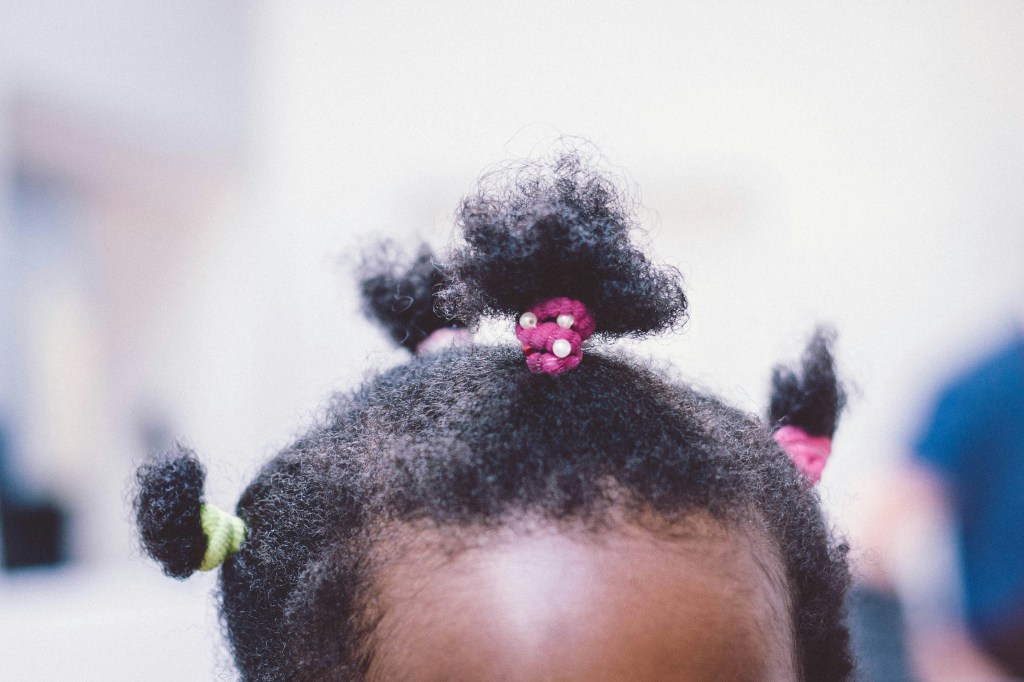
Yeah, yeah, I mean, I, I have, you know, I’m a single dad and I raise an eight year old daughter and like the, like, like she has known since probably at least four years old that nobody is to touch your hair. Like nobody is to touch you like without permission, right? And like even like it’s, it’s funny, but it’s not to see this eight year old girl, like kind of do like this matrix thing of don’t touch my hair, but it’s like, damn, you really shouldn’t have to do that. And then she tells them, she used her words, like “don’t touch my hair”. And like, nevertheless, in a climbing environment, you have touched, whether you are in the gym or you are outside, you have touched all kinds of nasty things, I don’t know where your hands have been, you probably didn’t use hand sanitizer, and now you wanna touch somebody’s hair?
Crystal (she/her)
Yeah.
Eric (they/them)
Yeah, it’s like people really believe that we are property, that you can just touch us, and we should not overreact at all. Any reaction is overreaction.
Crystal (she/her)
I’m so sorry your daughter still has to go through that. I mean, the hope is that affinity groups and education and stuff would move people past this and I was hoping by the time I was a fully formed adult, people would stop touching Black folks’ hair in public. And I’m really sad to hear that it hasn’t.
Eric (they/them)
Yeah.
Yeah, I think the other, yeah, I think the other thing too is like, you’ve seen my daughter, right? Big, beautiful, like Afro, right?
Crystal (she/her)
Yeah, yeah, she’s adorable. Yes. Exuberant.
Eric (they/them)
She doesn’t want people complimenting her hair all the time. She doesn’t like it. She gets told that all the time, but because where that comes from, right? If Black folks say that, they’ll get a pass, right? It’s not that big of a deal, but you got a lot of white folks that will say, oh, I love your hair so much. And the reality is like that comes from a place of, cause you just thought our hair was nappy all the time. And like, you didn’t like that. You had, you had, you had, you were saying that cause you had a special way of how you viewed that, whether you realize that or not. And so you are complimenting this person’s hair because it doesn’t mean fit that criteria. That’s ultimately what it is. And that’s troublesome. It’s exhausting.
Crystal (she/her)
Definitely. I did see something on Instagram. I can’t remember who the creator was, otherwise I would definitely shout them out. But she was talking about hair, and she’s like, listen, don’t make it weird. Like if you wanna compliment my hair, that’s fine. Compliment it and move on, but don’t make it weird where you just start gushing about it, especially if you’re a white folk, it just gets weird. Right? Don’t be weird. Don’t, don’t stare.
Eric (they/them)
Right. And don’t stare. Don’t stare.
Crystal (she/her)
Yeah, definitely. Was there anything in the, because you said you saw some of my other articles on like Black hair. Did you, did any of that connect with you in it or about the experiences with your daughter as well?
Eric (they/them)
Yeah, definitely. It definitely connected a lot. I can’t really, I can’t remember exactly what it was that I read, but talking a lot about things like protective styles, things that you have to consider when you do go climb outside and like what that’s like for like Black hair. It all connects to me because it’s just like there’s this thing of, oh, you just get up, like I just roll out of bed and climb. And like, that’s not what happens, right? Like, I mean, as a dad who knows very limited hair care, right? Like it’s a challenge for me to get out the door every day sometimes, right? And so I think when we go back and we talk about people touching your hair, do you know how much fucking work I put into this, right? Like you don’t go to the Louvre and just put your hands on the Mona Lisa.
Right? So it’s like, look, this took some work. I’m going to need you to chill out. Yeah.
That is personal space. Like, that is a part of someone’s body. I don’t even like touching people on the shoulder. So the idea of touching somebody’s hair is just so wild to me. But that’s because I’m not on the other side of that, right? And so I need people, people really need to understand that like that is a person. Like consent, right? It’s 2024. Like we know what consent is. And consent is not just about sex, it is about everything. And that is where you should be thinking, did I get consent? No. Anybody know you consent to touch their hair? Crazy.
Crystal (she/her)
And don’t be hurt if we say no. Just move on.
Eric (they/them)
Don’t be hurt. Don’t be hurt.

Crystal (she/her)
Yeah, oh that’s great. I’m glad someone connected with that blog. Because I feel like sometimes I put these things out and not a lot of people read them. But I’m like, this is important! Yeah, so thank you for… for being here.
Eric (they/them)
Yeah, yeah, no, for sure.
Crystal (she/her)
Well, let’s see. Is there anything else that you want to specifically talk about? I don’t know if you want to touch on this, but I know you and I, and if you are uncomfortable about talking about this publicly, we can talk about it later privately if you’d like to talk about it. But the Queer Mountaineers and COC disagreement.
Did you want to talk about that at all?
Eric (they/them)
Yeah. Let’s talk about it.

Crystal (she/her)
Let’s give a little background.
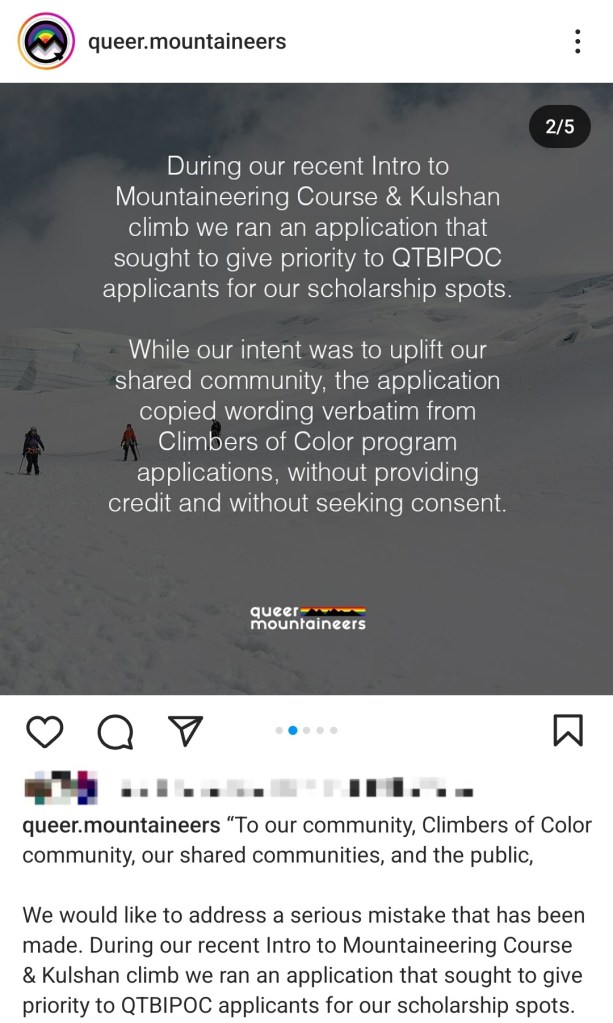
So 2023 I did put out a podcast and article about plagiarism, right? This is something that since then I’ve heard a lot of talk about amongst different affinity groups, specifically Black affinity groups with other groups taking their work, rebranding it but it’s still recognizable by that specific group, right? Now in this case, we’re talking about Climbers of Color and Queer Mountaineers. Queer Mountaineers had taken an application that I was actually one of the authors of, myself and another non-binary person, non-black non-binary person in climbers of color organization, originally wrote. And then every year we go back through and we also edit it as we learn, right?
Because holding space changes and we learn things and we want to make sure it’s better. So we had honed this application for years. I had put a lot of blood, sweat, and tears into it every single year and the Queer Mountaineers decided to borrow it. Now when I say borrow, it’s a light word for me because it was word for word for almost every question. If you’d like to see this, it’s in my other blog post and you can see screenshots of the comparison of the different forms, right?
Now we have a relationship with Queer Mountaineers, one that we cherish, right, because they do important work. However, we did not give them permission to use this form or application, and they were specifically using it for, I believe, a scholarship for people of, queer people of color, to do a mountaineering trip, if I recall that correctly.
But you were also pulled into some of that conversation and so I wanted to know, number one, what the impact was for you because you weren’t directly involved in it but you got pulled into it and it’s going to, it affected everyone I think. It really did. It’s since been resolved but I wanted to get your take on it.
Eric (they/them)
Yeah, going back to, God damn this work is emotional, right? Because I didn’t know, my neck just like doing this back and forth between two organizations, like really, really exhausting, right? And then I think the initial of like, like you had sent out an email.
Crystal (she/her)
Yes.
Eric (they/them)
Right, which I was not on the original email. And then the next day you sent a follow-up email and you included me on it. And within that, right, I was just like, oh, oh shit, okay. Well, that’s not good. Cool, let me forward this to the people that, to leadership. And so we had a conversation, this is Queer Mountaineers, between Queer Mountaineers.
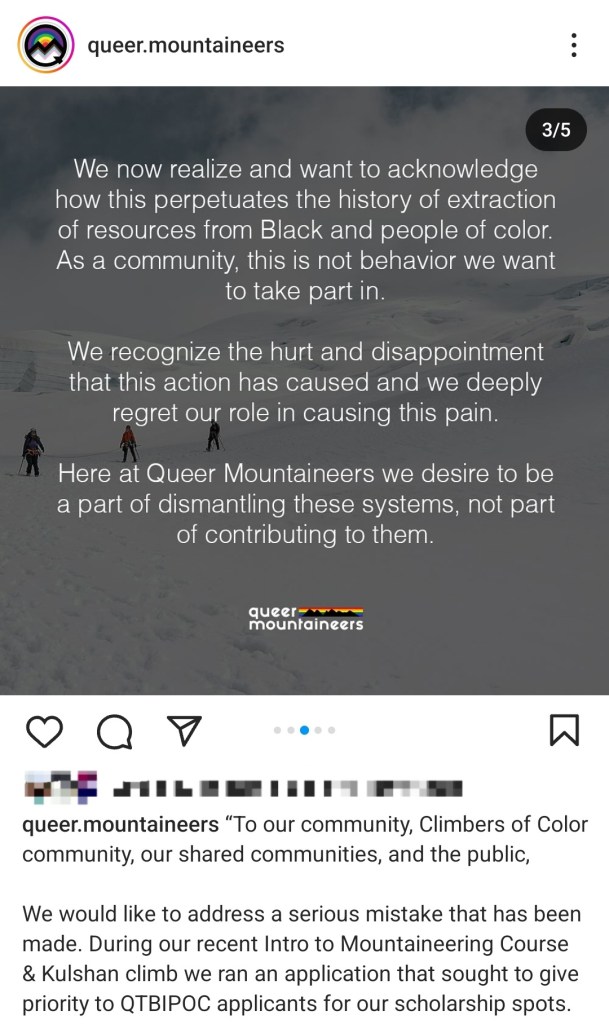
And then we eventually we met with you all, right? And so this is a very, very common response. These words were not uttered, but it was definitely like the theme of Queer Mountaineer side, right? And like that theme is like “we fucked up, but it’s not that big of a deal, right?” And I think what had to be understood from our side of things is like, I mean, honestly, in reality is, it’s the application. It’s not that serious, but what is serious is that you took that from an organization and not understanding that historically, right? Historically, I guarantee you, this is not the first time that it happened, right?
And that was the really turning point of the conversation with Queer Mountaineers of like, was I, which I had to explain, was that, yeah, I’m pretty sure this ain’t about Queer Mountaineers. This is about a historical construct of like, we have white folks have continually been able to take things from like Black and Brown people and not give them credit for it. We see it on TikTok all the time, right? And it was the same thing. And that was, I think that was the turning point of like where the conversation was, was like, oh, cause initially I just, again, they weren’t saying it’s not a big deal, but that was the overarching theme of when a majority white group responds to something, it’s just like, oh, it’s not that big of a deal. And, in reality, so a lot of folks, it would not seem like a big deal. And I honestly don’t suggest reading the comments, but if you go on the post, a lot of people reacted and said, oh, well, COC is overreacting. And the reality is, no, you don’t understand. When somebody constantly picks on you or takes something from you, you have, number one, it only has to happen once for you to say something. Let’s be honest and upfront with that, even if it were just once. That is still your right, it’s still your property, and you have the right to say something. However, this was not the case.
There have been multiple organizations, there have been multiple people who have done things to COC. And as individuals, as Crystal, as Eric, right, as all the folks who have done wonderful work, they have always had some, I guarantee they have tons of stories that they can tell about what has happened to them. So on the Climbers of Color thing, naturally it’s going to be emotional because, hey, this harm was done. I think the big thing that came out of that was just, you know, I was pretty pissed off because I didn’t want to be involved in the situation. Right? I was pretty pissed off because I didn’t want to be involved in the situation.
Crystal (she/her)
Okay, so to clarify it, to clarify it, the only reason that you were involved, I didn’t pick you in particular. Okay, just so everyone knows, I did email all of leadership. When I did not hear from them, then I pulled in everyone that was listed on their website and you happened to be part of that.
Eric (they/them)
Correct!
Crystal (she/her)
It was more about getting more eyeballs on it because I was afraid. Yes, I was scared they were just going to ignore it and not address it, honestly. So I’m sorry for pulling you into it. That’s the reason.
Eric (they/them)
Right, yeah. Yeah, no, and absolutely. But I will say this, midway through the situation, like 51% of the way through, I was like, I am glad that I’m here for this, because being a part of both organizations, it was really difficult, right? But I could also see and get, I could see that both organizations were trying, right? And the exhausting part was like having to explain why this is wrong, right? And the emotional labor that comes with the harm that was done to you and COC, right? And like that harm was also done to me. It was able to be done in a palatable way because I was part of the organization and I had a role with them. And so it was, but also like, right? Tone and everything is so important. So it’s really hard when you’re emailing back and forth and you’re like, hey, this is my experience. I think at the end of the day, I feel it was resolved, right? I hope that there are no more problems. I don’t believe that there will be.
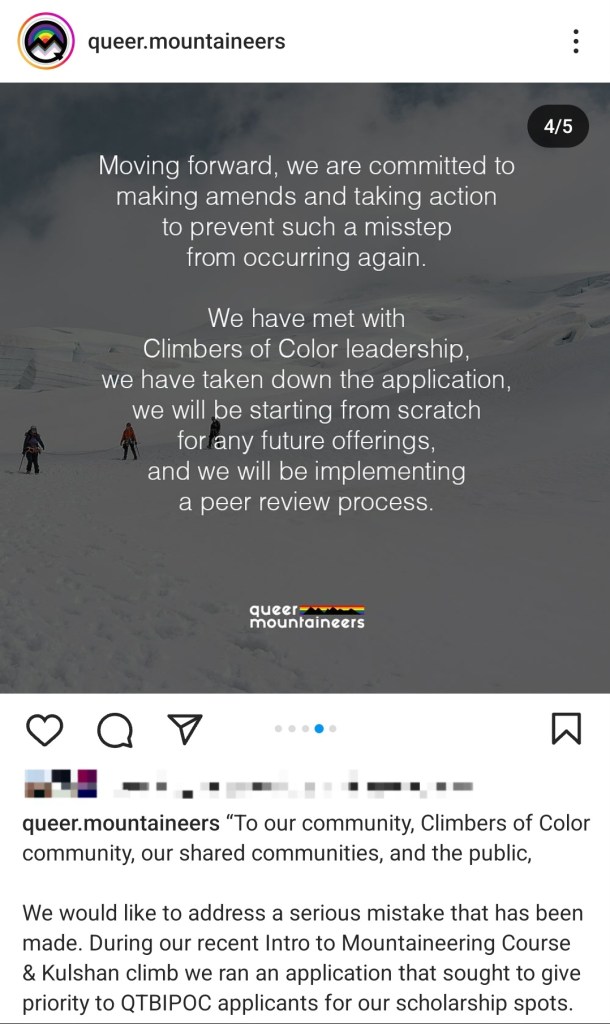
I just think the biggest thing and the biggest lesson that folks need to take away from this situation is number one, accountability is everything, right? Accountability is so, so important. As an organization, as an individual, accountability is so important and that is the biggest thing that people really want is accountability, right? We want…just own up to your shit because we’re not gonna be able to move forward if nobody owns up to it, right? And so I think that was a big thing that stood out was just like, you know, you gotta own this. One thing I first saw, one thing I will say, I loved the ability of, well, I’m just gonna call you out, Crystal. I love the ability, Crystal, that you were just like; these are the needs. This is what we want to see, right? We want a public apology, right? Talking about what future relationships look like. That is a beautiful thing, right? And for you to be in a place that you’re able to say that is wonderful, and I’m glad that they are able to come to an agreement.
I don’t know how much I should say, but, there was a journey towards getting, towards an apology, right? And so, some drafts were written and we had to go through the process of what we want the message to look like, how we want that message to be presented. And Queer Mountaineers had to listen to that. But COC had to put that out there and say, hey, this is exactly what we want.


Crystal (she/her)
Absolutely yeah.
Eric (they/them)
These are our expectations. We need you to follow this, otherwise we can’t continue that relationship. And it was done. And that was the great thing. I have seen a lot of people not agree to those types of things, and they went their separate ways, which is harmful to everybody involved, right? Not just the organizations, but the people that come to participate in all of our events.
So I look forward to working together, but goddamn, that was an emotional thing. But I am also a little bit grateful for being able to be a part of that and navigate that.
Crystal (she/her)
Thank you.
Thank you for the compliment number one. I will say Unfortunately, I’ve had a lot of practice at it.
Eric (they/them)
Ugh, yeah, unfortunately.
Crystal (she/her)
Yes, ‘m glad to hear that certain methodology is constructive, because when I first started out, I can tell you I was not constructive at all. Terrible at it, actually.
Eric (they/them)
No, no, no. And I, okay, full transparency, I had mentioned that. I said that. Because that was my first thing, was not knowing the full on history of COC. I said: this person sent an email. And I was like, they are hurt. I was like, it was very, if you were actively listening or actively reading in this case, right? You could see very clearly that you were hurt, not just mad, not just upset, but you were hurt, right? And that was the first thing I said. It was like, I was like, some harm was done, right? Like you weren’t just being, you can tell when somebody is just being mean and you can tell when somebody is being hurt. And that was the big thing for me. It was this person is just hurt.
Crystal (she/her)
Wow. Thank you for holding space for me on the other side like that. I had no idea and I really appreciate it. And you’re right, I’m really happy with the way that this was resolved. I’m really happy with the way that it was responded to as well. I could feel a little bit of tension and apprehension about it, especially when we went into the meeting with them. They’re like, we don’t really know what to expect. And I’m like, that’s fair. You don’t know if we’re gonna like flip out or start yelling and screaming or you know what, but like I said, I’ve had practice at this; and I know yelling and screaming doesn’t help anything. It’s a weird place to be as well, because it’s like you’re trying to be professional through this very emotionally tiring experience.
So it was good to hear that it was perceived a certain, the way that I intended it, and that it didn’t further do harm.
And I feel like it’s been resolved in a really respectful way. So I do appreciate the Queer Mountaineers taking the time to look, listen, learn, and then, you know, make that public apology because it was everything to me, because I was, I was, as you said, I was very hurt. But the podcast isn’t about me. How were you through that? How, how were you through that entire experience?
Eric (they/them)
No, you know, getting through that experience was like, it was really good for me, right? I came out on the end of it in a positive…I felt pretty positive coming out of it, right? It was just like, oh my gosh, this is happening. And it’s happening really fast and it’s happening really hard, right? And then it’s like, oh, okay. Like I can feel a little pride with Queer Mountaineers and say, hey, y’all did good on that, right? And we found a resolution, which is always nice. Because, I mean, I’ve tried to come to things, like I said, I’ve tried to come to terms with other organizations before, and they’re like, no, we’re not going to do that, and people part their ways. And it wasn’t beneficial to anybody. It was actually detrimental to both agencies that I’ve done that with. So seeing that, it makes me feel really good and I’m glad to be a part of both groups, honestly.
Crystal (she/her)
Yeah, that’s really good to hear. I mean, at the end of the day, affinity groups are supposed to be building each other up and cooperating together, and if we do have a disagreement, I think this is the way to go about it, right? Conflict resolution, listening to one another, and really holding space if harm and hurt has occurred, right? Yeah.
Eric (they/them)
Yeah, absolutely.
Crystal (she/her)
I’m really glad to hear your side of the story on this, because we didn’t really sit down and talk about it either, except via email.
Eric (they/them)
Yeah. Well, I guess that was the other part too, right? That we didn’t really, we didn’t really talk about that. And I guess maybe we should, I felt, cause I was a little, I felt a little hurt by the time because everybody’s like being emotional. And so, you know, I was included in the email, um, with another person of color from Queer Mountaineers. Um, and it was just, it was…tone is everything and that’s like tone is really hard in emails, right? And so I was very upset and I responded accordingly. And I can’t remember who it was that responded. They were like, whoa, we were really sorry. That was not our intent. We wanted to cover the bases and let you know. And it was really cool. Like I genuinely, genuinely felt that. And then something was posted in the Slack channel about what had happened…it wasn’t that you posted that in the channel. It was that like somebody thought that like, there needed to be more done and addressed with me. And you were like, we have already spoken to them.
Crystal (she/her)
You can be more specific. I know this person was me. You can be more specific. I am not infallible, okay? Yeah, let’s back up. You can name me.
Eric (they/them)
You know what I’m talking about, right?
Crystal (she/her)
Yes, okay, let’s back this up, because I want to be named in this email. I do, I do, because like I said, I’m not perfect, and I do want to be named as that person that sent you the email that was like, hello. All right, all right, so we back up. After the entire situation with Queer Mountaineers, right, as Climbers of Color started moving forward, we started setting boundaries with the Queer Mountaineers, right, because once trust has been breached, we’re like, okay, now we don’t really know where we stand with one another. This is what we would appreciate y’all would do when moving forward and interacting with us in the future. And then the question came about, well, what about volunteers that volunteer for both organizations? The question never came about as to who took the form and brought it over to the Queer Mountaineers. For me, that was actually a detail that I could live without and to this day I have never actually asked who it was because to me it doesn’t actually super matter. But I did send out an email to you if you want to talk about the email and another person of color that also volunteers for Queer Mountaineers and Climbers of Color.
Eric (they/them)
Yeah, I can’t remember what specifically was in the email, but it was basically reminding us of the policies that we can only volunteer for one organization at a time.
Crystal (she/her)
Represent. You can absolutely volunteer for as many as you want. Yes.
Eric (they/them)
Represent, represent, represent at one time. Yeah, but you can’t represent two organizations at the same time. It has to be one or the other. Correct, yeah. And so it was like that, and then, not sharing information without permission. And so we’re all emotional, right? And then it got, oh, because then it also got posted, something similar had gotten posted, or a brief summary got posted in Slack about what happened. Somebody had replied to that as if there needed to be any additional follow-up. And you chimed, I think it was you that chimed in really quickly and was just like, no, we don’t need to do anything. And I had, but I had already saw that message. So there I go, on my keyboard.
Because my emotions told me that and made me feel like y’all are drawing a line in the sand. And it was like, you have to choose. That’s not what happened, but because we are all having this emotional experience, it might have been conveyed that way. At least that’s how I received it. Going back, I actually read the email this weekend and it was not like that, though [and] that tells you how your emotions can really dictate how you receive something. But even through that process, because I wrote an emotional email back, right? And I said, I don’t appreciate this, right? And I was like, I don’t like being put in the middle of it. I didn’t actually be a part of this, blah, blah. And I think it was you and somebody else both responded and they’re like, I wanna be clear, that was not [the intention], but we are sorry that we made you feel that way. And that made me feel better even before this situation had occurred, right? It made me feel a lot safer. And then you say, hey, like through a tough conflict, like we can navigate this situation. So if any future conflict were to arise, I know that I was like, hey, I could talk to Crystal.
Crystal (she/her)
That’s… thanks
Okay, so I feel like when I read your email, I had the same reaction that you did when I sent an email to Queer Mountaineers. I was like, they’re hurt. They’re caught in the middle, so to speak, of these two affinity groups with an issue that has nothing to do with them. And it’s a tricky spot to be in, and I understand that they’re upset, so I’m not going to respond in any kind of way that’s going to you know, inflame this.
And I understand sometimes my emails, especially when I’m on the defense, can be exact and to the point. It wasn’t like a feel good email. It was like, these are the boundaries. And please do not cross them. And thank you. So I do hear the feedback that I could probably, especially in tense situations like that: be a little bit more compassionate, especially when someone’s in the middle, and I take that to heart for sure. But I’m glad that it didn’t blow up, that, you know, we were fighting about it. But at the same time, we did have to definitely make sure that boundaries were clear for everyone, because if you don’t know what the boundaries are, then it just creates a culture of fear, right? Because then you’re scared you’re always going to be messing up somehow. And we wanted to make sure that it was clear, but then the impact upon you was also terrible because like you said, tension and hurt was just running so high. It’s an unfortunate situation to be in for anyone, especially someone that’s involved with both groups for safe space.
Eric (they/them)
Yeah, really is.
Yeah, for sure.
Crystal (she/her)
Anything else to say about that whole situation?
Eric (they/them)
No.
Crystal (she/her)
I feel like it was resolved, it was done respectfully on both sides. Queer Mountaineers and Climbers of Color definitely still have a relationship together, and I mean I feel like that’s the way to move forward. Best case scenario.
Eric (they/them)
Absolutely.
Crystal (she/her)
Yeah, well that was my biggest question I had to you. I know it’s like, it’s interesting to hear your side of the story as well because you were essentially a hidden figure in holding space for me in my hurt. And that’s really powerful because it could have gone, you know, in a number of different directions and personally for myself I was, I was a mess.
Eric (they/them)
Yeah.
Crystal (she/her)
It always cuts very deeply for me and I never realized how deeply until someone was like, this is actually ancestral for you. And I was like, you’re right. And I didn’t put two and two together. So thank you for recognizing that.
Eric (they/them)
Not a problem.
I will just, I do wanna say one thing and that’s no matter who you are, right? One, body autonomy is a real thing, right? Like, if I can protect your space, put out your bubble, your boundaries, and clear them stately, you have the right to do so no matter who you are. And for those of you who are on the other end of like,
Somebody is telling you, hey, I have boundaries. You need to listen. That’s it. That’s all you gotta do is listen and respect that. It’s not about you. It’s about what that person is telling you. They’re telling you they need you to respect their space, respect their body. Do that and you’ll be good.
Crystal (she/her)
And it’ll be all good. Nice. I love that. Well, thank you. If there’s nothing else you feel compelled to share, I guess we can end it off there. That was great.
Eric (they/them)
Hehehe
Yeah, it was. I really appreciate it. This is cool.
Crystal (she/her)
Well I appreciate you coming
 Rock Rose Blog, LLC
One thought on “Hidden Figures: A Chat with Eric Ballentine”