
Part II of V
Of course, as times change so does policy. There has been a lot of talk by politicians about making sure non citizens are unable to vote (which I am confident they are not). And so came about the proposed policy to require voters to have their birth certificate name match their current legal name. This leads to an entire body of problems for people who want to match their gender identity with a name or even married women/people who changed their last name. It has had an unfortunate ripple effect: first women become legally dead and become “one” with the husband by taking his last name, and were encouraged to do so because they could not obtain things such as registering to vote, obtain a driver’s license, or a passport. Some even started to hyphenate their last name as well. However, in all cases their birth certificate does not match their current legal name effectively making them ineligible to vote. What a twist of policy! And now that bill has indeed passed.35
Despite this intentional hoarding of power by men historically and in the present, people have still gone about their daily lives as best they can. But the harassment, abuse, and sexual abuse of women has been continually fueled by this outdated and ridiculous notion that we, as women, belong to men. The notion that our bodies, our minds, our assets are really only an extension of men instead of truly belonging to ourselves is where men’s entitled attitudes stem from because of policy. And this has shown up repeatedly and even in the modern era with the rise of social media. I can almost guarantee any woman out there living her/their life publicly has had some sort of harassment simply by just being. Whether it be being punched in the face for walking down the street looking at their phone36 or wildly rude comments online, men are watching and always have something to say. I personally also have had comments online and in person that were beyond rude for no apparent reason except that we dare to step outside of what men’s society has expected of us as women the last 100 years.
And an interesting yet unfortunate thing is: women are harassed while the perpetrating men are sheltered and defended. And it is no different when this happens to famous climbers. And we will see this play out with two specific examples with the Reel Rock films. But first, let’s get acquainted with the history of Reel Rock itself.
Reel Rock is a film festival founded in 2005 by white men Josh Lowell, Peter Mortimer, and Nick Rosen under the companies Big Up Productions and Sender Films.37 Considering each of these men are about the average age of 50 years old, that means they were born close to the years of marital rape still being legal, women finally legally being empowered to have bank accounts, no fault divorce still not a concept in a lot of states, and approximately 10 years after segregation ended. This means their parents were the generation that women and Black people still did not have many of the rights we have today. Their parents probably lived through segregation and only fault based divorces being legal policy, which still shapes the next generation’s ideas and attitudes about women. And this is probably the experience of most white men their age, unless specific work is done to scrutinize policy.
If anyone remembers the Dosage films that came out, these are the same people. I refer to the Dosage films in my article/podcast Hip Hop in Climbing38 when referring to climbing history. Their first film was released in 2002: 8 years after the Violence Against Women Act was made federal law, 23 years after most states did not legally tolerate marital rape, and only 28 years after banking was made accessible to all races and genders regardless of marriage status.
Now, I bring this up not to shame but to examine the climate in which many of us have been steeped. And most of the time, the people who bury their head in the sand the most are the ones who benefit from these policies: and for a very long time that has been cis gender white men. Oftentimes, attitudes (conscious and unconscious) become the very core of an organization’s belief systems. And in this case, their films have been a reflection of what they attribute value to with underlying themes: which have mostly been hard climbing and depicting silly shenanigans of men idling time climbing.
I remember attending Reel Rock every year when I first started climbing. And yes, I do remember thinking there was very little diversity in the climbers; and even less diversity in the storytelling. It always seemed to fall into one of two categories: 1. Man meets rock/mountain/obstacle, man beats obstacle. 2. Man is silly and happy go-lucky while conquering rock/mountain/obstacle. However, I do recall one year in 2016 an exciting film with people I could relate to more: Ashima Shirashi and Kai Lightner.
For those of you who may not know either of them, here’s a quick rundown. Back in the day after Puerto Rican Obe Carrion (whom I mentioned in my Hip Hop in Climbing39 article/blog and who ended up being Ashima’s coach), I do not recall seeing many people of color in climbing as the sole subject of climbing content in widespread films (except maybe Jimmy Chin). And I started climbing about 2014. Until 2016 when Reel Rock released Young Guns in their 11th tour, I am not aware of any Black people appearing as main subjects in any of their films. Young Guns was a film about 15 year old Ashima Shiraishi and 16 year old Kai Lightner climbing and being coached. Before this film, to my knowledge later, there was one about Obe and Ashima in Reel Rock 640 about their coaching relationship. And years later in 2020, a film called Black Ice about a group of Black Climbers led by Conrad Anker to go ice climbing and a film about an Indigenous climber, Ronnie Kauk.41 These four films are the only ones I am aware of with Black people of Indigenous folk.
But in order to be more accurate with data instead of my own impression, there is in fact a person who has already done the research on diversity of the Reel Rock repertoire: Lena Ray.42 Lena took it upon herself to crunch the numbers and even make the information easy to digest.43
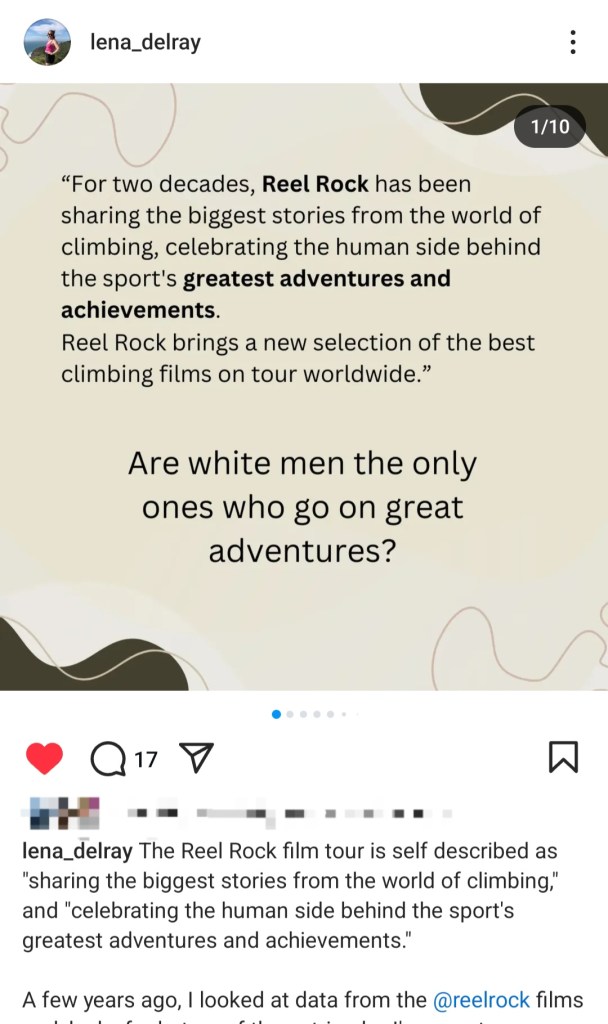
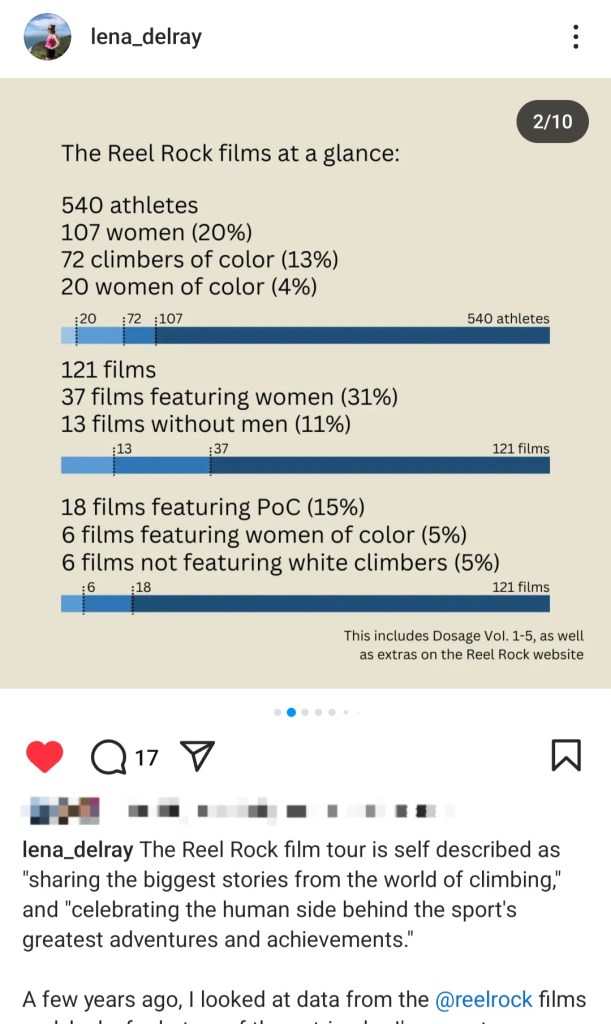
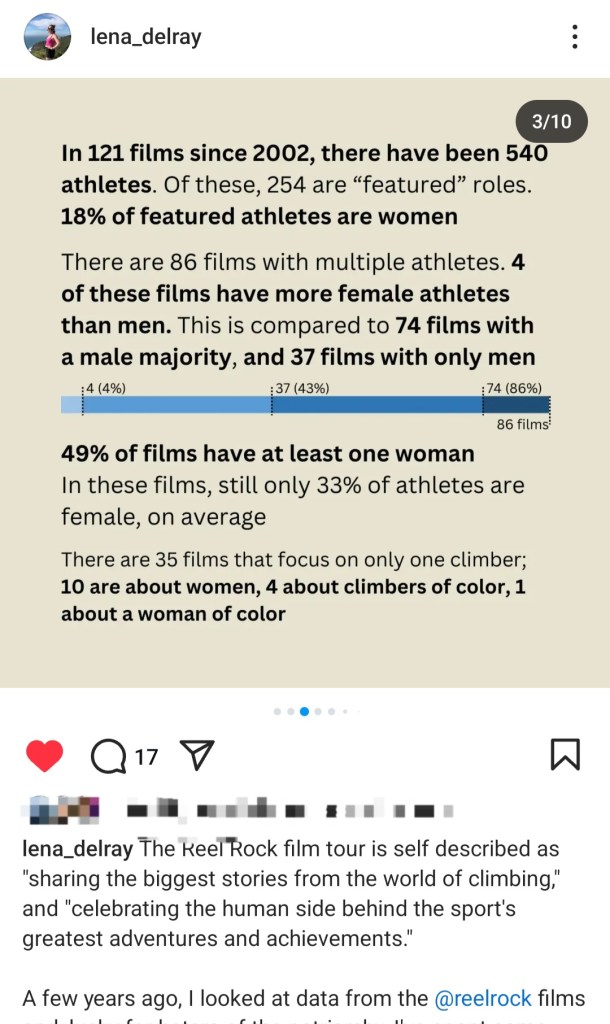
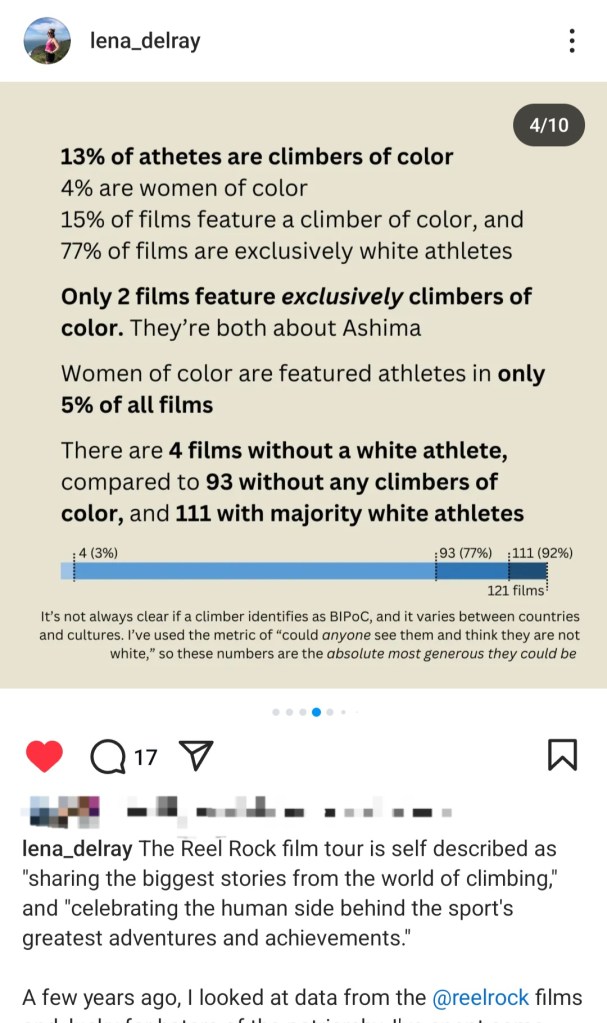
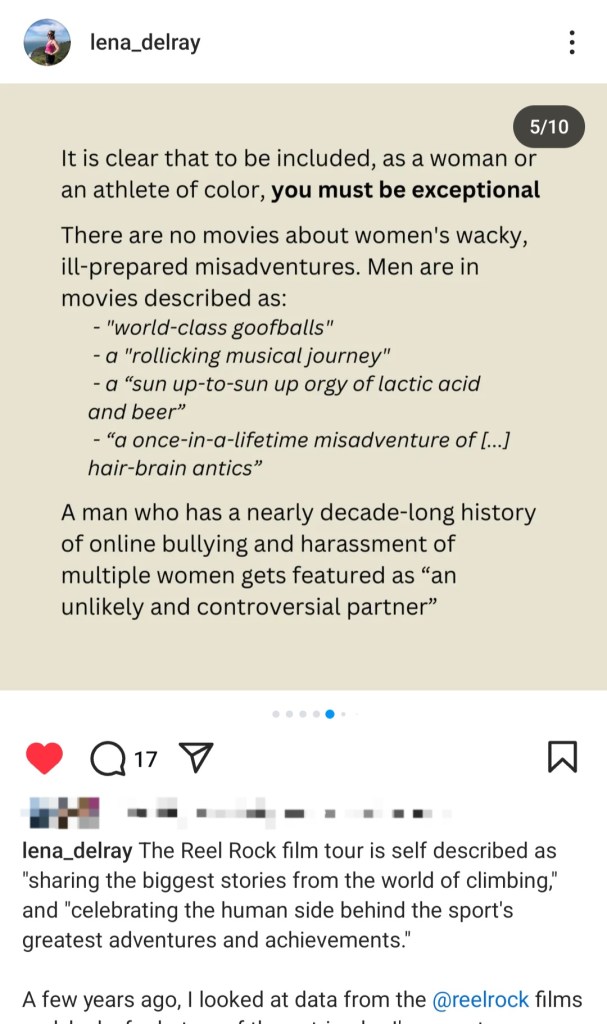

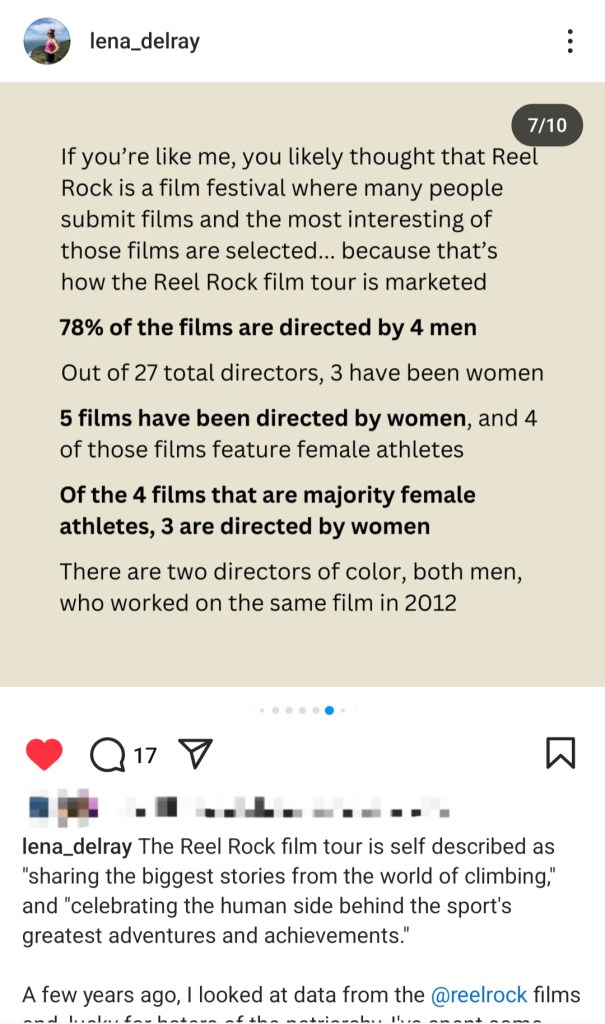
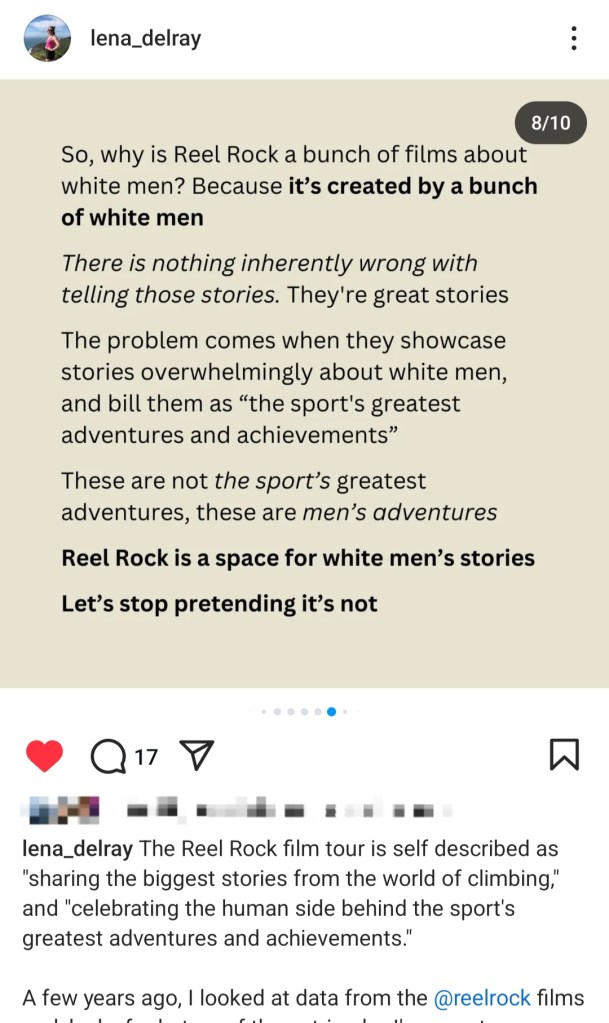


I think it worth repeating that Reel Rock was “…created by a bunch of white men. There is nothing inherently wrong with telling these stories. They’re great stories. The problem comes when they showcase stories overwhelmingly about white men, and bill them as “the sport’s greatest adventures and achievements” These are not the sport’s greatest adventures, these are men’s adventures. Reel Rock is a space for white men’s stories. Let’s stop pretending it’s not.”
This has been my experience in interacting with them. I have also heard a lot of chat online about these numbers being on par with the American Alpine Club’s estimate of 41% of non AAC members are women with men at 58%.44 I would not put a lot of stock into these numbers now since the report is from 2019; but even if we did that means that Reel Rock features 30% of women in their films which is not on par with the old climbing report. And I say featured because having women in the background in my mind does not count for much.
Another thing to note is that people have expressed to me that in order for your film to be considered seriously for the Reel Rock tour, you should be sponsored or funded by them. And the data in this rings true showing 78% of their films produced by the same 4 people. Again, not inherently bad but it does mean that they maintain, fabricate, and control the narratives that are widespread in the mainstream climbing community. Leading to less diversity and inclusion in general.
With this US policy’s backdrop of controlling women and the statistics of Reel Rock films, we can now get to the specific concerns the community has been expressing about 2 of their films. One is Cobra and the Heart. The other is Death of Villains. We will start with Death of Villains.
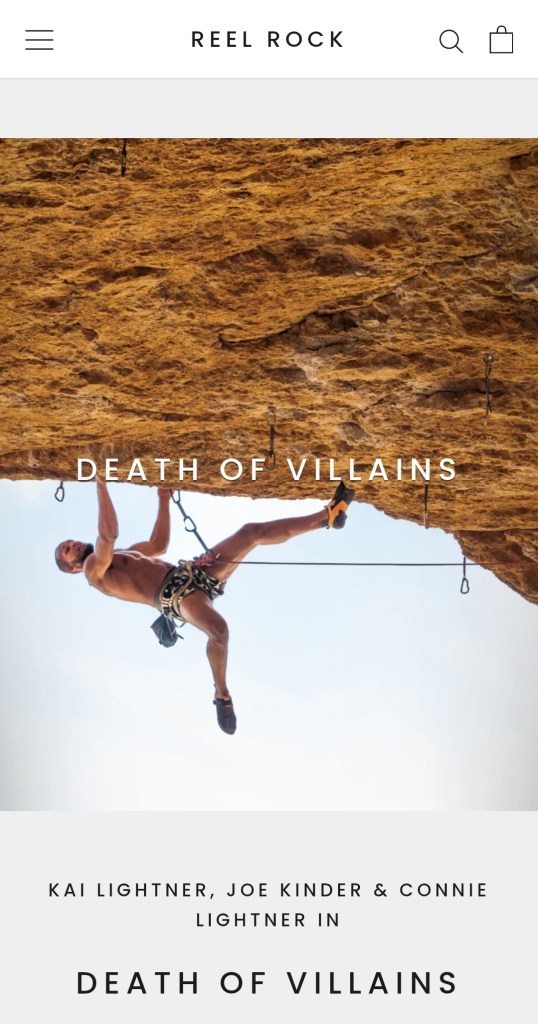
Full disclosure: I have not seen either film. I have not paid to attend a Reel Rock in many years: their narrative has never wavered but my attention has. However, I do remember meeting Kai Lightner for the first time at Reel Rock 11. I was so excited and got a poster autographed. Although I am significantly older than Kai: to me he represented most of the representation of Black climbers in mainstream climbing that I had in 2016 (besides Meagan Martin). And as the years progressed, seeing him open his own non profit called Climbing for Change45 (which I have also been a scholarship recipient of) and even speaking on social issues such as eating disorders kept me proud. Let’s be clear: my adoration for him will always be there. However, I will say I do question some of the decisions he and his mother have made as of late concerning the film Death of Villains and involving a man named Joe Kinder.
If you feel strongly about Rock Rose Blog bringing you free content about relevant issues and discussions, feel free to show your appreciation by donating my next year’s worth of platform access from WordPress. Sight access payment is due April 21st. Click here for more information. Thank you for reading!
Works Cited
35. Benen, Steve. “House Republicans pass the ‘SAVE Act,’ which is a solution in search of a problemhttps://www.msnbc.com/rachel-maddow-show/maddowblog/house-republicans-pass-act-solution-search-problem-rcna200681 04/10/2025
36. Burga, Solcyré. “Women in NYC Are Posting TikToks About Getting Punched in the Face on the Street.” https://time.com/6961350/tiktok-women-nyc-punched-street-trend/ 04/04/2025
37. MountainFilm. “Josh Lowell.” https://www.mountainfilm.org/people/josh-lowell/ 04/04/2025
38. Hudelson, Crystal. “Hip Hop in Climbing: Part III.” https://rockrose.blog/2021/04/29/hip-hop-in-climbing-part-iii/ 04/04/2025
39. Hudelson, Crystal. “Hip Hop in Climbing: Part III.” https://rockrose.blog/2021/04/29/hip-hop-in-climbing-part-iii/ 04/04/2025
40. Reel Rock. “Reel Rock 6.” https://reelrocktour.com/products/reel-rock-6 04/01/2025
41. Reel Rock. “Reel Rock 15.”https://reelrocktour.com/products/reel-rock-15 04/01/2025
42. https://www.instagram.com/lena_delray/ 04/06/2025
43. Ray, Lena. “Reel Rock Data.” https://docs.google.com/spreadsheets/d/1qSiPkQOcaedzo1ucnVQgufcAZaXdcRI8-ikf0CQyVGg/edit?gid=0#gid=0 04/06/2025
44. American Alpine Club. “Inaugural State of Climbing Report Released.”https://americanalpineclub.org/news/2019/7/8/2019-state-of-climbing-report 04/07/2025
 Rock Rose Blog, LLC
One thought on “The Reel Deal: Women, Policy, and Autonomy”