A chat with Mel Fernandes of A Higher Calling PNW where we talk about the Reel Rock petition and the work she does in the survivor of sexual assault advocacy work in the outdoors and climbing. Mel expands on the topics of The Reel Deal on this podcast, so it is suggested to finish that series before listening to this episode. Choose a platform:
Crystal (she/her) (00:52)
Welcome back to Rock Rose Blog.
A podcast and article center for Climbing BI POC and Policy. Today we’re going to talk to Mel of Higher Calling Pacific Northwest who has graced our presence with a costume of Cassandra, the Greek goddess, and who works particularly in a very niche part of the climbing realm in sexual harassment, abuser survivor advocacy work.
I’m particularly excited to talk to Mel, especially since I just released an article slash blog on the topic of harassment in climbing. and that is entitled, The Reel Deal Women, Policy and Autonomy. I would suggest that you go ahead and listen and or read this article first so that you will get everything in its full context. Mel does have some things to add additionally that I didn’t have in the original article. So buckle up and let’s talk with Mel about these situations regarding Reel Rock and beyond.
Crystal (she/her) (02:20)
Hello, good people of the world. Crystal here with Mel from A Higher Calling Pacific Northwest. Thank you so much for joining.
Mel (02:31)
Thank you for having me.
Crystal (she/her) (02:34)
Of course. ⁓ I guess we’ll just dive right in. I already said you’re with A Higher Calling Pacific Northwest. So do you want to talk about yourself a little bit? You could share your name, pronouns, what you do around the region, etc. I understand you’re close to the Seattle area as well. Just tell us a little bit about yourself.
Mel (02:46)
Yeah.
Yeah, so my name’s Mel Fernandes, I use she, her pronouns. I was born in Washington State, I currently reside in Skagit native land. This is the Hidden Voices podcast, right, Crystal?
Crystal (she/her) (03:06)
Hidden Figures? That is a series, yes, absolutely. And I think you would fall into that category with some of the stuff you’ve told me about being excluded in certain ⁓ works that you’ve been involved in through the scope of a higher calling PNW, so yes.
Mel (03:07)
You know it’s bad when I’m the hidden voice, right? You know the shenanigans. They’re coming. They’re coming for us mixed folks. They’re coming for the weird girls in the North. No one fits the ideal standard of inspiration in climbing movies, apparently, unless you have a weird white male friend near you.
Crystal (she/her) (03:50)
That would be accurate, at least the very mainstream movies. Absolutely. And so today we are going to talk about Reel Rock a little bit as well. Yes. But you were continuing on.
Mel (04:00)
Yeah, I’ll tell you what I do.
So a little bit what I’ve been doing in our community.
I work as an outdoor activist in the PNW [Pacific North West], and so I’m working on projects that support ⁓ primarily victims of violent crime and survivors of systemic oppression. I have been doing more political action. You guys see me… ⁓
spending a lot more time in Jewish spaces as I am biracial and Jewish and a lot of my work has intersected with Palestinian solidarity work. But you want to talk about Reel Rock and I have a very interesting experience within some of your writing.
Crystal (she/her) (04:39)
Well before we get to that, I have a question though, and I think a lot of people might also have this too. How much does this ⁓ violence work that you’re talking about intersect with climbing specifically?
Mel (04:53)
Right, so heavily in some circumstances. So folks should be familiar with the Safe Outside Survey. It was conducted in 2018, and data suggested that sexual harassment and sexual violence were a primary, they were a major, experience of many people who go climbing in our community. About 47 % of female respondents had experienced some sort of sexual harassment, sexual assault behavior. Which is why I want to call it primarily, because that is almost one in two. Sexual violence is one part of the work that I’m doing. I also work with families of people who were subjected to violent crime, violent assault, and did not survive what happened to them in the Alpine. So for folks who follow me…know what we’re working on, we’re going back out to Blewett Pass for the sixth year in a row to look for a man named Ian who is presumed murdered.
His body is still missing, his case was not processed, and so without a body his family continues to return to that search site where Ian was recreating outdoors ⁓ to try to create that closure. I got started actually because I was working with search and rescue and ended up finding a missing woman in North Cascades National Park.
Crystal (she/her) (05:57)
Unfortunate.
Mel (06:19)
Her name was Rachel Lokaduk and she had been missing from Hidden Lake Lookout. And I found that the county resources that we were providing her family were just ⁓ kind of, it made me feel personal shame to like leave that search site knowing that she deserved to be found. And so when we did find her as a community, there was folks who kind of peeled off and continued looking for her with her family. When we did find her, I noticed that I had the resources and had some public support in launching my own nonprofit to continue that kind of work. So my work really is in trying to find opportunities and gaps in the care, the communal care that we’re providing our own community. This is something we talk a lot about, when we see things that are being experienced by our fellow climbing folk and we don’t, we choose to ignore it or we choose to sweep it under the rug, it becomes part of our culture and our community. And I don’t believe that the Seattle region is a place where you should ⁓ pretend that there’s like not a murdered person ⁓ needing aid in your general vicinity, right? That his family is looking for them and you won’t help them or that you have, you know, we talk a lot online about instructors that are perpetrating harm on students in climbing organizations. When we ignore those things, the outcomes are just really unfortunate and create a lot of holes in a culture that I don’t agree with.
Crystal (she/her) (07:56)
Yeah, wow, thank you. Dove right in there. That was, that’s such a good analysis about culture because if you don’t do anything, like you said, it just becomes like this indoctrination that people don’t talk about. And how do we make change if we don’t actually talk about it, right?
Mel (08:15)
Right. I’m really hungry at this point in my life and my career for more stories that reflect the truths of those situations, that there are significant forces around bullying or harassment or, ⁓ you know, people who start families and then desert those families, right? There’s a lot of hurt in our community and I want to hear stories about the remediation and the healing that folks go through when experiencing these very human, you know, conflict is two humans in the same area, right? What those resolutions look like on the back end after actual work and actual restorative justice work has happened. And so what I was brought into in this situation was kind of ⁓ a question of how do we move forward from a restorative justice standpoint when there’s someone in prison, but they’re all these victims who need to continue living their lives. The Safe Outside Survey found that the kind of more common reaction to being assaulted is to pull away from the community, right, to go away from climbing and climbing-related activities and pull into a different area or find different interests that make them feel safe. But I would like to argue that we should be trying to reach out to those people and hold them and make sure that they feel safe in climbing.
And that’s where Reel Rock and I intersected. Not with their consent, unfortunately. They had to find out about me. Against their will.
Crystal (she/her) (09:56)
And just so everyone’s clear, what does restorative justice look like or what is kind of like the definition or you’ve seen it at work?
Mel (10:05)
Yeah, it’s a look at justice through intersectional perspectives that aren’t heavily reliant on white supremacist or traditional law enforcement perspectives. So in this case, this case was a little different where I work with a lot of folks who have never gone to law enforcement and perhaps never will. And so how do we keep those folks safe and how do we try to protect the community from whoever harmed them? But in this case, there was a man in prison for life. We’ll see, his appeal is being processed. So that could change, and then we’ll have a lot more work to do. But in this case we had the support of the criminal justice system, the federal justice system had stepped in and removed the perpetrator. So what were still the harms that needed to be restored was kind of everyone’s trust in the community that that was unacceptable and shouldn’t happen again.
Crystal (she/her) (11:08)
Especially since it took him so long to be held accountable. Like when I read that climbing, or outside article, I just, I was like, and that was it, right? Right? Right? And it just kept going and I, ugh.
Mel (11:26)
That says something, do you think that says something, are you commenting on how in the article, which the author, think her name’s Annette, she is Pulitzer Prize nominated now because of that article, huge. The article goes into how the community down in that area banded together to try to protect the perpetrator. I try to refer to him as just acronym, just initials CB rather than first name last name, I just call him CB. And I think that fits our tone. But yeah, they really banded together and that’s a phenomenon I see. So I think you’re remarking on how it takes the justice system so long to hold people accountable. Or were you commenting on how he continued to climb with more people and be held by people?
Crystal (she/her) (12:00)
I think both.
I was just astounded personally that it kept going that people weren’t…I don’t know it’s like what do you do in that case besides like try to warn your friends and then you’re just not able to…just feel so powerless I suppose because you’re not able to hold accountable. You’re not seeing him being held accountable. You’re seeing other people feeling safe around him and not Yeah, it’s just it’s really unfortunate.
Mel (12:46)
Yea it was… I’m thinking of a particular survivor who worked really hard to try to educate and warn other folk and was ignored. This case I think moreover though featured a lot of retaliatory harassment, so folks who came forward were straight up harassed in retaliation.
It was hard because I, it’s eventually how I ended up hearing about it too, is I actually got a call that somebody needed help because they were being contacted. People were like, I see what you’re saying about CB and I don’t want you to say those things about him. Or don’t say those things ⁓ in really unfair and unwelcoming manners. Like imagine you speak out against somebody who hurt someone and you get a text message, right? You’re on your Facebook or you’re in a comment section. You’re like, that was really not behavior that is reflective of the climbing community. And then you get a text from somebody saying, don’t you dare say anything. ⁓ There are some screenshots of his father going around. His father would also reach out. ⁓ And of course, full name and picture on Instagram, just sending DMs saying, you don’t know what you’re talking about. It’s like, no, we do. We do, daddy.
Crystal (she/her) (14:09)
I know people wanna have faith in other people, but sometimes there are truths, very ugly truths about people out there.
Mel (14:17)
Yeah, yeah, I think how people are parented has a huge impact on how they behave. So when you see somebody’s daddy misbehaving, it’s like, okay, well, we can see where that apple fall from the tree. But I wanted to point out something that I observe in my work particularly around violence and violent perpetrators. You will get a response to a man being arrested or somebody being questioned or somebody being removed from a community because they perpetrated violence in climbing. And the response will look like a bastardized version of restorative justice, right? They’ll weaponize things like abolitionism.
A bit of an inside joke is like you want to know who’s a white abolitionist just like lock up one of their friends and see how they handle it. Never, never have these people who were going hard for CB protested the killing of a black person at the hands of the police or unfair labor and legal practices by the justices and they’ve never done anything about ⁓ racial injustice in this world until their homie got locked up and then they have something to say about how, “oh the government’s crooked” and “they’re coming for us.” And I think the Outside article touches on it in a very light way of you started to see people band together to protect him. And I did hear that there was some stuff going on at kind of just the county level. Something I have also experienced is…sometimes a climber has connections with police or law enforcement or something that makes it so that they can continue. ⁓ Yeah, I had like a case involving somebody who was in search and rescue and it’s like, did they do the background check? When did they do the background? How did they get through the background check at the sheriff’s office? Search and rescue. Like, there are just times where that comes out.
Crystal (she/her) (16:14)
Mm. Mm-hmm.
Mel (16:21)
There was, do you remember when there was a black athlete in Montana who was harassed?
Crystal (she/her) (16:28)
Yes, I know who you’re talking about.

Mel (16:29)
Yeah, yeah, harassed at the hands of an Outdoor Research manager, like a very high up. Yeah, and I don’t hear people talking about that case and trying to protect the victim in that circumstance. I don’t hear people talking about this case; is still happening. ⁓ I yeah, I sometimes kind of check in to see how things are going.
Crystal (she/her) (16:37)
I do recall this, yeah.
Mel (16:58)
There was some legal ramifications, unfortunately. The person who was fired is a litigious individual, a litigious former Outdoor Research employee, and so he ⁓ tried to punish the guy for reporting the bad behavior and tried to hold folks who spoke out against the injustice accountable legally. And ⁓ the case didn’t go through. The case was, I think…I don’t even know if it was processed, I would have to look. But it didn’t go the outcome of the aggressor. And he’s still…he still online going “Anananananana cancel culture! Here comes the cancel culture! The woke mob got me fired.” It’s like, bro, you can’t act like that and be the director of a fancy company.
That’s unfortunately how capitalism works both ways in some circumstances where like, actually, the free market kind of requires you to not be a dick to fellow human beings.
Crystal (she/her) (18:01)
Yeah, that would be nice. Just act accordingly. Don’t shit on other people. It’s pretty simple. It’s pretty simple.
Mel (18:10)
Sometimes. But no, people, I bring that case up ⁓ just because I think it’s reflective of other cases where my heart deeply goes out to those victims who need justice and the community is just not interested because there’s just some white man somewhere that needs our sympathy because he feels bad for what he did.
Crystal (she/her) (18:30)
Yeah, goodness. And I feel like too, some of these examples I know are mostly just white women or black men as well. And so I wonder sometimes how many stories are out there for women of color, because the stats for any kind of harassment or sexual violence are also very staggering as well.
Mel (18:54)
Right. And I just can’t talk and don’t talk often about those cases where the victims are so vulnerable. If people are following my work, they hear about the cases that the victim is physically safe and isn’t at risk of losing the financial resources they need to keep a roof over their head.
You guys won’t necessarily hear about those things going on and certainly reporting is still really low in those circumstances. It’s interesting. In the work that I have done in that arena, ⁓ there’s just not…something that goes into reporting is does the victim feel safe and does the victim have a support system to come forward about things that happened, you know. In victim advocacy in general, if you’re working with a community advocate who’s addressing domestic violence or sexual harassment, you know, they say, okay, who can support the person through the reporting process or the speaking out process? And certainly when it comes to like, outdoor athletes who are experiencing these kinds of things, because the harm or violence may be happening in the Alpine, it seems really hard to get over the barrier of reporting after the fact, right?
I can speak too. There’s some, there’s some, I don’t know, would you call it social capital when we are like, given climbing opportunities that we wouldn’t necessarily think we deserve? I don’t know the word for it.
Crystal (she/her) (20:30)
Given climbing opportunities that we don’t necessarily think that we deserve…I would say feeling indebted maybe
Mel (20:36)
The thing that’s being exploited. Yeah, the feelings of indebtedness to whomever is creating opportunities to work in the outdoor region industries. ⁓
Crystal (she/her) (20:37)
I would say feeling indebted maybe. Yes. And yes, that’s the worst type of power to abuse right there.
Mel (20:51)
Yeah, yeah, I don’t know if it was you, but somebody around the same time you were talking about ⁓ some of your previous work had also said that they weren’t getting paid for any of their ⁓ outdoor BIPOC advocacy work like they were doing their labor. I know you did that. You definitely, yeah you definitely did that. There was somebody else.
Crystal (she/her) (21:09)
⁓ that would be me. I’ve not been paid for a lot of stuff. Guiding, yes. Everything else, no. But yes, this is very common.
Mel (21:19)
Very common. was somebody else that I was shocked. I was surprised to hear that you had not been getting reimbursed in any aspect, but there was somebody else who I was like, some of you are the faces of bringing racial diversity or disability justice or any sort of accessibility and inclusiveness into this white dominated space and you’re not getting paid and you’re getting harassed and you’re not telling people about it? Excuse me, but like fuck that. We gotta change one of these things girl. At least get paid. No, I’m just kidding. At least get, my God, you know me though. You know what I’m gonna start doing is I’m gonna start charging for an Instagram follow.
Crystal (she/her) (21:52)
At least get paid. Yes. You could like I’ve been looking into it like Substack. I think I’m going to start that because my work is more writing based and you can do subscriptions and everything so you can get paid on multiple platforms.
Mel (22:14)
There should just be a fee to watch me because all these people who are in my request right now, one of the Reel Rock producers, he told me that he was upset that he would have to be aware of what was happening on social media. I was asking him, like, hey, can you make sure you’re aware of what your athletes are kind of doing online? He said, no, I don’t want to be on my phone. Well, now he’s requesting to follow me on Instagram. $500, sir.
Same with one of the moderators for a very large Facebook group in our area also requested to follow me and I have, I’m sorry, but I’ve talked so much shit about his organization at this point. There’s no way he needs, he does not want, he’s gonna have to pay to hear me critique the lack of diversity and inclusion at his organization.
Crystal (she/her) (22:38)
There you go.
That’s where consulting work comes in, which is why I turned into an LLC so that if people did want my super opinions on this stuff, minus some blog posts here and there, they’re gonna have to pay me. But circling back around to speaking out, say someone did have a situation that would fall into the realm of your nonprofit work. What is kind of the process for them to go through and how do you guide them in speaking out and supporting them in this really difficult and sometimes shame-filled process?
Mel (23:34)
Great question because there’s actually no way to actually get a hold of me specifically. Folks, there’s no website intake or forum you fill out. ⁓ I am referral based, so there are folks at organizations in the community who refer to me when they see a need. ⁓ Anyone in our community should be able to go to a resource center and get support for going through domestic violence, sexual violence, sexual harassment. ⁓in an outdoor space, specifically too if you’re working in an outdoor space, you should have HR and HR should be handling your sexual harassment complaint. Is that what is happening in actuality in our community? No. And in some cases I’ve been brought in because organizations are diligently trying to silence someone from speaking about what happened to them.
I got a call not that long ago and I typically will screen out my calls, say, yeah, what do you want to talk about? before I give my office line. But I knew and trusted the person so I picked up the phone and she was like, we’re dealing with sexual harassment and it’s at an organization you’ve already been working with. And I’m like, my gosh, not again. Like I don’t.
What do mean they can’t get it together? And so that was a call where the situation was there was some sexual harassment involving a instructor who was using his power to, his position of power to increase the romantic opportunities he had with the women folk and was doing so dishonestly and unfairly. Allegedly. I was brought in towards the end after the reporting had happened. After the attempts to mitigate the risk had been dealt with and hadn’t been dealt with in a way that honoured the women who reported the harassment. And so it was one of those calls where they say we have tried everything, what do we do? It’s like, well, go. I have some options for that too, right? If we’ve tried everything and they won’t listen, then there are still options for speaking publicly or going to… The nice thing is that over the years I’ve created communities with survivors who have all gone through the same thing. And so if you come to me and you’re like, I’m going through this, I can connect you with someone who’s unfortunately gone through something very similar and at least you have some support, but also those groups act as a coalition against fighting the harassment. They can do more than perhaps just me, one person, who hasn’t gone through what they’ve gone through.
So yeah, people essentially get referred to me. Occasionally somebody reaches out because they’re aware of me through seeing my work elsewhere. And I try to just continue to refer to resource centers. I work with any sort of domestic violence center in the area. I will ensure that you have the phone number to call or a advocate that I know at that organization to get a hold of. A Higher Calling has done wonderful work with King County Sexual Assault Resource Center. We did a series of educational courses in one of the off seasons a few years ago, just teaching folks what sexual harassment is, how to intervene when you see it, how to respond, how to report, these kinds of things.

Crystal (she/her) (27:03)
And I think that’s so important. Myself, I work in a male majority type ⁓ work professionally. And I do feel like there’s a lot of rolling with the punches, ⁓ either with harassment or off color comments that are just totally inappropriate. ⁓ And so sometimes I feel like it just takes that moment when you’re like, I’ve had enough. This is systematic, it is constant, and it just has gone too far this time. And having those resources and knowing where you can turn, I think are very, very important. And honestly, I didn’t even know until I had started following you probably maybe a year ago, maybe a little less, ⁓ that there was resources for sexual harassment in the outdoors. ⁓ It’s a very niche area that you are in.
But it’s very much needed because we’ve seen these situations come out again and again. And I think particularly the situation that brought my organization, that I was with at the time, to you was someone was going around flashing people at Vantage. And we just put the call out and we were like, hey, y’all need to know about this person. We don’t have like a picture of his face or anything.
Mel (28:23)
Yeah, I remember that.
Crystal (she/her) (28:26)
Yes, yes. And so we in our organization started to have a conversation about trying to do maybe even just like base background checks for people coming in, because unfortunately, you never know. You never know. And even then, like the situation with Vertical World’s lawsuit with that one climbing coach that was inappropriate with teen underage women, underage girls, ⁓ they didn’t have a record.
So I feel like sometimes, yeah, how far is enough? Like what can we do to actually make it so climbing is safe and so that people can speak out and will be believed so that this doesn’t happen again and it doesn’t keep happening.
Mel (28:57)
Right, how far? Yeah, how far?
Right, right, and I forget, how do you think you found me? I’m like, pretty niche, right? I don’t have a lot of followers, so I always have to ask people, like, where did you find me?
Crystal (she/her) (29:24)
I found you through the person that actually pitched our organization who was running our social media at the time. Yes, who pitched our organization that we should start to do background checks.
Mel (29:30)
⁓ yeah! Yes, I remember those conversations and I love when you post.
Crystal (she/her) (29:38)
Yes. And I was definitely all for it as well because we did have someone go through the ranks that we knew was harassing people. And I’ve talked about this on my podcast before too. ⁓ And so we, know for a fact that unfortunately predators do come through our ranks, even in POC organizations and
Mel (29:48)
So they know.
They know there’s no vetting, that’s the problem. We don’t know. We are not walking around trying to touch the girlies and the kiddos without their permission. We’re not thinking about that. They are and they’re figuring out how to get it done. They also talk to each other.
Crystal (she/her) (30:16)
Working the system.
Mel (30:23)
There’s this crazy thing in America where you get put on a website.and you can just use that website to figure out who else in your community is. You know the registered sex offender websites? You can just figure out who, so they can contact each other and that information is shared and I have seen it get shared within cases that I’ve worked in. They say, my gosh, you can sign up to teach here. They do not do background checks
Crystal (she/her) (30:30)
I literally have no response.
Mel (30:50)
You didn’t… I’m glad you… I always feel bad for having to tell people these realities. They are better to know these things.
But yeah, that was kind of a problem that I was going through, I think, when we first connected, is once one pedophile figures out that they can get into your organization and start perpetrating violence, they tend to tell other pedophiles. And so those people tend to flock together into situations where they know that they can operate. And I think there’s something, there’s conversations in our community going on, not necessarily to that deep and dark of an extent, but just with the unfair treatment of women. We’ve been able to identify several organizations throughout the years that just have a history of ⁓ harassment towards women, easily other men who want to harass women get into those organizations and perpetrate more harassment. They can tell when certain organizations are set up for that kind of thing, and they’re not going to be detected, or they’re not going to be held accountable.
We’re talking about criminal vetting, there’s also just that idea of like, well, if they don’t have a record, what do you do? And it’s like, well, you have to make sure that your community can report and that the reports get dealt with. And I don’t, whatever happened to the Vantage flasher?
Crystal (she/her) (32:16)
I don’t know, there was no name reported. It was just, as far as I know, an anonymous tip. So they might still be out there, unfortunately. ⁓ Hopefully they got scared off because it was posted and people were talking about it and they were like, you know, stick together and make sure that you report this if you see anyone acting, you know, a certain kind of way.
Mel (32:21)
Yeah. Yeah.
Crystal (she/her) (32:41)
I was very proud of the community in that people were talking about it. Of course, there were a few comments that they were like, well, how do you know they’re flashing people? And I’m like, I’m just gonna go out on a limb and say that I think climbers can understand the difference between trying to go scamper off and like, excuse yourself, relieve yourself versus intentionally flashing you. I mean, we poop on a wall for God’s sake. So I think we can tell the difference. But there’s always those people.
Mel (33:06)
Yeah, context, guys, context.
Yeah, I love it. They’re like, what if they were lying? It’s like somebody is lying about seeing, ⁓ you know, what a fantastical lie with no purpose beyond just trying to keep people safe, right? ⁓ Yeah.
Crystal (she/her) (33:23)
Yes.
And that’s hard because I want to believe everyone’s genuine and I want to believe that people are ultimately good. But I think that in this world, unfortunately, we just have people that have just lost their way or have been influenced by dangerous and clearly insulting ideas ⁓ to certain demographics. And it’s really unfortunate.
Mel (33:46)
That’s very kind and genuine of you. I disagree.
Crystal (she/her) (33:51)
Tell me why you disagree.
Mel (33:53)
Oh man, you want to have philosophical discussions? I think that people behave in patterns that are kind of just predetermined by where you’re born and who you’re growing up with and where you live and how other humans act.
So if we want to, I wouldn’t say that people are inherently bad or inherently malicious. Certainly when young people are born, they are kind and sweet and wonderful.
But I think that our society in specific operates on such an exploitive economic system that you’re taught power dynamics really quickly and how to subject other people or other things or other environments to your own power for your own benefit as long as you are benefiting from the structure, then it’s okay. I think there’s a lot of discussions that go into the restorative justice around rehabilitation of perpetrators of violence and what that could possibly look like and what that would need to look like. And I get asked all the time, like, so and so is so far off the deep end, how do we help him? How do we help this person and it’s like well we don’t have control over the overarching systems that would need to help him right. There’s someone who is able to commit violence towards a certain demographic of person you know I have dealt with white men who have histories of like abusing children like, physical assault of kids and they are just horribly racist like you can find their ⁓ manifestos of how much they hate black people online, despite the fact that they’re like teaching for an organization that is marketing itself as an outdoor advocacy agency, besides the point. But you would have to look at this person and think like, what are all the systems that are allowing this person to perpetrate violence on children and on people of color? And how do we change those systems before that person really ever could, I think, face the music about what their behavior is?
They’re just benefiting from these behaviors. are getting, they’re people who particularly right now are using the internet to express hate towards women are getting a lot of positive reinforcement.
I’m incapable of stopping Twitter from existing and telling these people that they’re… Twitter tells you that you’re right if you think that way. ⁓ A lot of people’s jobs tell them that it’s okay to enforce hierarchical structures of power and control. I can’t stop that. You were talking about how you work in a male-dominated industry and I just refuse to work for men anymore. I just can’t. I just won’t.
Not with my particular set of skills, right? I’m not the one to have a man tell me what to do anymore and just behave in a number of ways that I would have to educate them into being fair and kind. Yeah, don’t think that people are necessarily bad, but I don’t think that they’re necessarily gonna change unless we change the systems around them.
Crystal (she/her) (37:10)
That’s a tall order. That’s a very tall order. And outside of some of our immediate control, unfortunately.
Mel (37:16)
Right, and that’s, yeah, and these are larger discussions on how you continue to do organizational and coalition building work, how we can continue to fight the good fight, knowing that it doesn’t really change overnight, but it does change over time. Think of your own self growth. I like to reflect on the things that I thought about growing up as a girl in Stanwood, and how I was able to, I don’t know, get some education and some exposure to the world and it worked out for me, it wouldn’t necessarily work out for everybody, but again, being socialized as a woman, there are power structures that I’m indoctrinated into where I’m supposed to act certain ways to appease certain systems, and I just won’t anymore.
Crystal (she/her) (38:07)
Yeah, I, a little bit about me for just a little second. The reason I work in that field, I think it’s really important to be there and have that representation. And somehow for myself, it’s kind of fighting against those stereotypes of like, oh, women can’t do mechanical work. Like they don’t have the brain for it. Black folks can’t fly a plane. Like that kind of rhetoric. But at the same time, I do constantly, constantly struggle with being there because there are things that I put up with that I feel like I wouldn’t in my personal life. I would never in my personal life. ⁓ And it’s just a lot of, we’ll just say microaggressions. But for me, the work outweighs that and sometimes some days it doesn’t as well.

Mel (39:00)
Yeah, yeah, this is something we were talking about. Do you wanna, I was gonna ask you, kind of, we were talking about our places in this whole Reel Rock thing. Are you comfortable with talking about, like, the Washington Climbers Coalition situation?
Crystal (she/her) (39:09)
Yeah. Yeah, absolutely.
Mel (39:16)
Cause you did it on my birthday, Crystal. You did it on my birthday!
Crystal (she/her) (39:20)
Okay, okay. I was not in charge of the Reel Rock thing. Full disclosure, I am on the board of the Washington Climbers Coalition. However, this blog is a complete fabrication of my own as a company, Rock Rose Blog LLC. So all of the opinions expressed here are my own and not a reflection of the board or the organization. I also was not in charge of doing any of the Reel Rock stuff. But to be fair, the WCC does Reel Rock stuff every single year, like as long as I’ve been aware of them, they’ve had that relationship. And so I can see, I could see the struggle that they were like, we want to keep these good relations, you know, and also this money is going to come to us. It was a real, it was a real discussion. And to their credit, I will say that I believe that they did the best that they could. Did I necessarily agree with all the decisions? Probably not.
But I do honestly believe that they are trying to do the best that they can and they did the best that they could ⁓ and good on them for doing that.
Mel (40:29)
I just thought it was hilarious that it was on my birthday.
Crystal (she/her) (40:31)
And you didn’t come.
Mel (40:38)
No. I am still deciding if I will ever see another Reel Rock movie ever again in my life.
Like I want to talk to you a little bit about our places in these systems and like how we mitigate like how we feel versus like what the reality of the situation is right? In my mind like, I would never work again. I would just be a farmer on a farm I would self sustain away from capitalism and I would never go to the doctor and I would just be a little communist with my cats and they would work and I would I would distribute their labor. No, I’m just kidding ⁓
Yeah, so there’s some hard decisions I’ve had to make on using my skills in an economic system I don’t necessarily agree with. And I think that, particularly when it came to the Reel Rock boycott, it was one of those things where I could just be like, yeah, I don’t believe in this. I don’t believe in centering stories of outdoor advocacy against white male apologia. And I don’t believe in elevating someone who claims to advocate for others but then advocates for convicted rapist and so I was like yeah I’m out of here. And I know that there was some contact with the Washington organizations that were gonna host Reel Rock, right? You talked about in your blog that SBP kind of quietly bowed out.
Crystal (she/her) (42:01)
They did.
Mel (42:12)
I’m not entirely sure of all of the things that the task force was doing but I was made aware a couple times when other folks were reaching out with connections to survivors just to say like hey, I don’t want you to do this because it just doesn’t honor the people who are trying to move forward with their lives at this current point in time. And I actually got to this point too where like I emailed a northern aspect organization who was hosting it? It was like hey like I’m not going to this and like you guys should think about what you’re gonna do because it’s you know, it’s a real issue to can take consider and they responded wanting my help in like understanding the situation and planning and mitigating the circumstances and I just was like no not doing that. I’m not helping you either with the organizational piece of showing this movie right like my own heart was like I actually can’t make this into more work for me
Crystal (she/her) (42:57)
Right, probably unpaid as well.

Mel (43:00)
Absolutely, absolutely.
How can we accommodate the feelings of victims. But it’s very clear that the victims were saying that they wanted a boycott in that situation and I wasn’t going to continue trying going to continue trying to help make it seem like it made sense to just show the movie and do a donation, right? Or like, show the movie and make a statement. It’s like these, there was some variety in how victims were responding to the situation and so we couldn’t speak for a dozen folks and say they all wanted the same thing. But there was more than not a push to not show those films.
I didn’t want to help facilitate them.
Crystal (she/her) (43:49)
Makes a lot of sense. Sounds like a lot of work and also a lot of emotional stuff to be carrying as well on their part and on your part, too. How involved were you with the Reel Rock petition? If you want to talk about that.
Mel (44:04)
Yeah, so the petition was started as a response to some communication that was happening behind the scenes. So if you guys want the whole truth, this is how I say it. I’m gonna disclose too, my thoughts and feelings are my own as far as what I think happened, how I interpreted what was happening. I’m one person, there was a lot of people involved.
Reel Rock itself is like a number of producers, and then the task force itself is a number of climbers and then survivors who experienced things with Charlie Barrett, our group. There were multiple people who spoke out about Joe Kinder back in the day, so there’s a lot of people to take account of and retelling their stories in a way that I don’t want to make any oversimplifications. But essentially, how it started for me is that I was in Palestine in May of 2024 and I was working hard at keeping myself and the people around me alive in the West Bank.
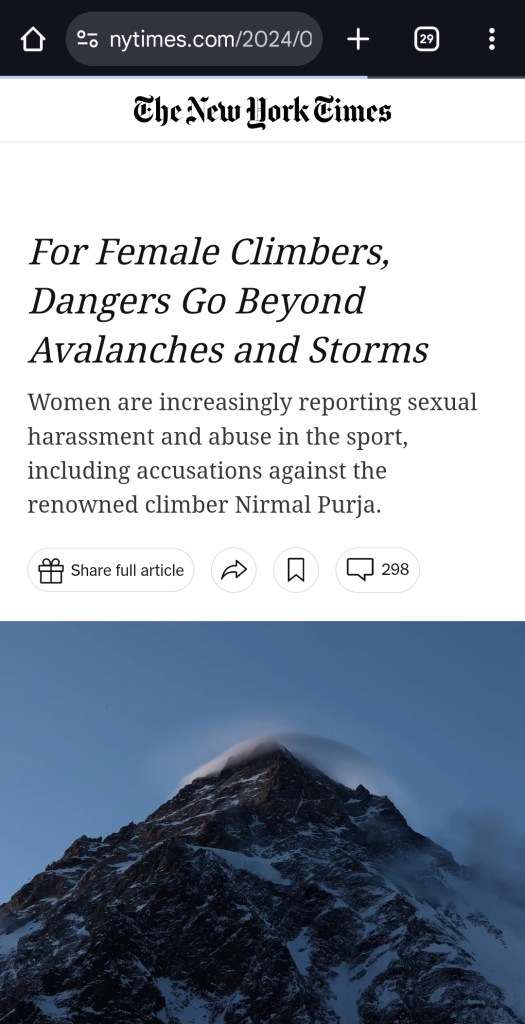
And I ⁓ had stayed off my phone through the majority of the traveling and getting situated, but I did eventually get on my phone. And what was happening in the community was the New York Times article about ⁓ Nims Purja and Charlie Barrett. So there’s a New York Times article. It’s entitled, For Female Climbers, Dangers Go Beyond the Mountainside, is essentially the title. And in it, ⁓ some of what’s cited is organizational efforts to combat sexual harassment, sexual assault. And so the Mountaineers were brought up in that context. And so I was getting tagged a lot and I was like, hey Mel, they’re talking about some stuff we’ve been working on. I don’t work for the Mountaineers, but I have been trying to get them into a spot where they can be a safe place for women through working with women who have had negative experiences in the past. So I was on Instagram for a lot of that and I kind of ran into Bobbi Bensman in the comments section. Like I heard her kind of saying something in the comments section about Charlie and I think I reacted to it or replied to it and she jumped in my DMs and she had some experiences she was going through. She already followed me at the time. I don’t think we’d connected yet. She was being contacted by the current supporters of Charlie Barrett. So for folks who are aware, he went to jail, I think, and he was sentenced to prison in May of 2024. And there was still a large community around him at that point for whatever reason.
And so some of the organizational harassment that is experienced by people who reach, who spoke out, is that they are contacted, like personally, on their cell phones by people who are like, don’t say that about Charlie or that didn’t happen and you don’t know what you’re talking about. Victim blaming, victim shaming, just systemic pressures that you go through when you’re trying to speak out. And you know because you’ve spoken out against injustice and harmful behaviors in the past. So you get pressured.
And Bobbi was going through some things, but so were some of the other victims. And so I kind of was like, hey, I’m busy. But here’s my team. Like, here are some folks at A Higher Calling who have absolutely gotten these text messages. Typically what I see from folks is like threatening text messages or weird screenshots of things. I just recommend, hey, just save it. Save it in case you do need to get some help from someone else about this kind of situation.
He had just been sentenced, I believe, and so there was just some, hick ups. But I remember shortly after the letters of support that were written in the sentencing hearing were released.
And so I became educated from, for folks who are wondering, I was traveling internationally with an anti-violence organization that was primarily made up of Israeli Jews but also incorporates American Jews. And so we were in the West Bank driving in food, ⁓ just occupying certain lands’ fences so that Israelis couldn’t penetrate them.
I took a lot of pictures of Israelis who were coming to the fence line to harass me or harass the people around me. ⁓ Otherwise I was just, I was kind of just staying in solidarity in one spot. ⁓ And it’s interesting because you can’t use roads, you’ve got limited electricity, limited plumbing, but you have the internet. So you’ve got your phone, everyone has their phones out. You know we’re all trying to communicate and keep each other safe. And I’m getting tagged and I’m getting communication about just people who will go to these extents to defend a convicted rapist. And so that really hit me too, that I could not escape. It’s kind of telling you like we are what we’re born with. Like no matter where I am in this world, the climbing community is like right there behind me. Pay attention to me, don’t you feel bad for this white man?! Like no I’m in a freaking war zone.
Not right now guys, I’m busy, I’m busy. will literally, I was like, I have spent so much of my life and my passion trying to make the climbing community a safer place. Like, will you guys just let me handle this for a little while? Like, I’m off doing something that deeply resonates with my racial and ethnic identity. And so after about a week or so, I decided that there was going to have to be some work that was done while I was traveling to try to support and organize folks who were coming forward. Because to be really specific, the letters were published and people, anyone read them, there are no cameras in the federal court systems. We’re dealing, ⁓ folks should be familiar right now with the Diddy trial. There’s no live report. There’s Twitter, you can tweet ⁓ in between breaks I think, but you can’t record in the court at all unless you’re like a reporter.
Which is how Charlie’s case would have gone down. So we, you know, people knew that the way to find out about it was through the published court records that were being put online by the federal government.
And so when those letters hit, people read them and then people confronted the folks who wrote them because the letters were ⁓ not reflective of the values we hold in the climbing community.
Have you read the letters?
Crystal (she/her) (49:29)
I have read part of Thomasina ‘s. I did not read any of the others.
Mel (51:13)
Yeah, Thomasina ‘s in particular, you know, we kind of, before we started the petition and I called for the boycott, well what factors could have changed to make this a softer response besides like, no, none of, we don’t want to include this. I think there were some things where she refers to Charlie as like one of the most kind, genuine, people she knows and trusts. Like he’s a good person was her letter. Her letter also included her child. And her child would have been around the age of a young person who Charlie Barrett had also done bad things with, right? And so her letter was also, he’s really nice to my daughter and my daughter is like around the same age so it’s it’s you know, it was like bro.
Crystal (she/her) (52:09)
I hope there was no unfortunate situations around that, honestly. And I feel like a lot of these people that are out to abuse are really highly manipulative and they’re good at it as well, which makes them even more dangerous, honestly, because then they’re fooling people around them that are close to them. And I think in my article, I did find a quote of someone that was talking about how really, we should be silencing him forever and instead of completely going off on someone like Thomasina, who has been also in a way a victim to his horrible crimes as well, behavior.
Mel (52:53)
Yeah, I took some notes on that I’m pull that up too. So we- in the context of- Oh yeah, from your writing, yeah.
Crystal (she/her) (52:58)
You took notes? Oh my goodness. Wow. Pressure’s on now. Okay. Thank you.
Mel (53:18)
Yeah, no of course. No, have pages of it. No, no, no, I loved your work. But I wanted to follow up too on the context of what we were saying. We were like, if this letter had gone any other way, did it merit the response that it received and the answer is no because it didn’t end there. And so some of the story that you reported on is missing a piece which is that her letter comes out, I think it’s like, I want to say it was like June 2nd when the letters were published, it probably was a little bit earlier.
Crystal (she/her) (53:36)
To be clear it was after the conviction, right?
Mel (53:46)
Absolutely, it was after the sentencing that the letters were published and so folks started responding to Thomasina. And I don’t recall the date I’d have to refer back to because again I was in another country in another time zone, just a world away. ⁓ Her responses to survivors of rape and sexual assault who reached out to her were horrific. Were ⁓ a double and tripling down of you don’t know what you’re talking about, what you went through is not anything what Charlie is going through as he has been unfairly convicted. And I am here to support the people who are truly being harmed here. And so I had to then sift through that communication. And so the people who say like, she’s a victim of Charlie’s are forgetting that she retaliates against survivors of other people.
And because we share some space, because her community and our community are very close together, I work with survivors up there and I have heard some not great experiences that they have dealt with.
And so when we looked at the letter and then we looked at her immediate response to folks reaching out in concern, you also need to take into account that she responded publicly with an Instagram post that folks don’t seem to recall, but she also made an Instagram post after this that basically said like, I am the victim of this terrible harassment that you guys are subjecting me to. I am advocating for people who truly need advocacy and you are harassing me. So when we looked at all three of those things, ⁓ we thought, oh gosh, this requires a response to her being elevated into a movie. Also, and in addition, ⁓ I reached out to her. I’ve talked to folks who were like, why didn’t you just talk to her about this? Like I did, I actually wrote her and said, I am in Palestine and this is interrupting my work, she was, I think she had posted something to the effect of like, I’m so busy. And I was like, me too. Me too, but I’m taking some time out of my work to address the gushings of people who don’t feel safe anymore, because they’ve realized that the people they are looking up to will stand with convicted rapists. And unfortunately, like a lot of us have dealt with sexual violence, so when we hear there’s somebody, in particular a woman, advocating for someone who has been not only proven in court, but someone who we knew was a bad person, it makes the community feel less safe, right? If our leaders aren’t stepping up. And so I push back against that idea that, ⁓ number one, people are not victims of being lied to. It’s not a crime to lie to someone. You cannot be held in court for lying unless there’s some sort of white collar crime attached to it, right? ⁓ think like Enron is like ⁓ when lies become actual criminal events. But actually it’s not, and so I don’t think that people are victims of crime for being lied to, and I don’t think that they actually need to be infantilized, coddled for their bad decisions. ⁓ I have a huge bone to pick, sorry to do it on your podcast, with ⁓ climbers who are advocating for Palestine from the safety of their air-conditioned homes while they excuse violence at the hands of white men.
Crystal (she/her) (57:18)
That’s fine.
Fair enough. Yeah. So I do agree with the whole lying thing. And maybe victim is too strong of a word then, but I would definitely say ⁓ there was some manipulation going on for sure. And the ways in which people do, specifically men, twist around truths and everything like that. And people, you know, ⁓ actually fall for it is really unfortunate, especially when it’s women because I feel like women are a really easy target for people to shift all the blame and completely forget about the men’s actual crimes and abhorrent behavior.
Mel (57:58)
Yep.
Yeah. Yeah, and I’ll agree with you that it doesn’t make sense to punish women for doing these things that ⁓ patriarchy sets us up to do. So my solution in doing all of the work, and this was months, right? We’re talking June, and I start calling for a boycott in December was in trying to bring folks in to have conversations about why that behavior was harmful and how to move forward from it. And I think I talked to three out of the six letter writers. So there were other folks whose letters were published who had conversations about what could be done to mitigate that harm, who apologized, and who admitted faults.
And that was not Thomasina and continued not to be until we’d already created the petition and met with Reel Rock
Crystal (she/her) (59:11)
I see. There was more to the story then. Definitely. Thank you for sharing that. I had no idea that it was to that extent, honestly. And that’s really unfortunate.
Mel (59:24)
I don’t think I gave them the benefit of the doubt, but I thought business-wise it makes a lot of sense to delay the film and then try to… In my mind I was like, they could incorporate this restorative justice practice into talking about a film where two folks ⁓ deal with harm in a relationship, right? And the film had not come out at that point, but I was just hearing that here’s a woman who went through this horrible thing because the father of her child left her.
The movie’s about them getting back together and like learning new things about humanity and the complex emotional whatever blah blah blah blah that Reel Rock told us it was gonna be about they also told me it wasn’t like she wasn’t a major part of the film and which is also not true having watched it but I thought it makes business sense to pause and let this play out so that it can be captured ⁓ particularly when it was packaged right next to the Joe Kinder film where there was discussions of the harm and there was some apologizing and sitting with the emotions that came from that harm, I thought, ⁓ oh they’ll want to capture this and they’ll wait. And ⁓ it just became clear that they weren’t going to. And so the task force kind of organized. ⁓ So first I started to hear from Bobbi that ⁓ Thomasina was going to featured in one of the films. And I thought, gosh, ⁓ oh boy, that’s unfortunate. Yeah, I started to think, well, I haven’t watched a Reel Rock in a while and it’s not really something that defines our community or like has anything to do with us. And so I thought, well, if you guys need me come find me,. And essentially what happened next is that ⁓ Reel Rock and a brand were in talks for a sponsorship and that brand pulled out. That brand told them, hey, we’re not helping support this film featuring someone who vouched for a convicted rapist, so stop. And then that communication kind of just sat there, but I heard about it and I thought, okay, what a great opportunity to call in Reel Rock have some conversations about why this should be handled in a different way, right? And it was really early at that point that I think a lot of the, I have learned so much more about the community in which Charlie Barrett was perpetrating harm. So I’ve met more folks who found out about Reel Rock later or who weren’t as close to, kind of like me, weren’t as invested in what Reel Rock was doing. So they had a lot of time to mitigate that before it really blew up.
I’m so thankful that Bobbi Bensman exists and can speak for that community, has connections to those folks, and is like a total badass who has like, lot of significance in that community.

Crystal (she/her) (1:02:28)
Absolutely. So how did the talks go? Was there any restorative justice that you think was appropriately carried out in general?
Mel (1:02:41)
Well, ⁓ we did some of the first steps, which is to address the harm, to bring, acknowledging the harm, trying to address it. So, ⁓ did it get to where I felt it was addressed? Absolutely not. And I didn’t even feel like the petition did as much work as I had wanted to get my hands on.
That being said, part of our initial conversations was like, well, why don’t you write Thomasina again and see if she wants to work on it? I was like, me! Me specifically. Not me anymore. Not me anymore. I was like, there are great options and resources if you guys are wanting to facilitate conversations. ⁓ There was a lot of ideas back then. Oh does she want to talk to someone specific who experienced violence or she wanted to work with a professional who does restorative justice accountability work? ⁓ But what they asked for was for me to do some of that work. And I was just like, I’m no, no, no, no, I’m here to tell you that like, we’re so far away from being ready to do this work that you guys are trying to elevate someone into a stature of advocacy and activism.
And it’s, I think what I said during the first meeting was just like, this is my world and my work and you guys are stopping me from being effective in casework where I make a difference. Because we can’t get past, we can’t get past, we cannot move forward from the situation. ⁓ Part of what the survivors of some of this stuff are just asking for is an acknowledgement that it should not happen again. That we have to learn and we have to move forward in better knowledge, to your point. ⁓ Women are scapegoated for these things, but women are actually a huge entry point into harmful behavior. So I often am dealing with stereotypes around boys clubs or like the old guard of just being a bunch of dudes that are older and are like, yeah, no, we just, we protect our own, but in actuality a lot of these guys are using women to meet new women. So they’re going from place to place. I experienced this once in my earlier, you know, my origin story includes having someone in my life who came to me who ⁓ was perpetrating violence against women and decided that I was a good friend to meet new victims with.
It happens. It absolutely happens. My response to it has been to dedicate portions of my life to making sure that other women like me are not put in that position. A huge proactive thing we can do is educate centers of influence or women with power so that they don’t become magnets to this kind of thing. Imagine if somebody had educated someone like Thomasina years before about what to look out for or how to better evaluate the men around them so that they didn’t incidentally ⁓ attract someone who was just there for climbing and doing terrible things. But I can talk from experience that I was an outspoken woman’s advocate when it happened to me and so it was very foolish for that person to think that they could get away with it and certainly they didn’t. ⁓ But yeah, we need, instead of coming to victims, which we should still be coming to victims to try to help them move forward, reactively if we can proactively come to vulnerable people and say like, is, these are some of the things to watch out for just so that you’re more aware of what that looks like, what could be happening. Because I also read that Outside article and wondered how someone that volatile and with a federal conviction Charlie Barrett had a federal conviction and seemed to be very mentally unwell. How he was continuing to be regarded in that stature. When I think if I had somebody in my life who had been to federal prison and was starting to struggle with some sort of undiagnosed thing, I would just hope that they got help. I wouldn’t be writing letters saying, let him out of prison.
I thought one of the letters, a couple of the letters touched on the fact that prison is no place for rehabilitation. You don’t go to prison and come out. You don’t go in an abuser and come out not an abuser. You typically get abused in prison and you come out worse. Also and however, the correct place for that person is not the mountains where there is no restriction on their physical capabilities right it’s like well you don’t write don’t tell the and I don’t understand I’ve talked to some of the letter writers about like what did they tell you to write like what what was the context for this letter why would you tell a judge like just let him out and let him out into the mountains the judge is not going to say yes right. The letters did not work he got life, you know
There was a lot going on and I do wish it had happened differently. However, the way kind of things went down, it gives us ⁓ a good place to start on conversations around what to do next, what can be done in the future. Do you want to hear some of my notes?
Crystal (she/her) (1:05:22)
Yes. And can I add one thing before you dive more into the notes too? I do agree with the fact that I feel like women and anyone should be educated on the ways in which people abuse and the warning signs for it as well, because you are indoctrinated into that stuff, most likely. And it takes time and it takes effort and a lot of manipulation to be able to push those boundaries so far that you’re like, how did we get to this physical altercation or abuse ⁓ and that’s also a very big conversation as well. So yes, let’s dive into your notes.

Mel (1:05:51)
Yeah, I love… It’s funny because I go on these podcasts about outdoor recreation and we hardly ever get there because we’re having philosophical conversations about the socioeconomic conditions of the community in which we live in.
So love how you started out with lists of the material conditions faced by women. I think this is ⁓ a key factor that men don’t understand. We can’t really put ourselves into other people’s shoes of material conditions we don’t understand.
Crystal (she/her) (1:09:40)
Are you referring to the history?
Mel (1:09:46)
Yes. So things about, yeah, things about getting jobs or bank accounts.
Even I didn’t understand that growing up. Because I can get a bank account and own a house, right? So I needed to learn more about what it took to get women there.
Crystal (she/her) (1:09:56)
Or even why sometimes women do not leave ⁓ dangerous or abusive situations.
Mel (1:10:03)
Mmm-mm yea. Oh my gosh, I was very much following the Diddy case right now. I don’t know if you heard, but his ex-girlfriend Cassie testified first. She’s very pregnant and so they need her on the stand and then they need to make sure she has time to go have a baby and not worry about this kind of thing. And Diddy came to her in a time in her career where she was about to get everything she ever wanted. And he was offering her all that fame and fortune and status. He was, you know, she signed to his record company for a 10 deal record. Excuse me, record deal. And so she thought, I just have to put up with a little bit here and a little bit there and I’ll have a huge career with 10 records and everything I could ever want. And then she only ever produced one record. He did not let her work. You know, he took everything she ever wanted and just⁓ And so you have to remember, I think that we all have to remember, that’s really at the heart of it. It’s like we’re looking towards people to love us and treat us with respect and help us provide for ourselves and roofs and kids and things. ⁓ Women are in these situations every day.
Yeah, sorry, it got a little heavy there.
Crystal (she/her) (1:11:35)
The whole topic is very heavy. But you know, people come to this, my podcast, hopefully expecting these topics to be clearer to them. And I think that takes some of the heaviness away, because when you have mystery, then you have anxiety because you don’t know what you’re in store for. People know what they’re in store for with this podcast.
Mel (1:11:56)
They sure do. No, and I bring these kinds of things up because I’m interested in truth. I think people question what my motives are and I primarily work in creating space for victims to talk about what happened to them and to speak truth, to speak my own truth and to express myself. And so when I hear brave women talking about what happened to them, I’m always like, yeah, that’s right. You tell them. You don’t stop. Go until you can’t speak anymore. Go, keep going. And they do. Oh my gosh, they do.
Okay, so I loved how you put, think Lena Ray is their name. She’s on Instagram. She did the study of Reel Rock production. And it’s interesting because the task force talked to them about that survey and they disputed the data saying that it is unfortunately, the reality of the situation is that were primarily male for a long time and have just recently become female. The community has become more inclusive, right? There’s more people entering the space that can be included. However, I did not notice when I talked to her, the director data was so defined and exclusionary. Like, where’s all the women and people of color doing the movies then?
Crystal (she/her) (1:13:18)
Very.
It’s very exclusive. And I was talking to someone else that they had a movie out and I was like, are you going to submit this to Reel Rock? I actually went back and looked at her data later because they told me that usually it’s very exclusive. You have to either be sponsored in part. And this is all hearsay, but sponsored in part or like one of them to actually do one of these movies. So then I was like, I think the director data is very important to also put in there as well, because they are capturing the narrative so wholly and completely and we know why. It is their company, it’s fair enough, but ⁓ at the same time, you could always expand it.
Mel (1:14:04)
Yeah, but I don’t see, I don’t see, what’s the, ⁓ what’s the, what’s the magazine company? The National? Blanking on the production company.
Crystal (she/her) (1:14:19)
For climbing?
Mel (1:14:20)
No, no, no, for like movies of all time, like outdoor movies, like nature movies, like National Geographic. You don’t see National Geographic behaving like this. They would never.
Crystal (she/her) (1:14:26)
⁓ National Geographic, okay. Yes. Mmm.
Mel (1:14:33)
They would never. So I thought that was really helpful. wrote that these are stories about; these specific stories that we’re talking about are stories of women ⁓ empowerment or ⁓ black joy in climbing, black freedom, black expression, women celebrating their own family heavily told by white men, right? Heavily influenced by white male producers.
And I think that that shows. I will say that the Kai Lightner film was primarily produced by his mom, Connie. So you get to see, I think, a much better reflection of what that joy looks like. I cried in the movie when he, so Kai finishes the climb and then he calls his mom. Joe Kinder is not there, by the way. I was like, oh my God, he’s not even there. Thank God. Thank God he’s not. I’m just kidding. No, he finishes the call and he calls his mom
And he’s like, I did it. She’s like, no, I knew you could do it. And like, what a wonderful way to experience like, the love of your mom. Like it brought me to tears and it was so cute. And exactly what you need in a climbing movie. Why there was a strange, mulleted man with bright white shiny teeth running around the background, I can’t explain to you.
Crystal (she/her) (1:15:46)
Nice.
Mel (1:16:09)
It was very interesting. I told Crystal previously I watched the films so that I could talk better about kind of this narrative that’s being foretold. We’re consuming something that’s telling us to be inspired and certainly it is. But why does it include these weird stories about these weird dudes that are just misbehaving? I don’t know. I don’t know. It’s like, for me, my own personal experience is like Reel Rock is asking me to consume something I find actually inspiring, but also include a white man, right? I couldn’t just have a story about a nonprofit director who is doing great things in his life without just letting some guy come along and feel redeemed too. I understand that that’s what Kai wanted from his movie so you gotta respect that decision. I just, I disagree with kind of the narrative swings that were done to make what Joe did to multiple climbers in our community seem less serious.
Crystal (she/her) (1:17:18)
Anything specific?
Mel (1:17:20)
Yeah, so I’m looking at my notes. Within the film, I also want to see…because I know you continue to write a little bit about that.
Crystal (she/her) (1:17:33)
Yes, I was very clear that I didn’t think that Kai needed Joe. Like Kai’s work speaks for itself. He didn’t need to put himself back into that like, mentee position. I don’t feel like. Yes, this person probably helped him do the climb. Tons of people help other people do their climbs, but do they necessarily feature them in their films in Reel Rock? Not that I’ve seen.
The only time that I’ve really seen that mentee mentor relationship is Kai and Ashima really when they’ve been in Reel Rock. So maybe in a way it’s a return to glory, but at the same time, move on. You don’t need him. Just my personal opinion.
Mel (1:18:15)
I love that. ⁓
I love that. It is, you know, the movie is about Kai coming back into his own and feeling empowered in climbing. And so I think your point is that, you know, maybe he felt like he needed someone senior to him to guide him through the process. You know, he talks in the movie that he felt encouraged by Joe, and that’s great. Did I need to see Joe look into a camera and express how bad he feels about things he did on Instagram like 10 years ago. I don’t and I think it’s part of a, honestly I think it’s an intentional narrative shift on that part to make it seem like it’s something that is being addressed and it’s being taken very seriously when it’s actually being kind of dissected in a more consumable way to make Joe seem more sympathetic.
I don’t feel bad for him. My understanding of the situation is that he, for many years, as he admits in the, as he describes himself in the movie, like a bad boy. But I think he was kind of well known as just being kind of a dick to certain individuals who happened to be women most of the time. And he found himself using a Finsta, a fake Instagram account, to make fun of people. And he didn’t think that that would have ramifications, but of course it does when you are a paid, you know, you’re like a mini celebrity of a brand, right? You’re a brand ambassador is what we’re called. So I disagree with the framing. So there was the things that were told to me by Reel Rock production, like before the movie. And then there’s the things that I saw in the movie. And there’s just this framing around it being a single climber who reported Joe. That it was one woman and it was one post and it happened one time and that’s just not the reality of the people I’ve spoken to who also spoke out. It’s not the reality of like, articles. If you actually go back and look at the articles that were written at the time you see other names besides just the one and they don’t mention her in the film, you know, at her request, I imagine, and so I won’t. But it wasn’t just one person and it wasn’t one time and it’s not being a bad boy to have this weird creepy Instagram account when you’re…no it’s actually kind of pathetic. I don’t… and I said that very publicly in a comment section. I forget how long ago that was but I was just like I don’t care. I don’t want to include my stories about moving forward from harassment and dealing with like, body shaming or disordered eating for folks who are coming out of that. I don’t have experiences of my own. They don’t need to include the person who brought the shame to the table, right? And I don’t need to see them kind of experience their feelings of regret. I do wanna hear about the restorative processes they went through to come out the other end of it. Like I wanted to know more about like, the way Joe talks about it in the film. He’s like, well, I just drove out into the desert and I just started bolting because I was lonely. And I was like, okay.
Did you have to get a real job after you got let go from your organizational ties? How did you survive? What did that process look like? What did you learn? Where did you go? What did you do? That’s another story separate and away from a coming of age experience for a young climber or a climber who’s doing racial justice work in the community.
But it is something I’d be interested in. It’s not at all in talking to production. Like it’s not at all what they were interested in showcasing. And I would speculate it’s because a lot of it hasn’t happened. So I don’t know if there’s actually been anything like therapy or hard looks at like, what that situation taught us about our community so that maybe it doesn’t happen again. I can tell you that like online bullying and harassment of women continues to happen
Crystal (she/her) (1:22:46)
Yes.
Mel (1:23:13)
And so I would love to see someone like Joe would be a great person to talk about to folks who are perpetrating it. This is why we don’t do that. This is what I learned. yNot, you know, I listened to… Something that happened for me is that I went down the rabbit hole of what had been said about this in a single incident, these incidences in the past, and there was another podcast that Kinder had done where…not necessarily him but the host of the podcast. I don’t want to misspeak and say which podcast. It was just a white male podcast. They need to have tariffs on them. It was a pre-tariff podcast episode where they said that Joe had been canceled unfairly.
Canceled!?
Crystal (she/her) (1:23:34)
With evidence to support that somehow?
Mel (1:23:39)
You can get fired from a job, it’s not the same as being cancelled. And I understand the backlash from the community felt intense.
But then it’s like, okay, did you have to go work a real job? Like, how did you sustain yourself? Or did you just keep climbing because you’re actually still able to continue to climb for money. And it’s just that you’re not a sponsored athlete anymore. That’s what I really, for personal knowledge, because I’ve spent a lot of my time just doing laborious jobs to have money so that I could do the things that I really want to do in my life with my activism.
And so when somebody says like, I didn’t get free shoes from my climbing brand that I worked with because people didn’t like what I put on the internet, I’m like, okay, well, people do not like what I put on the internet either, buddy
I still got a bartend till 2 a.m. regardless of who’s canceling me on the internet.
Crystal (she/her) (1:24:43)
Yeah, like you said, I don’t think there’s a story there. I think even if Reel Rock or any other entity doing videos, films would want to do a story about that. I personally haven’t heard nor seen any restorative justice that would be an interesting story at this point or any story, probably because it hasn’t been done. Unfortunately, that’s an assumption just based off of the material evidence that I have seen and observed online.
Mel (1:25:13)
Also, there were dick jokes in that movie.
Crystal (she/her) (1:25:17)
Fun.
Mel (1:25:19)
There was a banana involved.
Crystal (she/her) (1:25:23)
Oh my, ⁓ I’m good. I’ll be honest, I don’t watch Reel Rock anymore. I was turned off of it years ago and then went I think last year because I got a free ticket, but I just, it’s not my vibe. It’s really not. And I’m hoping a lot of other more inclusive film festivals will actually come about. And when I say inclusive, my first podcast ever, sorry, article ever was also on the call out of another film festival involving women. So when I say inclusive, I mean, has done the work inclusive people of color, LGBTQ, you know, disabled the whole bit. But I digress. It’s not happened yet. And for now, we have venues like Reel Rock to contend with and decide whether or not we want to support.
Mel (1:26:12)
Yeah. Yeah. Do you have time for more of my notes?
Crystal (she/her) (1:26:18)
Yeah, absolutely.
Mel (1:26:19)
Your three pillars: the whiteness the men and the climbing hard and so when we were watching

Crystal (she/her) (1:26:25)
Which was paraphrased from the survey. Yes. Yes, paraphrased from Lena Ray, correct. I cannot take full credit for that.
Mel (1:26:33)
Great great yeah and so I used those pillars to evaluate what I was seeing right it’s like okay well not white oh but man okay but climbs hard it’s like okay I get what I’m seeing here yeah yeah
Crystal (she/her) (1:26:55)
Yeah.
Mel (1:27:03)
And then for the other film, which I feel bad I didn’t actually, I think it’s the middle movie. It’s a movie about climbing a mountain. I think it’s a movie about hard rock climbing, a spire. I didn’t watch it, I feel bad. It was not reported to me for anyone who had harassed anyone or anyone who had ever assaulted anyone or anyone who had gone to court to vouch for anyone who assaulted, harassed someone. So congrats on one out of three unproblematic kings in the film, kings and queens.
Crystal (she/her) (1:27:26)
Excellent.
And just one other note about the whiteness, the male, the climbing hard as well too. And climbing and just as an observation from me as a cisgender woman, I have noticed as well that sometimes black males will definitely dominate a space as well. And I don’t think it’s an intentional thing. I just think that they get this like kind of weird pass sometimes where they’re like, oh, you’re black, but oh, you’re a dude.
Right. And I, there’s, there’s been some, you know, philosophers, ⁓ here and there that throughout history have been like the Negro man first. Right. And in that case, then we’re not truly talking about diversity, equity, and most importantly, inclusion. Right. ⁓ spoiler alert, the next article I’m working on is a continuation of black hair. And I do touch on this a little bit more talking about how if we’re going to lift everyone up, it literally has to be everyone. It cannot be like, well, we have diversity because we have black male, men in here. Like, it’s not enough. It’s way below where the bar actually should be.
Mel (1:28:57)
Absolutely. Yeah, absolutely, and I…
Yeah, I hope that wasn’t the intention of Reel Rock producers, right? To make an inclusive decision based on who they find acceptable. Because I think that argument can also apply to the other film, which featured a mixed race person, a woman who had an Indigenous parent. Who made excuses for a white man, right? It’s like, what? Can I get a movie that reflects someone who just is out living their truest life with genuine people around them and isn’t making excuses for white supremacy in their own life?
Reel Rock says no. Reel Rock actually insists that I include them in all of my inspiring movies. I did want to disclose too A Higher Calling has been a wonderful and happy recipient of Climbing for Change, Kai Lightner’s nonprofit. Their funding. And I don’t take money from hardly anyone, so I felt very happy and very comfortable in working with them. But it did create a conflict in me to continue working with an organization that doesn’t necessarily see that situation the same way that I do. I think we can respectfully have differences. This is a larger discussion within like leftists and liberal spaces around like, do we have to agree on everything? And of course the answer is no.
I think what Climbing for Change is doing is so unique and it’s so breathed by the fact that Kai doesn’t fit the stereotype of what, know, goodness, I can’t even think of anything similar to what he’s been doing out there. And to what you said, I am curious, there’s some figures writing about that. There’s a podcast, it’s called HBC, it’s Harvey, I forget his: I’ll send it to you, but he did a think piece on how it’s possible that all the gender division right now is orchestrated to get to black men. So a lot of this men versus women discourse that’s so hardcore in politics, anything online, in anything that men are enjoying right now, there has to be an anti-women aspect to it. And it is so you can continue to alienate men of color from women of color and he pointed to Megan Thee Stallion and said, look at that. He said, look at all this anti-female indoctrination of a victim of a crime and look at the black men who are not supporting her utilizing things that white people are doing, right? They don’t have to look very far to figure out how to do it because white men have been doing it for a long time. So I thought it was a very interesting argument and I know he’s got a lot more work out there that we can listen to.
Crystal (she/her) (1:31:36)
Interesting. Yeah. Yeah. Yeah.
Mel (1:32:02)
I thought, huh, if it’s become so hard to alienate black people from white people, like if we are creating the structures and coalitions that we claim to be creating, and they’re not effective in getting through anymore, maybe the situation is to alienate men from women, right?
Crystal (she/her) (1:32:24)
Yep. Division by any means, I suppose. And that’s really unfortunate. And, know, the fact that I have talked about Kai Lightner on this particular podcast, I do also want to full disclose that I have actually taken personal scholarships from scholarship, one, from Climbing for Change for my AMGA certifications. And I want to thank them for that. Absolutely.
But when it comes to things that affect my demographic specifically as a woman, I think it’s kind of non-negotiable for me to speak out about, regardless of me feeling indebted to this organization that does a lot of good work in the community. No one’s perfect. We’ve seen organizations have complete collapse because they’re unperfect or just conflict and everything and the real work begins in how we manage and mitigate that and do as you call it restorative justice afterwards. So I am curious to see how they go forward and I am hoping that there will be change for the better within that realm.
Mel (1:33:40)
Yeah, do you have feelings of belonging and wanting to defend someone who is in these situations?
Crystal (she/her) (1:33:50)
In this particular case like climbing for change?
Mel (1:33:53)
Since we both have personal relationships, I think it’s a little different than any other circumstance. And believe you me, if I didn’t like climbing for change, this wouldn’t have been a discussion for me. I just would have been like, okay, we’re out. We don’t need them. We’ll find our money from, we’ll do a Reel Rock showing. That’s how we’ll get our nonprofit dollars for the year. Just kidding. No, in other circumstances do you look at these situations and ever think like, because I do sometimes I look at situations involving women and I second guess whether I should be as strong and withstanding in my moral care.
Crystal (she/her) (1:34:36)
That’s a really good question. I think personally that it’s hard to be strong and particularly it’s hard to be a strong woman. But at the same time, a little bit about me, my upbringing, I was in the foster care system. So I think it’s interesting too when you talk about, and I aged out of the foster care system, like I was never adopted. And so to speak to your point where you’re talking about when you’re born kind of a certain way and you kind of have this designated path. The reason I like to think that people are inherently good is because I have to because I have seen the abuse and the humiliation and harassment and straight up just nastiness that humanity can actually dish out to me and to other people that I have known and grown up with. And to those, may they rest in peace who never made it through the system because we become literal victims in death from that system as well. And so I have to believe utterly and truly that my strength is because not just because of my gender or not just because of my experiences, but that there is change and there is inherent good because if there wasn’t, it would literally drive me insane. And I would not come back from the brink of that. With that being said, though.
With certain situations, I definitely have been a lot more guarded. And I think that we can still be guarded, but yet open to experiences if we have a certain amount of knowledge and understanding of situations like how abuse is perpetrated, how it begins, what are the red flags? Like, what is this path that we’re going down? And if you’re able to recognize those things, then we can protect ourselves way more than if we just had a friend that’s like, hey, that looks kind of sus, maybe you shouldn’t, you know, because then it’s you taking your own personal power into your hands to be able to be like, stop, this is enough. Did that answer your question?
Mel (1:36:46)
Thank you for being so real with me. I love it. Yeah, think, you know, when you asked me that question earlier, I was like, she wants to get into it.
Crystal (she/her) (1:36:53)
I’m a deep thinker. I like to think about these things. I think it’s interesting. And hopefully the viewers and people that watch this will find it also interesting.
Mel (1:37:07)
Yeah, the stories we tell ourselves are integral to how we continue moving forward. And I also tell myself, like, things will get better. Just have a little faith.

Crystal (she/her) (1:37:19)
It’s hard to right now, but maybe we’ll get through it. Maybe we will get through it.
Mel (1:37:23)
I tend to be and I actually had a bias when I first started out, way, way back when, I tended to give women more of the benefit of the doubt when it came to situations involving abuse. I tended to fall into those patriarchal ideas around women. They just didn’t mean it, they didn’t know better, they are a victim of patriarchy. And it didn’t last very long because I was victimized by women.
I went through some really hard, I learned some really hard lessons early on in my activism where I realized I couldn’t actually trust some of the women around me to not take my work and give it to the men who were perpetrating violence or just horrible situations where people sent my address, women would send my address to abusers who were trying to find me to harass me. Like the craziest stuff and you just realized like it…
The intersection only lasts as long as the white supremacy you just get to the point where it’s like, they just wanted to improve their own material conditions by appeasing someone who was gonna hurt me.
Crystal (she/her) (1:38:37)
Yeah.
Yes, and I feel like that’s so true in POC community as well. I still interact with particular parties of the community that I helped build as well in the Seattle area POC wise, people of color wise. But it was a rude awakening for myself as well when I got caught in that same situation where I was like, people of color give them more the benefit of the doubt. And you really just have to look at people’s attitudes, their behaviors and their language. And now I’m coming back to where I am slowly trying to trust myself and like, trust my gut and just not question it. And hopefully that will carry me through further in the future.
Mel (1:39:25)
I think what you learned through the whole villain saga of your own.
Crystal (she/her) (1:39:29)
Yes, exactly.
Mel (1:39:31)
The death of your villain, or the life of your villain. Wait, I don’t know. I forget what the metaphor is supposed to be. I’m sorry, guys.
Crystal (she/her) (1:39:39)
Well, I became a villain in that I was standing up for myself and really not taking some of the situations that were put upon me.
Mel (1:39:48)
No, I lied. I think the climb is called Death of Villains that Kai was doing. Did you catch that?
Crystal (she/her) (1:39:59)
Yes. Yeah, that’s yeah, that’s definitely. Yeah. That’s the name of the climb. Yes. Interesting.
Mel (1:40:05)
Did you catch that? I thought it was very interesting. I thought was very interesting that, you know, Joe was kind of self-reflecting about his life and saying, life of victims, death of victim, or villains, excuse me, villains and victims. That’s a funny word to get mixed up. But yeah, he was naming the crag reflectively. And in climbing it, there was more villainous talk than we could stomach. And so was, I appreciated all of your experiences in what you went through in your last organization because they are…they will teach you to be better in your work in a way other people, other activists, won’t be as effective as you are because you understand the reality of the situation and what’s at stake and what it takes to actually make the work happen. I tend to look at my own mistakes early on as indicators that I can just continue to do the work no matter the setback because I have been through some really…there’s a lot of there’s a lot of ex friends out there a lot of ex besties and I I’ve had to come to terms with personal losses, but also the gains in my own knowledge. And I was gonna get into this earlier and I hesitated a half step because it’s loaded for me. When I talk to women of color in the outdoor professional industry, they tell me typically the perpetrators of the harassment they are facing are other people of color
Crystal (she/her) (1:41:35)
That is really unfortunate.
Mel (1:41:40)
I’m coming to them, I’m like, who do you got? I know how to bust them, let’s go, it’s the patriarchy, I’ve got them. And then they’re like, actually, here’s the very complex situation. It’s somebody very close to me, very similar to me. And I go, okay, well. Oh no, you know, Oh no. I don’t mean to laugh, but it’s one of those situations where you’re like, okay.
When will it end?
Crystal (she/her) (1:42:07)
Yeah, that is so unfortunate. I mean, the situations that people get caught in are so complex and so loaded, as you said, that it’s just, it’s really hard to comb through these things. But organizations like yours and other ones, like, you’ve been through this kind of stuff and you’re able to really turn back around and help those people or assist them in their journeys. And so if anyone does ever need to speak to someone like you, please reach out, y’all. Reach out and talk to people about this stuff and really try to process it and start your healing journey because sometimes that’s the only thing we can do is start talking about it and seeing how we can start to process it.
Mel (1:42:17)
You know, the change starts with us. And you and I talked in our, we had a conversation and I used the phrase, we keep us safe, which I am borrowing from a friend and I think she may have gotten it from some literature, but it is in application, like the truth of how we keep each other safe.
So, we keep us safe is a truth that I put into action by making sure that the people around me are safe. And that doesn’t necessarily guarantee my safety from some things, but in a lot of ways actually does keep me safe from being harmed by people who have bad intentions because they can’t get to me because I’m too busy with people who love me, who respect me, and who are there for my needs. And so if that’s not, know, if somebody’s listening at home and they’re not in that situation, particularly in the climbing community, we should be working to get them there, right? You should have partners that keep you safe, who challenge you to be good climbers and good people. You should have accessible areas to climb in. You should have the gear you need. And you should be safe when you walk out into the crag and there are strangers to meet, right? We should be able to commingle and be safe and respectful. So thank you for having me on to talk about such a deep and complicated structure, power structure to dissect.
Crystal (she/her) (1:44:20)
Thank you for lending your expertise to it. It’s, like you said, so complex and someone like you that’s been just really steeped in this kind of work, it’s very valuable to speak to you and to have other people have access to you, even though it’s unpaid, to be able to kind of hear these things because it’s shocking, but we need to be able to protect ourselves and half of the battle is knowledge, knowing that knowledge. So thank you so much for coming on and talking to us about this. Do you wanna do any plugs or shout outs? Like where can we find you on Instagram or et cetera?
Mel (1:45:01)
So, to go back to something you said earlier, I am compensated in the continuation of my work through the Victim Assistance Fund. So givebutter.com slash vaf Victim Assistance Fund Party. I’m relaunching it in 2025. It’s a restorative justice fund that helps victims by gifting them financial resources for things like mental health, legal help, and community support.
I occasionally will use it to make sure that my time is compensated. The last time we launched it, it was for the Taylor Swift tickets back in 2023, and we had that auction, and we raised $5,000, so we are in the process of gifting scholarships out to survivors who need those funds. So please head there if you want to make a donation. Otherwise, just come hang out. I am on Instagram, Instagram.com slash The Dirtbagette, and then you can find a higher calling at ahighercalling.com and Facebook. If you need to get a hold of me, the best way is through Instagram DMs. There is still ⁓ some talk of me getting off of the internet and having some time away. So I’m also available at ahighercalling@outlook.com this summer, if you guys can’t find me on the gram.
Crystal (she/her) (1:46:24)
Thank you, Mel, for all the work that you do in the community.
Works Cited
The Reel Deal: Women, Policy, and Autonomy
Body of missing hiker recovered in North Cascades more than a year later
Hidden Figures: The Villain Arc
For Female Climbers, Dangers Go Beyond Avalanches and Storms
 Rock Rose Blog, LLC