This article available as a podcast here
I of VI
My mind is a weapon
And my body is a battlefield
And I know my soul’s intentions
To know what is, to know what’s real
I don’t need armor, I’m more than brave
Gotta go harder, I will not be a slave
Armor by Iniko1
Black hair has always been a big topic: one that I have talked about before in my Black Hair and Climbing 8 part article series2. I would suggest reading that to first gain a deeper understanding of this topic before venturing into this article.
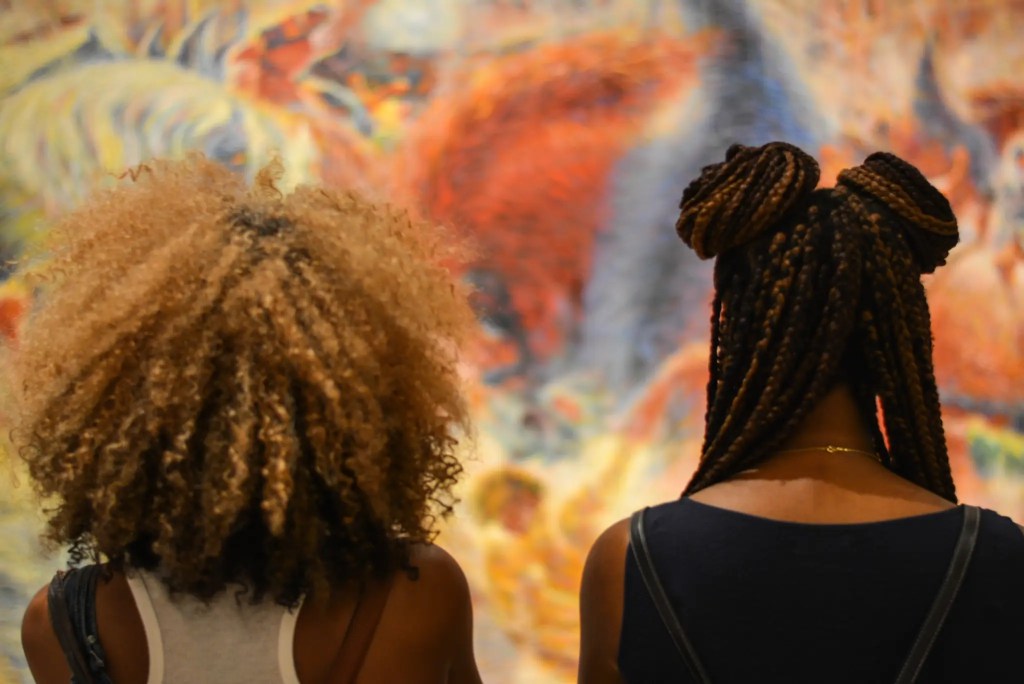
This will be a continuation of the Black hair pieces with a focus on hair policy aimed at afro hair, policy/FDA regulations on hair products, and beauty standards or possible ease of care for sports (such as climbing) driving us to chemical products (specifically straighteners), and finally hair product lawsuits. Also the known danger of using specific ingredients in hair care products aimed at Black people.
To offer more insight into a journey with hair and subsequent straighteners, I am offering up a personal story of my own. I have dabbled in hair straighteners and such. For those of you who may not be familiar; a chemical straightener is a way to straighten hair and has been most widely used by people with afro hair. Some have even seen it as a right of passage for Black women applying chemical straighteners as early as 8 years old. You will also see the terms straighteners and relaxers: I prefer the term straightener because relaxer to me implies a negative connotation with natural hair.
Growing up, we were very poor. There was no way we could even afford a hair treatment regularly for my hair as it is not a permanent treatment. Also, my white mother had very natural outlooks on products so she never even introduced the idea to me as she was against chemicals in general. But my hair was always a pain point. No one in my family knew how to brush it so getting ready during the day turned into a crying fest for me from the pain of brushing (never never never start the brush from the scalp and attempt to pull it all the way through with afro hair by the way). Most of the time I kept it in a short afro so I would not have to go through anyone attempting to “brush” it and get it pulled into a tight pony tail.
Once I got a little older, I really wanted to grow my hair out again. My mother didn’t always have time to do my hair before we left the trailer house and one particular day I was being critical of her brushing techniques. She was tired of my crying and I wanted her to continue because I wanted to look “pretty” and feel tidy. I was willing to sit and cry through it. But the crying was too much and we were both at our wits end: I was too little to do my own hair and she had no idea how to do my hair. She gave me an ultimatum: either we stop by the barber and cut it off or I place a scarf over it. Of course, this ultimatum produced more tears from me. On one hand I HATED going to get my hair cut (hence me trying to grow it out and avoid that altogether). The last time I went I had asked them for my teeny weeny afro and they buzzed my hair so short it had no curl left. Everyone kept mistaking me for a gender I didn’t identify with (a boy) that year of third grade, which I also didn’t care for. No one where I grew up the first twelve years of my life knew how to cut or care for my hair.
As I was grappling with my ultimatum my mom had given me I definitely did not want to go get it cut. On the other hand, I was mortified at the idea of wearing a scarf on my head. No one I knew wore any sort of scarf on their head: it was either baseball, cowboy hats, or beanies for the local people. I didn’t want to stand out even more than I already did as being a light skin Black presenting person in an almost all white community. My mother, having lived in a diverse area of California in the past, tried to assure me that Black people do wear scarves on their head to cover their hair but I would hear none of it.
After a lot of crying, I accepted the scarf. And I pouted the rest of the day. This started my adoration for scarves on my head though. I collected all of my mother’s scarves I thought were pretty and hoarded them. I wore them a lot to cover my hair while it grew out so no one could see the undesired “frizziness” of it. I started to cherish covering my hair completely.
Had I known there was an alternative that may change my hair texture into straight and more white presenting; I may well have jumped at the chance. My little brain knew I was different; my mother never shied away from telling me I was Black and she encouraged me to be proud. But she was also very candid about the fact I would have a difficult time in life in many ways due to that and also being a woman. She never encouraged me to try to pass or change myself, but she just couldn’t help me with my hair at all. And she definitely never even suggested I try to get it straightened.
But when I was ultimately placed in a foster home years later as a young teenager: I was introduced to straighteners. The couple I was placed with were also in a very small, all white mountain town. Everyone knew everyone and therefore all knew that I was a foster kid who was there possibly temporarily. And my hair was seen as something to be tamed.
I think my white foster parents always looked at me like a project: something to improve off their good graces. We will call the foster mother “Rachel.” Rachel always wanted me to “lose weight” and “be ladylike”. She was also a very particular woman who always had her nails and hair done so I am sure it was not a huge stretch for her to find out about hair straighteners.
One day Rachel took me to get a hair cut. I seldom asked a lot of questions back then as I was painfully shy and rarely spoke in general. But when she said we were going to get a “hair cut”, I assumed it would be another painful session of me trying to describe what I wanted and being disappointed, as always. This time was different from any other time I had been to a hair appointment. Without even asking me what I wanted, she had apparently already spoken to the person about relaxing my hair. So the first time I ever used a conventional straightener, it was not my choice. I actually didn’t want it: all I knew is that they were full of toxic chemicals. But at this point in my life I had no choice; no bodily autonomy being a foster kid, not even with my hair. In the slim hope of pleasing, you do as you are told in hopes they will “keep” you. Even though I really never even liked her that much, I needed to be somewhere so it was important to keep the peace.
I got the straightener. And it was painful. If you have never had a one; just know that it is all pain. The only way I can describe it is if someone walked up to you and lit your hair on fire and it burned evenly over your entire scalp. I didn’t enjoy it. And after my hair was straightened, there was Rachel telling me how much prettier I looked now that my hair was straighter and “tamed.” It almost made it worth it for how she smiled at me.
This was her version of care for me: straightening my hair to be presentable. I know now this was her doing her best the only way she knew how: through the lens of whiteness.
Continued in Part II
Works Cited
- “Iniko – Armor (Official Visualizer).” Youtube, uploaded by Iniko, 23 Jan 2024,
https://www.youtube.com/watch?v=6omDdpsZWls&pp=0gcJCdgAo7VqN5tD - Hudelson, Crystal. “Black Hair and Climbing.” https://rockrose.blog/2023/01/02/black-hair-and-climbing/, 01 MAY 2025.
 Rock Rose Blog, LLC