IV of VI
The FDA was mostly focused on drugs and food, however, their power also extends to cosmetics. In line with some criticisms of the FDA, some of their guidelines could also be called into question. One example would be the consumption and use of propylene glycol.
In my natural hair care journey, I was always looking for the best products for my hair. Ones that would bring life to my curls and last throughout the day. Something to minimize frizz and keep definition. And this desire changed over time. I remember my first big chop after having decided to go natural. My hair was damaged and the curl pattern was erratic after I stopped using harsh ways to straighten it. And I transitioned from calling my hair’s pronoun from “it” to “she”. She was damaged and broken. I had done my best to take care of her and I was failing: my hair was thin on top and it looked a mess most of the time. Much like my foster parent who had done her best to take care of me the only way she knew how, I had followed in those colonial footsteps and ended up almost losing my hair completely.
When I went for this big chop (a drastic cut to get the damaged hair off and let the natural curl grow back in), I didn’t know what to expect. The salon specialist talked me through the cut, what to expect as I transitioned to going natural, and what products to use to help in reviving her. She gave me an asymmetrical cut and sent me on my way with some new products.

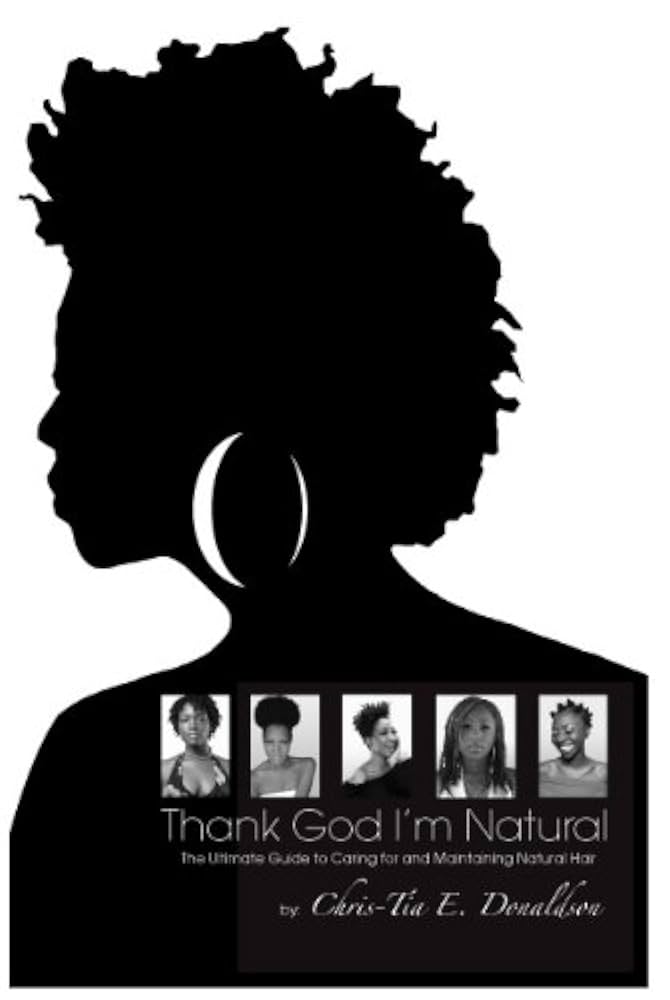
And the products worked: my hair would seemingly retain moisture and slowly she started thriving in a way she never had before. My thinning spots started to disappear. I also began more of a deep dive into hair care and products. And I found the book Thank God I’m Natural22 or affectionately known as TGIN.
This book was a game changer for me: the guidance I had been looking for. The author, Chris-Tia, talked about her hair journey and how it felt to look in the mirror at natural hair and not be used to it or even feel beautiful. She gave me the courage to keep going. And I was especially taken in by the hair care recipes in the back.
I had always felt at odds with the Black hair care industry. The majority attitude always seemed to be kempt hair by any means necessary including harsh chemicals. And having been born to a semi hippy mother who was against chemicals in general, I reluctantly agreed to the chemicals because I felt I had little choice. But the TGIN book gave me an entirely new outlook: recipes for my own hair care products without chemicals. And without propylene glycol, which happened to be the number one ingredient in my newly natural hair care product routine.
It was here I was first introduced to the idea of propylene glycol being suspect. It is everywhere in the United States: hair care products and food. It is not naturally occurring in food and has the characteristic of retaining moisture extremely well. And when I say it is in a ton of conventional, processed foods: it’s in a lot. Next time you go grocery shopping, take a peek at the ingredient list from major manufacturers of food. “The World Health Organization recommends a maximum intake of 11.4 mg of propylene glycol per pound of body weight (25 mg/kg) per day. The estimated exposure to propylene glycol through foods in the US is 14-34 mg/kg per day.”23 Although there are guidelines about this and rare examples of possible propylene glycol poisoning, we truly do not know the effects of eating this and then using it in our hair for long periods of time (like 35 years or so of doing our hair everyday starting at a young age and maybe adding heat?). I would argue that there is a lack of evidence and scientific data to support any sort of conclusion as to whether or not it is harmful, however, there needs to be more research done because most likely the number one demographic using this chemical with more exposure than anyone is people with curly, coily, or kinky hair that does not readily hold on to moisture aka Black people’s hair. Or even how it interacts with our bodies in conjunction with chemicals such as formaldehyde. We have yet to know the effects of propylene glycol, especially for people seeking to add moisture to their hair.
The type of systematic poisoning which has been taking place for decades is Black people using formaldehyde in routine hair maintenance to attempt to achieve respect in society via straight hair. Unlike propylene glycol, we know the toxic effects of formaldehyde. “A 2018 study found that hair products used primarily by Black women and children contained a host of hazardous ingredients. Investigators tested 18 products, from hot-oil treatments to anti-frizz polishes, conditioners, and straighteners. In each of the products they found at least four and as many as 30 endocrine-disrupting chemicals. Racist beauty standards have long compelled girls and women with kinky hair to straighten it. Between 84% and 95% of Black women in the U.S. have reported using straighteners, studies show. Black women’s often frequent and lifelong application of chemical straighteners to their hair and scalp might explain why hormone-related cancers kill more Black women than white women per capita…”24

This is serious. And we are not just talking about workers anymore. We are talking about people who use chemical straighteners regularly with a concentration of the demographic being Black women. The knowledge of health risks due to formaldehyde reached as far back as 2010, but mostly in light of workers exposed to it day in and day out. Under the workers’ guidance, California in particular has banned its use as well as a few other carcinogenic chemicals in beauty products.25 And many are still asking the FDA to follow suit.
“Such a ban [nation wide] would be a crucial public health step but doesn’t go nearly far enough, scientists who study the issue said. The elevated risk of breast, ovarian, and uterine cancers that epidemiological studies have recently associated with hair straighteners is likely due to ingredients other than formaldehyde, they said. Formaldehyde has been linked to an increased risk of upper respiratory tract cancer and myeloid leukemia.”26 And the word has not gotten out completely for consumers to be aware of what they are applying to their locs. The FDA advises: “…consumers should ask their hair stylists about ingredients and can look for these words on labels: Formaldehyde, Formalin, Methylene glycol.”27 It is not enough: we know the effects of at least formaldehyde. There needs to be a ban on its use as a start.
Although there have been petitions to the FDA from salon workers28 and lawmakers29 a-like, there has been no headway. “2016 scientists at the FDA determined formaldehyde in hair straighteners unsafe, and the agency started to take steps to ban the chemical. But for reasons that remain unclear, the FDA never followed through with a ban.”30 The ban has been delayed31, paused32, and now in limbo under the 2025 administration.33
I would have a few guesses as to why; but let’s just say if we have learned anything from Madam CJ Walker it’s that the hair straightening industry is big money. Even to this day. New products with benign ingredients take time and money to develop. It’s cheaper to keep churning out the same chemicals. What do the for profit companies care if you suffer from cancer, etc? As long as they get their money.
We have the government holding information from studies done around underrepresented demographics (Black people) and their health in relation to products used; yet will not take definitive action. If they are not taking action what can we do? Well, we sue.
Continued in Part V
Works Cited
22. Thank God I’m Natural. “Our Story.” https://tginatural.com/pages/about?srsltid=AfmBOor9MGJPkHSwWHB4eUNTBFzBK4IOZUehXCo1FKEm0bjWHsoPX0jh, 16 May 2025
23. Healthline. “Propylene Glycol in Food: Is This Additive Safe?”https://www.healthline.com/nutrition/propylene-glycol#TOC_TITLE_HDR_4, 16 May 2025
24. Cohen, Ronnie. “FDA move to ban formaldehyde in hair straighteners called too little, too late.”https://www.npr.org/sections/health-shots/2024/02/06/1229421257/formaldehyde-hair-straighteners-curl-relaxers-cancer-risk-fda, 20 May 2025
25. McConnell, Jamie. “California Bans Formaldehyde from Cosmetics.”https://womensvoices.org/2020/10/08/california-bans-formaldehyde-from-cosmetics-23-other-toxic-chemicals/, 20 May 2025
26. Cohen, Ronnie. “FDA move to ban formaldehyde in hair straighteners called too little, too late.”https://www.npr.org/sections/health-shots/2024/02/06/1229421257/formaldehyde-hair-straighteners-curl-relaxers-cancer-risk-fda, 20 May 2025
27. Cohen, Ronnie. “FDA move to ban formaldehyde in hair straighteners called too little, too late.”https://www.npr.org/sections/health-shots/2024/02/06/1229421257/formaldehyde-hair-straighteners-curl-relaxers-cancer-risk-fda, 20 May 2025
28. McConnell, Jamie. “Salon Workers Petition FDA to Ban Formaldehyde in Hair Straighteners.”https://womensvoices.org/2021/06/15/fda-must-act-to-protect-salon-workers-from-formaldehyde/#:~:text=Formaldehyde%20is%20a%20known%20carcinogen%20and%20is,chronic%20sinus%20and%20lung%20infections%2C%20and%20more, 20 May 2025
29. Congresswoman Shontell Brown Press Release. “Brown, Velázquez, and Pressley Call on Trump Admin to Finalize Formaldehyde Ban in Hair Products.”https://shontelbrown.house.gov/media/press-releases/brown-velazquez-and-pressley-call-trump-admin-finalize-formaldehyde-ban-hair, 20 May 2025
30. McConnell, Jamie. “Salon Workers Petition FDA to Ban Formaldehyde in Hair Straighteners.”https://womensvoices.org/2021/06/15/fda-must-act-to-protect-salon-workers-from-formaldehyde/#:~:text=Formaldehyde%20is%20a%20known%20carcinogen%20and%20is,chronic%20sinus%20and%20lung%20infections%2C%20and%20more, 20 May 2025
31. Amarelo, Monica. “Delayed FDA ban on formaldehyde in hair straighteners imperils salon workers, consumers.”https://www.ewg.org/news-insights/news-release/2024/12/delayed-fda-ban-formaldehyde-hair-straighteners-imperils-salon, 16 May 2025
32. Garcia, Michelle and Lovelace, Berkeley Jr. “Federal regulations paused, halting FDA’s proposed ban on formaldehyde in hair products.”https://www.nbcnews.com/news/nbcblk/fda-formaldehyde-ban-limbo-trump-executive-order-rcna187961, 16 May 2025
33. Howard, Jacqueline. “FDA’s plan to propose ban on formaldehyde in hair-straightening products remains in limbo under Trump administration.”https://www.cnn.com/2025/02/11/health/fdas-formaldehyde-hair-products-trump-administration 20 May 2025
 Rock Rose Blog, LLC