
This article available as a podcast here
VI of VI
How does all of this affect us in climbing? I do recall one Black woman influencer admitting once that she preferred her hair chemically straightened. It was just her preference. Fair enough; but I would also like to add that the climbing industry itself also pushes Black people to assimilate with our hair whether we acknowledge it or not. We are encouraged, even rewarded, for having straight and/or low profile hair.

Let’s think back to my previous blog on Black hair I wrote back in 2023. I did talk about the need for high volume swim caps that were banned from the Olympics because they “…did not fit ‘the natural form of the head’ and to their “…best knowledge the athletes competing at the international events never used, neither require … caps of such size and configuration.”45 In the context of swimming, having a higher volume swim cap is a hydrodynamic disadvantage but something Black athletes had deemed necessary for their hair. Of course, if Black athletes still win with this minor disadvantage it will enforce what deniers of our requests for comfort and function have feared all along: that we are excellent despite. In this particular case, however, it has nothing to do with safety in the sport. Unlike climbing.
Beyond white approved presentability; conforming our hair to straight and/or low volume actually has the unintended effect of keeping us safer. BUT negatively. More specifically the incident described to me by Jaylynn Ayanna in Black Hair and Climbing: Part VI. The story they recounted about not being able to fit climbing helmets in an REI store is one I have heard many times. I myself have multiple helmets for my outdoor activities because my hair does change sizes, as many people with afro hair does or even people who wear hijabs or the like. The temptation to straighten hair to make it smaller is very great because if a helmet fits right, then we are safer.
Over the years I have had a wide range of hairstyles: everything from shoulder length natural hair, butterfly locs, box braids, two strand twists, to bubble braids just in the last 4 years or so. With and without added hair. And I have found that having added synthetic hair is something fun that I like to play around with. However, every time I go to pick a style I think to myself “Will it fit under my helmet?” Added synthetic hair means more volume and sometimes will not fit under a climbing helmet. This is a safety issue. If a helmet does not fit correctly, then it will not fulfill its function of protecting the head: the entire point of its existence.

I have seen many instances of ill fitting helmets: in Reel Rock films with Black climbers and in my own affinity group courses taught by the guide staff. We all know how a helmet should fit; but for some reason professionals keep letting it slip. And it has been consistently Black people with ill fitting helmets. The incident with Marian (May) Perez and their climbing helmet is an example of what can happen.
If you are not familiar: May Perez is a guide who is also the CEO and co-founder of Rise Outside Collective. Rise Outside Collective is an organization “dedicated to diversifying the outdoors.”46 May has spent a lot of time in the outdoor industry and in climbing. One day they had a climbing incident that involved a tumble. For this incident, their helmet did fit them in a way that made it function properly. However, they point out that where they did hit their head would not have been protected in the past when their hair was longer due to where the helmet sat because of the greater volume of hair.47 And this is the sad reality of anyone not fitting into that box of what a climbing helmet currently offers.
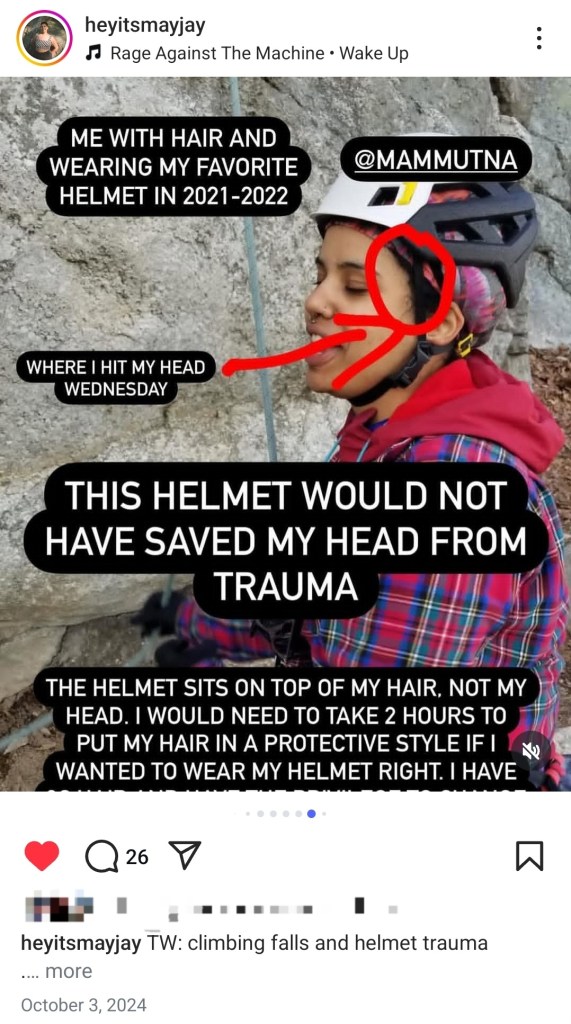
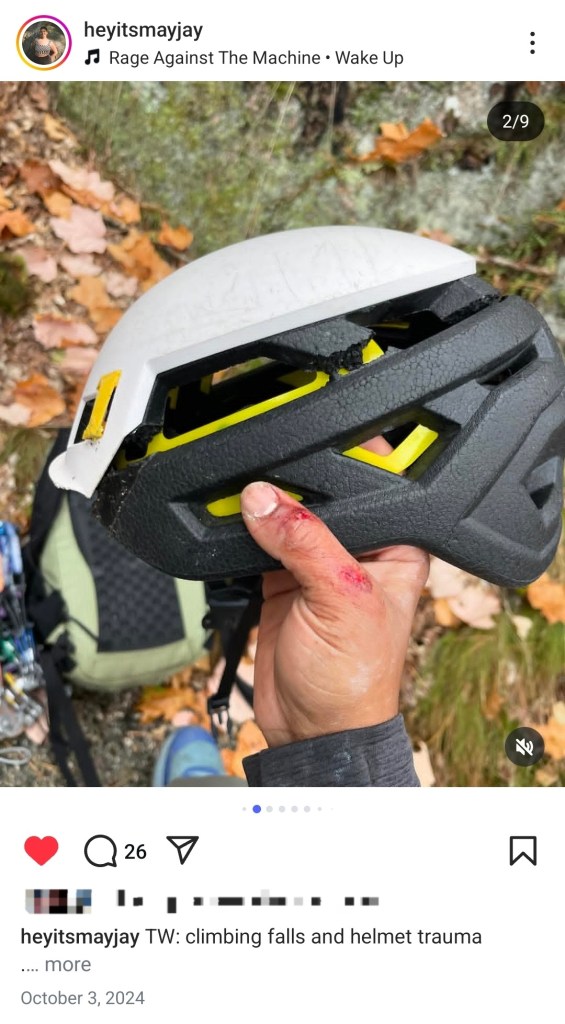
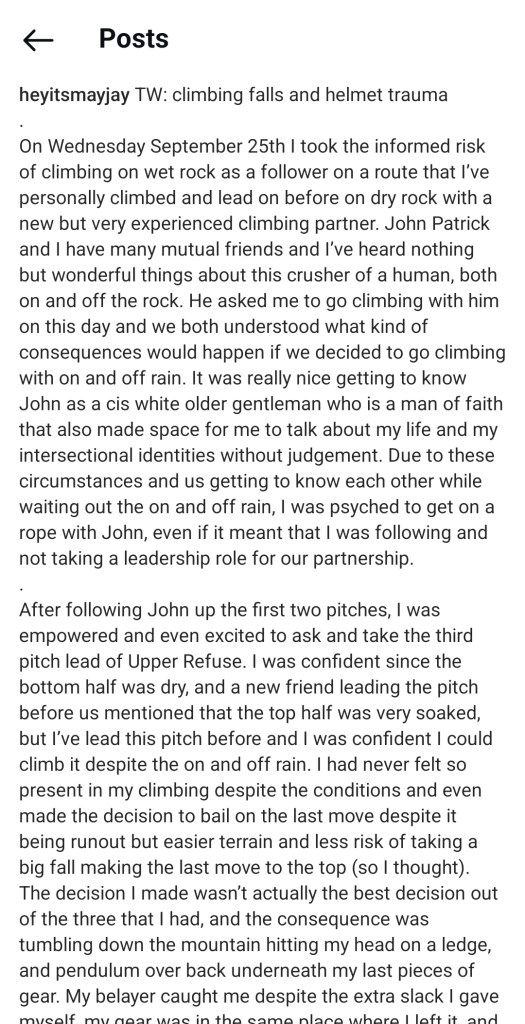
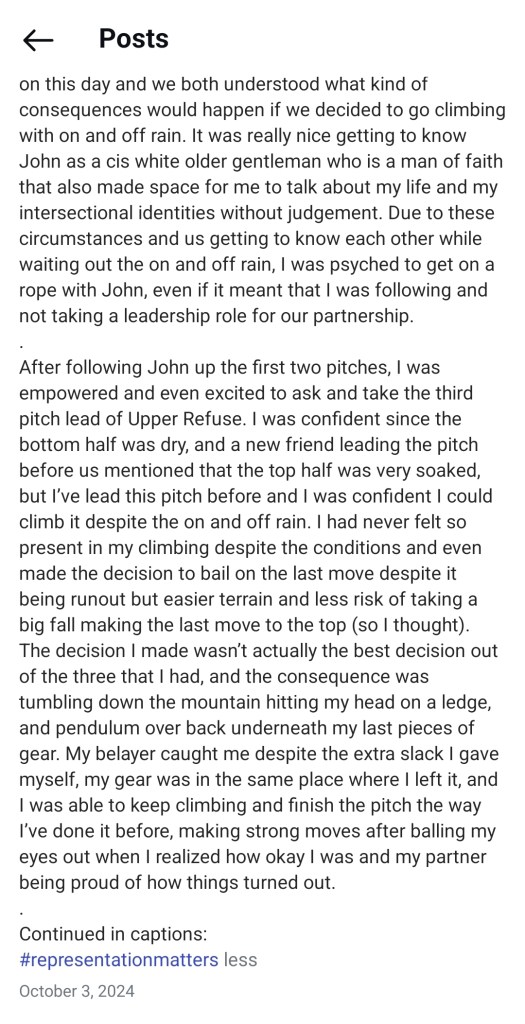
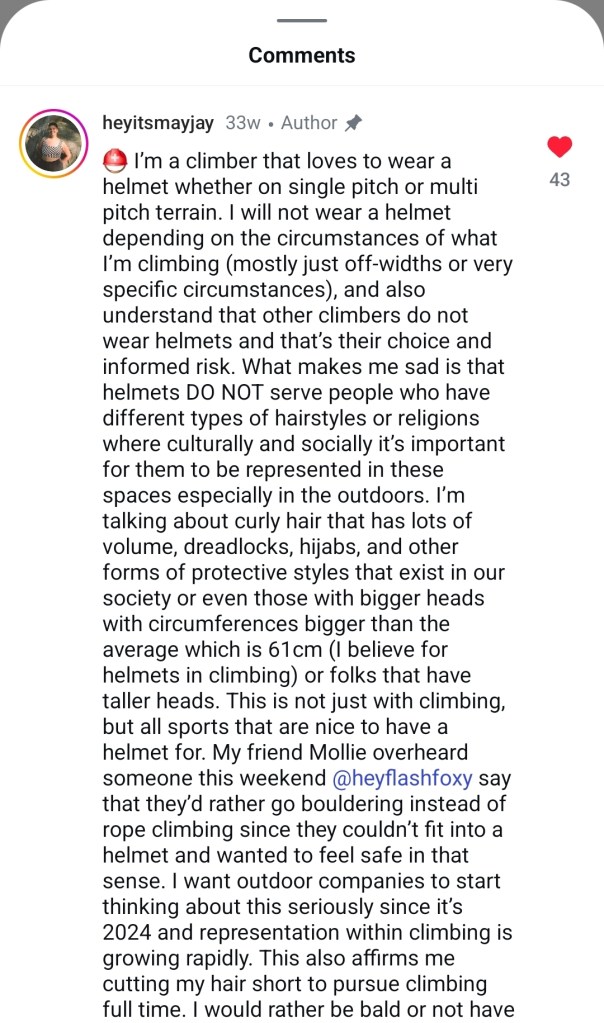
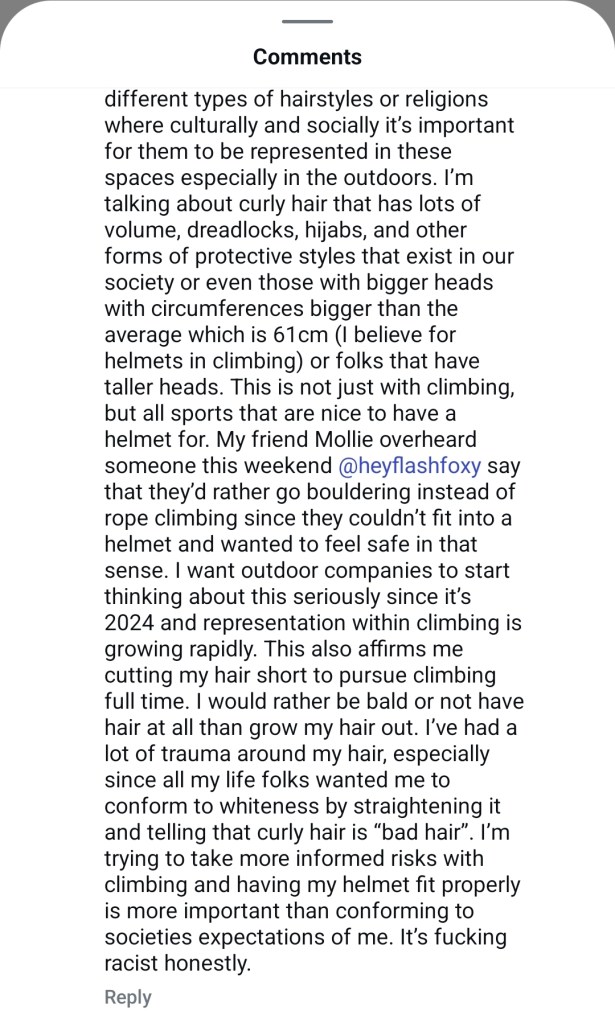
When I was running programs at an affinity group, I was actively searching for harnesses and helmets that would accommodate a range of bodies. Arguably, the first two most important things a climber needs to be safe in roped climbing is a well fitting harness and helmet. I created an entire resource document outlining different pieces of equipment including ones that would fit plus size bodies and bigger heads/high volume hair. And the search was tough. I found the only one option at the time for “larger heads” via a website that is still up from 2016 called Weigh My Rack.48 But what measurement is a larger head considered?
“When shopping for a climbing helmet, you’ll notice that they usually come in two sizes – typically S/M and M/L. This is because climbing helmets are adjustable, so each size covers a range of head circumferences. Each brand varies slightly, but the smaller helmet size is usually for a head circumference of about 19in – 22in (48cm – 55cm) while the larger size accommodates heads that are about 22in – 25in (55cm – 63.5cm). There is always some overlap for those who fall right in the middle.”49 For reference: my head is approximately 22 inches without a hair measurement so I always purchase M/L. With added hair in styles such as box braids, cornrows, two strand twists, or bubble braids I know that I will barely be able to squeeze my climbing helmet on because the hair does add volume therefore putting me at about 25 inches. The only style that I have not been able to fit under a helmet were butterfly locs. But this is not the case for many people. If your head is already closer to 25 inches and you add hair or have a loc style, there is little to no option for you on the market. Weigh My Rack does have one option50 listed that offers 24.8-26.3 in (63-67 cm) at size XL, however, it is a skiing helmet which comes with its own set of drawbacks for the application of climbing.
So what are our options here? Advocacy groups encourage people to come to climbing as they are; to come with their full selves. But that is not something people with afro hair or voluminous hair coverings due to religious beliefs can do safely. Therefore, in the context of climbing we are in fact rewarded with being safe by choosing to cut our locs off, abandon our religious beliefs, and or straighten our hair. It’s a conundrum my grandmother would say “You’re damned if you do, and you’re damned if you don’t.” How can we change this with major climbing gear manufacturers?
One avenue, of course, would be one of us creating a new line of inclusive climbing helmets. For the people by the people type of thing. REI does offer a Path Ahead Ventures Investment program which attempts to increase the number of people of color outdoor companies.51 Theoretically, if someone wanted to specialize in offering larger sized climbing helmets this could be a path forward.
However, with the new impending tariffs on goods to and from the US it is more difficult than ever for small businesses to thrive let alone start. Unfortunately, the model of US business has been to manufacture goods overseas and import them to sell. This has been a labor cost cutting strategy for a long time and those out to build wealth usually take part in this system.
And to also insert that the already existing companies have the power, resources, and influence to offer larger sized helmets should be a detail not missed. It’s like the swim caps for afro hair: white owned businesses looked around and thought to themselves: there is no need for a helmet larger than 25 inches in diameter because it will fit everyone. And when they say everyone they mean everyone white or white ideal striving. It’s an entirely missed demographic that is overlooked due to and enforced by, say it with me now, racism.

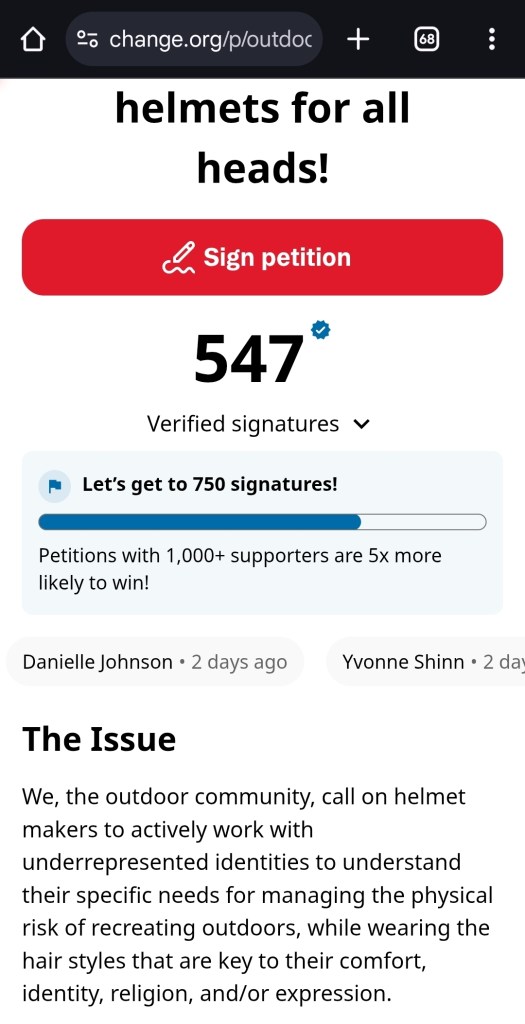
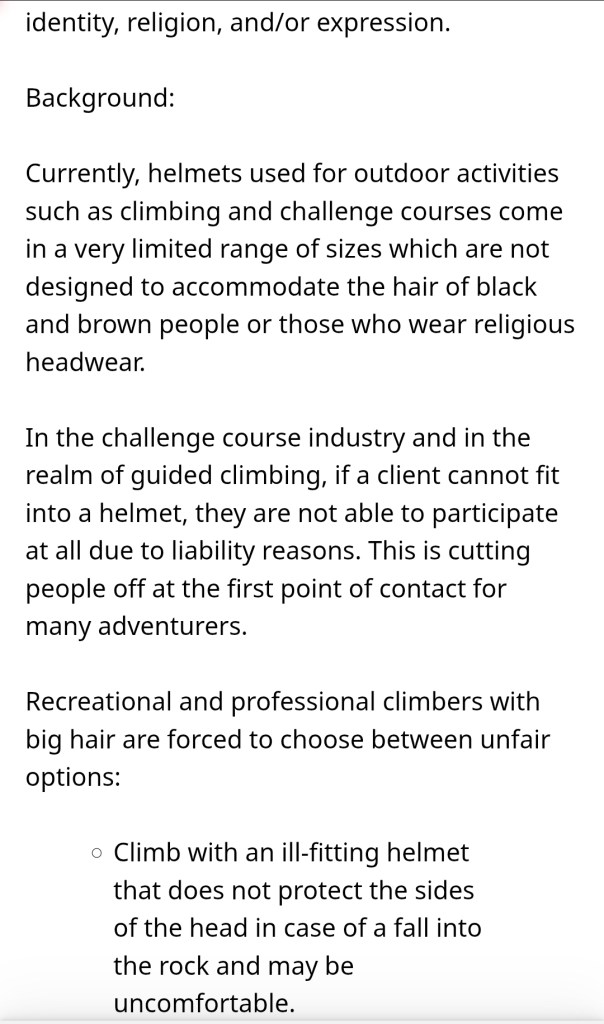
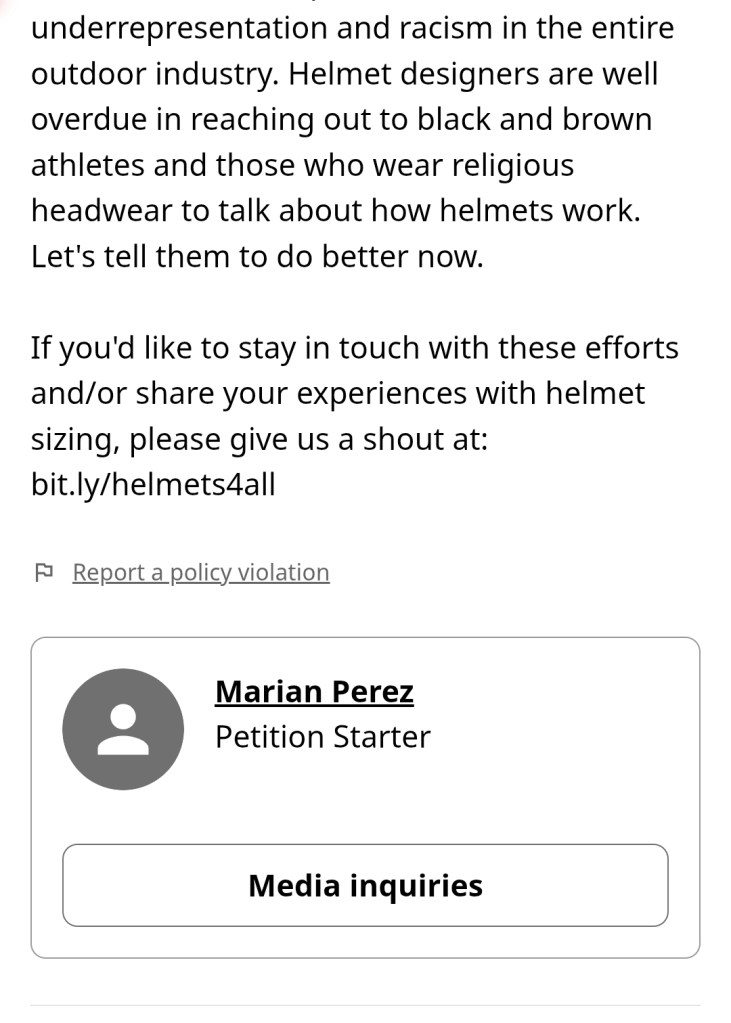
One brave soul has decided to do something about it in another way. May Perez of Rise Outside Collective has started a petition January of 2025 to “call on helmet makers to actively work with underrepresented identities to understand their specific needs for managing the physical risk of recreating outdoors, while wearing the hair styles that are key to their comfort, identity, religion, and/or expression.”52 It goes on to say:
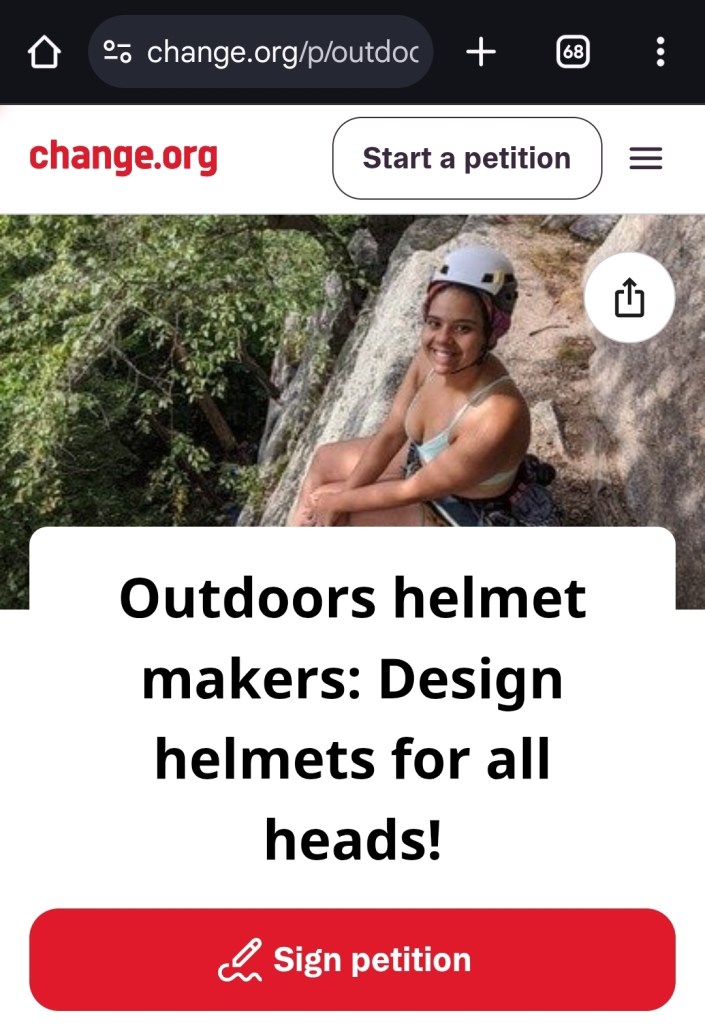
Recreational and professional climbers with big hair are forced to choose between unfair options:
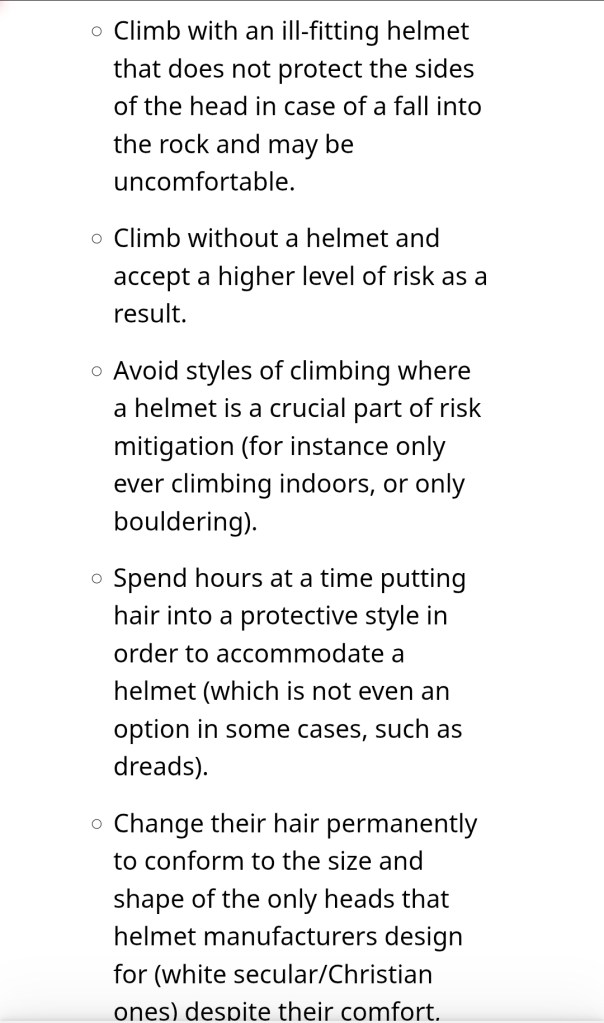
- Climb with an ill-fitting helmet that does not protect the sides of the head in case of a fall into the rock and may be uncomfortable.
- Climb without a helmet and accept a higher level of risk as a result.
- Avoid styles of climbing where a helmet is a crucial part of risk mitigation (for instance only ever climbing indoors, or only bouldering).
- Spend hours at a time putting hair into a protective style in order to accommodate a helmet (which is not even an option in some cases, such as dreads).
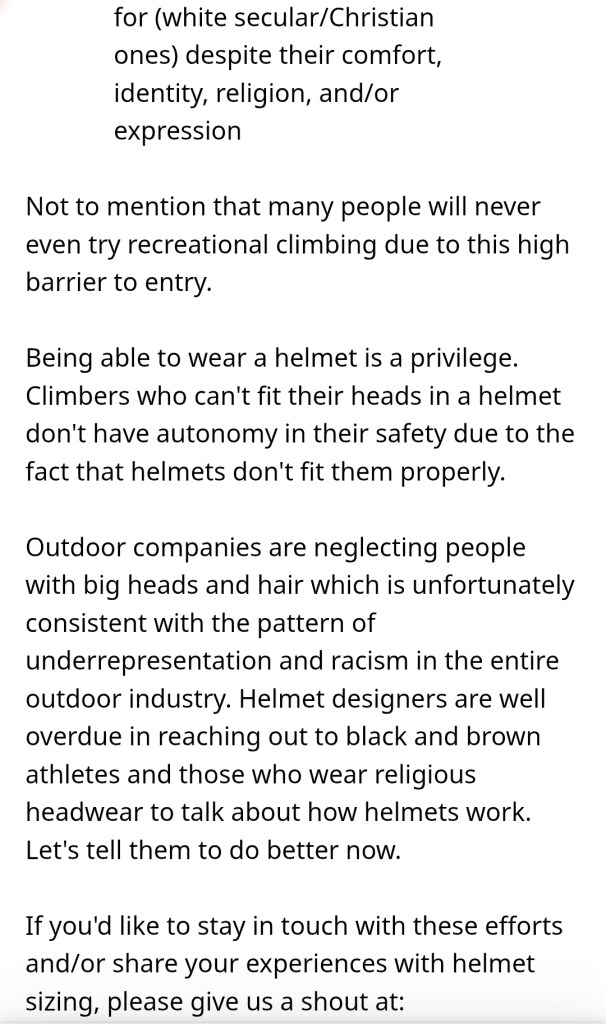
- Change their hair permanently to conform to the size and shape of the only heads that helmet manufacturers design for (white secular/Christian ones) despite their comfort, identity, religion, and/or expression
In coming back to the option of chemically straightening hair or wearing an ill fitting helmet we now know that either has the potential to end your life. All for striving to fit into boxes we were never meant to fit into. Companies who have ignored this issue (and yes, how could you have missed it over the last couple of years) will hear loud and clear that their business as usual is not good enough. It never has been. But it all comes down to their bottom financial line: having larger helmets is not profitable because we are a smaller demographic in climbing. They should still do it; but I have reservations about whether or not they will. I encourage you to sign this petition anyway.
In the end I personally think the only thing that would truly grab their attention and inspire action would be a lawsuit. It would be a hard fought lawsuit with a potential to lose simply because they could chalk it up to user error, much like the McDonald’s hot coffee lawsuit. But the difference here is that industry wide we have little choice in well fitting helmets. “Being able to wear a helmet is a privilege. Climbers who can’t fit their heads in a helmet don’t have autonomy in their safety due to the fact that helmets don’t fit them properly.”53
Industries are changing their attitudes around hair. Even synthetic hair for braiding and styling has been newly found to have carcinogens and lead (which is highly toxic and absorbable). “What is unique about braid extensions is the length of exposure users have to them,” Thomas says. “Synthetic braids are typically worn for about four to six weeks. Black women and other individuals who use synthetic hair are, therefore, exposed to those ingredients consistently during that time.”54 Companies, consumers, and organizations can make more informed decisions about their hair choices now because the information is out there. But the accountability is not. And some may choose to opt out entirely such as the Miss Ivory Coast Pageant who has completely banned the use of weaves and wigs leaving the only option of rocking natural hair.55 Although health concerns were not cited, it is probably a smart idea; one that will hopefully encourage growth in the topic of hair and colonialism.
We all would benefit from analyzing and defying a system of beliefs created by oppression and upheld by people or companies not willing to take action. The first step may be you rocking your natural hair for the first time or a multi million dollar company investing in safe and effective ingredients for people who do want to straighten their hair still. Either way, a change is needed for the sake of us all and our health.
A special thanks to Jean Quintero for bringing this chemical straightener topic to my attention.
Works Cited
45. Hudelson, Crystal. “Black Hair and Climbing.” https://rockrose.blog/2023/01/04/black-hair-and-climbing-3/, 22 May 2025
46. Rise Outside. “Rise Outside.” https://www.riseoutside.org/, 22 May 2025
47. https://www.instagram.com/p/DAq2pKjSWeC/?img_index=1&igsh=OXY3YXVzamZzenB5, 22 May 2025
48. Dennis, Allison. “Climbing Helmets for Big Heads.”https://blog.weighmyrack.com/the-best-rock-climbing-helmets-for-big-and-large-heads,/ 22 May 2025
49. Clarke, Julia. “How to fit a climbing helmet.”https://www.advnture.com/how-to/fit-climbing-helmet, 23 May 2025
50. Weigh My Rack. “Summit MIPS.” https://weighmyrack.com/helmet/smith-summit-mips, 23 may 2025
51. REI COOP. “Path Ventures Ahead.” https://www.rei.com/path-ahead/investments, 23 May 2025
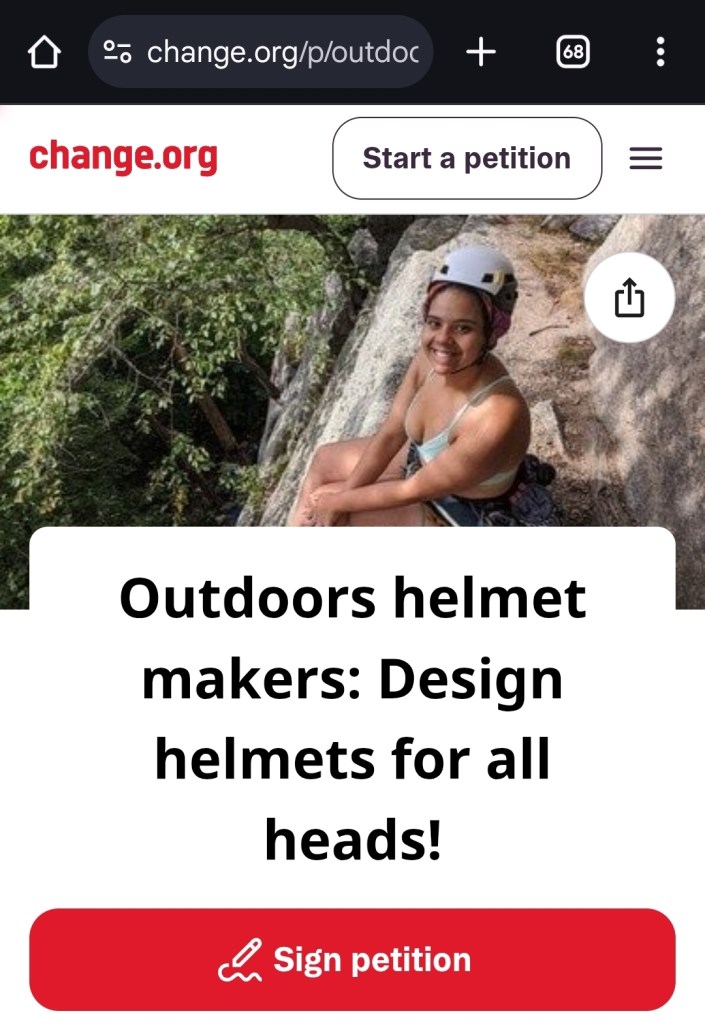
52. Perez, Marian. “Outdoors helmet makers: Design helmets for all heads!”https://www.change.org/p/outdoors-helmet-makers-design-helmets-for-all-heads?fbclid=PAZXh0bgNhZW0CMTEAAaemtaZExIELFYHUFpLpUdmNtyiDD7Y2M0MSDZCYcGe4tfYK3xPJJlGMXahzAw_aem_Y5BEB8T5XTS6z_3AOzVRxQ 20 May 2025
53. Perez, Marian. “Outdoors helmet makers: Design helmets for all heads!”https://www.change.org/p/outdoors-helmet-makers-design-helmets-for-all-heads?fbclid=PAZXh0bgNhZW0CMTEAAaemtaZExIELFYHUFpLpUdmNtyiDD7Y2M0MSDZCYcGe4tfYK3xPJJlGMXahzAw_aem_Y5BEB8T5XTS6z_3AOzVRxQ 20 May 2025
54. Jackson, Leigh-Ann. “Dangerous Chemicals Were Detected in 100% of the Braiding Hair We Tested.”https://www.consumerreports.org/health/wigs-hair-extensions/dangerous-chemicals-detected-in-braiding-hair-cr-tested-a4850978424/ 23 May 2025
55. Abdur-Rahman, Nahlah. “Au Naturel Only: Ivory Coast Pageant Shocks Contestants With Wig & Weave Ban.”https://www.blackenterprise.com/miss-ivory-coast-pageant-bans-wigs-and-weaves-for-contestants-to-embrace-natural-hair/ 23 May 2025
 Rock Rose Blog, LLC