
Part VI
Watch this as a podcast with subtitles on Substack or Youtube.
“While all the time that I was loving you
You were busy loving yourself
I would stop breathing if you told me to
Now you’re busy loving someone else
11 years out of my life
Besides the kids, I have nothing to show
Wasted my years, a fool of a wife
I should have left your ass long time ago
Well, I’m not gon’ cry
I’m not gon’ cry
I’m not gon’ shed no tears
No I’m not gon’ cry
It’s not the time
‘Cause you’re not worth my tears”
-Not Gon Cry by Mary J. Blige1
Content warning: abandonment in a wilderness setting, abuse, alpine death, and attempted murder
How do you determine if someone is competent enough to take you on an experience you have never been on before in an outdoor setting? Who seems competent? Who is actually competent? Does that competent person automatically become your care giver in this new setting? And how much personal responsibility should one take to be prepared for a new adventure? How does gender and possibly race/ethnicity play a role in this?
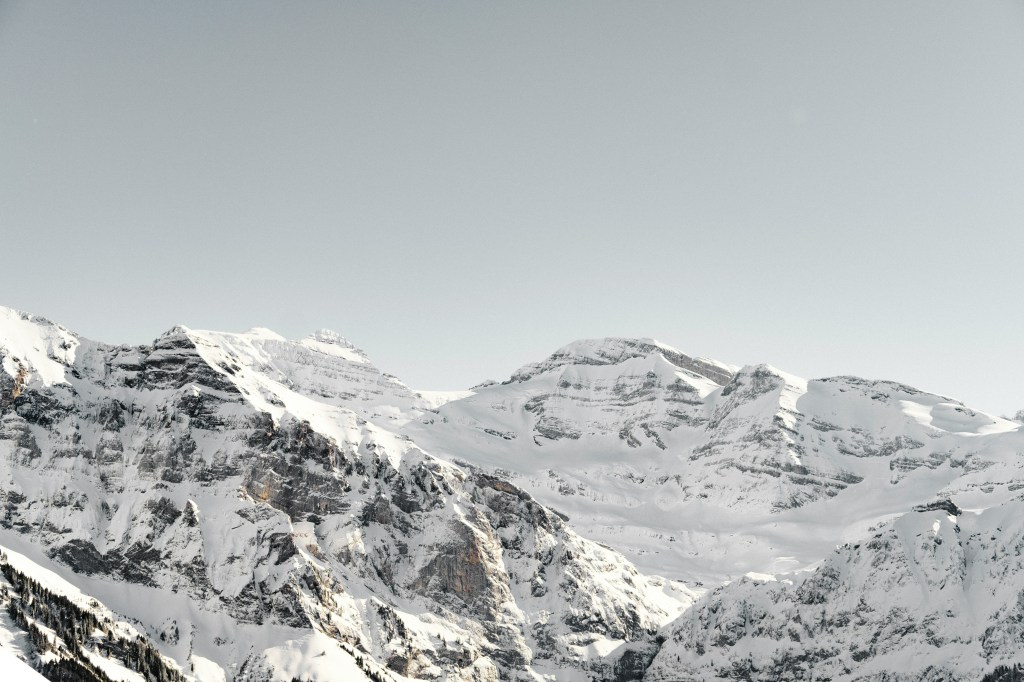
The buzzing I have seen online recently surrounding people being under prepared for outdoor adventures, most specifically women, has had an uptick due to a now famous legal case of a man climbing in Austria where his girlfriend froze to death on their attempted ascent of the country’s tallest peak, Grossglockner, with a 3,798-meter (12,460-foot) summit. For reference to those local to the Pacific Northwest: Mt. Rainier has a 4,392 meter (14,411 foot) summit.
This is not new. I have personally heard stories from women and disabled people about being left alone behind on hikes, approaches, or adventures when they did not fully know the way or were comfortable with it. I myself have hiked with people who would dart ahead without one look back and it always made me feel less than adequate, even a little disrespected.
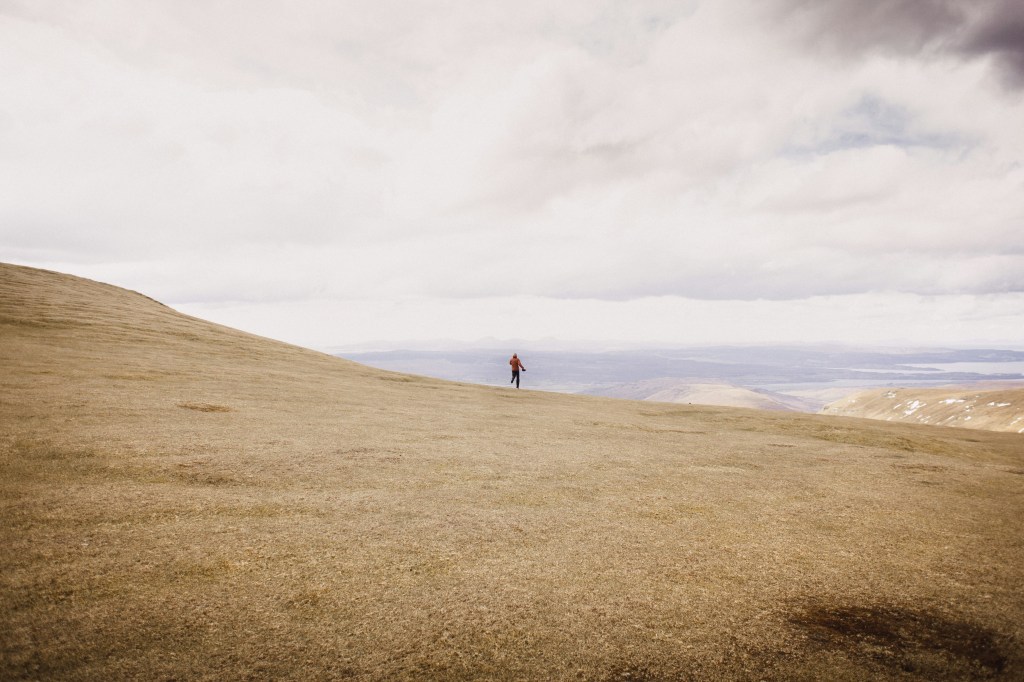
When I was guiding and developing the programming for an affinity group I was also the instructor for the guides we would hire and mentor. One of the things I hammered in during every training session was to make sure people did not feel like they were being left behind on approaches to a crag. The specific requirement was one guide at the front leading the way and one at the back to ensure everyone was one happy sandwich. And I would advise the guide in the lead to glance back every once in a while to make sure the pace was adequate for everyone. And if it was not: the pace would be adjusted or they would pause and let everyone catch up. A skillful guide will even stop at particular landmarks to impart knowledge about the area keeping everyone entertained and not focused on the pace for it to feel more like a guided nature walk. I felt this procedure was especially important for demographics such as people of color looking to feel a sense of belonging in the outdoors where they may not see themselves reflected or represented in the first place.
The additional part of this is ego. Of course as a guide you may be the strongest hiker in the group. Well, congratulations if you are. This means nothing in my opinion. It’s not about you or you getting your heart rate to a challenging level regardless of your client keeping up; it’s about the person’s needs in that journey.
But of course in this context we are not talking about professional guides because the man who left his girlfriend to die was not a professional guide. It was only 2 people attempting to scale a mountain. And this is where it gets even more nuanced.
First, the facts about this horrific incident in Austria.
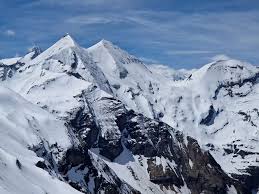
January 2025 a couple made up of a man and a woman named Kerstin attempted to climb Austria’s highest peak in predicted conditions of “strong winds of up to 74 km/h (45 mph)…-8C [17.6 F],2 with a windchill temperature of -20C[-4F]” and snow. They also had a late start considering the climb they had ahead of them. A complete timeline can be found in a CNN3 article if you are more interested in an hourly breakdown.
I will not go into specifics here, but I will say that offers were made by a rescue helicopter to evacuate them which were not taken advantage of. By the time the man called for help the conditions had deteriorated so badly a helicopter rescue was out of the realm of possibility. No one seemed to speak with Kerstin scaling the mountain directly. All communication was done through the man.
Was it a series of bad judgement calls? Yes, on multiple fronts. Late start, not taking weather predictions seriously/or checking them, deteriorating weather conditions, smart watches showing the individuals’ decline in energy before the helicopter flew over offering assistance, Kerstin already going into the climb sick with viral pneumonia, her “wearing the wrong type of footwear for the terrain”,4 the list goes on concerning the prep and actual climbing.
And lastly, the deadliest of bad judgment calls came 50 meters from the summit. Both people were cold and tired. The man claims she told him to go get help so he “secured his girlfriend to a rock with a sling” however, “she was found by rescue workers the following day, hanging from a rock face, her feet dangling, her crampons loosened…she had probably fallen.” One article specifies not just handing, but also hanging upside down5. Krestin had frozen to death. Furthermore, “He told the court he could not explain why he had failed to wrap her in the emergency blanket she was carrying or place her in a bivouac bag. When her body was later recovered, the items were found in her rucksack.”6
I just…can’t. As a guide and empathetic person myself, this infuriates me. Why carry emergency equipment if you are not going to use it when there is an actual emergency? Of course the man “said he had himself been suffering from hypothermia and exhaustion at that time, suggesting an impairment in his ability to judge the situation.”7 I will interject here that if his partner was climbing with pneumonia, I am going to assume he has low empathy in general so it would make sense that his empathy for others left quite quickly as soon as he got a bit uncomfortable himself. It is a harsh judgement but Krestin died mostly due to his actions.
And this is where it gets a bit philosophical when it comes to partner climbing and care. There are “questions about when personal judgement and risk-taking become a matter of criminal liability.”8 But first we have to decipher whether or not this was a guide and client relationship and if it differs from recreational climbers. In the courtroom they did use the term “guide” when referring to the man. This is not to be confused with people who do this professionally. These were two people on a recreational trip: no money was exchanged and no contracts or waivers were signed. Therefore I also think this court case will have little to no impact in the guiding realm.
However, they made an argument that the man was the “more experienced climber…and the responsible guide for the tour.”9 There seemed to be no consensus on Krestin’s experience level. One attorney and her mother claimed she was a competent climber and mountaineer while the other claimed she was out of her depth. And I personally do not think the shoes mistake is a good indication of her competence. Sometimes on adventures you will make small mistakes or settle with less than optimal equipment for a number of reasons and I do not think it speaks to anyone’s competence as a whole much.
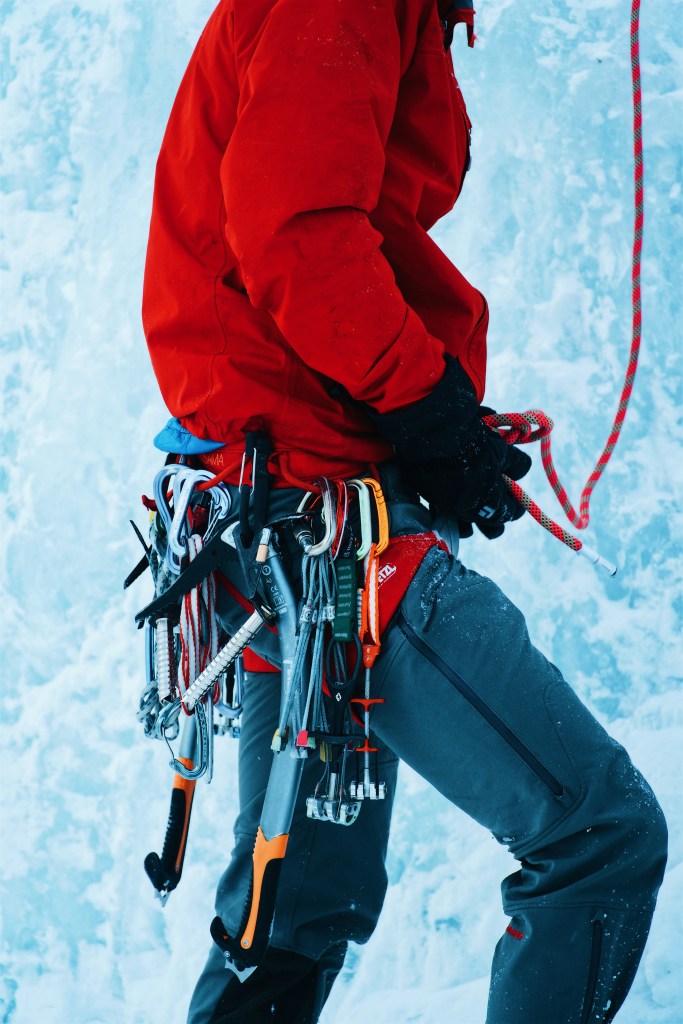
To me, what does speak of competence are the man’s actions. Let’s say she was out of her depth on this trip. I would argue the man was out of his depth to climb with another person: emotionally and psychologically. One has to have emotional empathy to look at someone and think to oneself: yes pneumonia is especially ravaging to the body; maybe we should reschedule. Or even: wow they are cold with prolonged harness suspension and seem to be declining in mental function; let’s see what we can do to bring their body temperature up and blood circulating to their brain before it gets dangerous. Or even: they have to leave them for a long period of time to seek help, make sure they are not weighting the rope they are tied in to and find a shelf for them to rest on. Any climber worth their salt knows that hanging in a harness for a prolonged period of time regardless of environment will also succumb to death due to suspension trauma10. Add winds of 74 km/h (45 mph) and -8C [17.6 F] temperature and no one could survive suspension for long.
As a guide, the most common answer to get someone out of a harness is simply to lower to the next available ledge, flat area, or the ground. If that is not an option; then hauling tactics must be explored which is exponentially more difficult especially if the person weighting the rope is unconscious or cannot process movement directions. But the answer is decidedly never to leave them suspended.
I say too that he was not psychologically equipped to climb with other people because this particular man has left people in the wilderness before. I say people because since there is one who has come forward to testify and he has been climbing for enough years to be deemed “competent” by a court, there are likely more. An ex-girlfriend of this man bravely came forward during trial to establish this behavior as a pattern.
“The court also heard from Andrea B, a former girlfriend…who described how he had left her alone on a previous tour on the Grossglockner in 2023…She said she had been at the end of her tether, feeling dizzy and her headlight had gone out…She said she was crying and screaming when he suddenly disappeared, walking ahead and leaving her behind.”11 I am not surprised this man has done this before. Luckily, she survived to tell the tale but we cannot ignore the trauma this has definitely caused her. “So that was the last mountain expedition we undertook together,” she said.”12 I say good for her not engaging again.
This also strengthens my argument of his incompetence. Although the specific climbing line was not specified, notice that this is the same mountain. Yes, the same mountain that he had experience on, where Krestin met her untimely end. As a climber or a guide: you should be better prepared in general having done the route before or at least on the general mountain. It would be even worse if it were the very same route. As a climber knowing the route, there would have been information gathered in your head from experience or even research about bail spots or potential shelter areas should the weather turn, etc. All part of a well thought out plan. But instead…INSTEAD he apparently learned that his success hinged on how well he climbed the mountain regardless of how his partner did. Anyone worth their hard climbing ability would have learned from that previous situation about partner selection, preparation, or at least emergency preparedness. But he did not and it cost Krestin her life.
I do not want to downplay any abilities Krestin would have been able to contribute. But, in court they claimed he “had been the more experienced climber, and therefore the “de facto” leader, saying he had no mountaineering qualification but rather had garnered his knowledge from videos and other sources and that the couple had acted “on a level playing field.”13 I would also add that he had done the mountain before! That already makes him the de facto leader: it is much easier to follow someone up a route they have done before.
I also do not want to place him on a pedestal as the ultimate leader and Krestin simply a fawning woman following him up a mountain. As I have said before, it is difficult to ascertain her abilities and experience as she was most likely pretty impaired due to hanging in a harness cutting off her brain blood, being cold, tired, and sick. Climbing with a partner who is not at optimal health should always garner extra attention and caution from the partner feeling well. But in many cases this does not happen.
The end of this particular story is that the man was found guilty of gross negligent manslaughter from his actions. A sad end to any adventure.
Although I do not think in this case his actions were to intentionally kill Krestin, that man’s actions did lead to her death. And many online have deemed it a term called Alpine Divorce.
Alpine divorce is described as having “…been left in the wilderness by their partners during an outdoor excursion. “Alpine divorce,” an unsettling, now viral dating term, is being used to describe this form of relationship abuse…”Alpine divorce” is a term that appears to be derived from a 1893 short story of the same name written by Robert Barr. The grisly story revolves around a husband who plans to end his marriage by pushing his wife off a cliff while they’re hiking in the Swiss Alps..The term went viral on TikTok in mid-February [2026], when a woman with the handle @EverAfterIya revealed that a man had abandoned her during a hike on Valentine’s Day. Her video received a slew of comments from TikTokers who called what happened to her an “alpine divorce…While a range of stories have been shared, the term is currently being used in a broader sense. “Alpine divorce” isn’t being used to describe attempted murder, as Barr wrote about in his short story.”14
Leaving someone in the wilderness with the knowledge that they do not have the tools to make it out alive (especially in life threatening weather conditions) or there is a chance they will not survive is not only abuse: it is attempted murder plain and simple. This term may not apply to Krestin’s situation as it was an accidental death caused by a reckless alpinist and he was rightfully convicted of gross negligent manslaughter.
I personally hate this term of alpine divorce. Divorce has always been a tool of empowerment for women. So when you express divorce in sync with violence against a woman, it sickens me a bit. I would highly encourage you to explore the rest of my Reel Deal: Women, Policy, and Autonomy series, specifically the areas where I talk about marriage and divorce. As a reminder, Part I goes over who has historically been property (spoiler alert: it’s women) in relation to these topics. “The numbers speak for themselves: once fault based divorce was dissolved, women experienced less abuse and suicide because we were able to leave and see a way for us to operate in society of our own volition. A woman trapped in a marriage having the knowledge that leaving meant a whole other host of problems would be a difficult decision to make; especially if your mental health was tested constantly in the abusive relationship.”15 Also on the flip side: I do not know where the man trying to murder his wife in the above short story lived, but a regular divorce would do, my dude. You do not have to kill her. However, if he did reside in an area where there is an absence of a no fault divorce law then he may not have felt as though he had a choice. I firmly believe, however, despite the laws in place, murder is never the answer.
I will not be calling it alpine divorce. I will be calling it what it is: abusive abandonment, attempted murder, murder, attempted gross negligent manslaughter, gross negligent manslaughter. Even if one makes it out alive from the ordeal of being left in the wilderness; it’s attempted harm. And that’s not nothing.
There are voices out there also saying that Krestin and women like her need to take some accountability for their actions, or lack thereof, in the planning and execution of an adventure.
To a certain extent I agree: we, as women or any other marginalized demographic, are not helpless. We can be smart, capable of learning, and able. We just need the chance, but we also cannot ignore the massive gatekeeping of knowledge and resources throughout history by cis gender white men, usually. I do also talk about why women have largely been absent in climbing and elite climbing over the years until more recently in Part V of the Reel Deal. “What if it were earlier in the decade when Cedar [Wright]’s wife did not have access to her own bank account and resources? Theoretically he could have imposed his will on her with this dress code because society and policy allowed it (and his parent’s generation most certainly did). And to take it even further: would his wife even be climbing? I personally have known women that are servants of the house doing all the cooking, cleaning, and housework while the husband works and keeps all his wages to himself, only supplying her the bare minimum for groceries and childcare items if they had children. Does this sound like a situation in which a woman would go to the crag of her own volition to discover climbing? Absolutely not! The policy and structure that was in place up until even the 70’s had major potential road blocks to women climbing of her own volition and can further explain why a lot of us have been brought into the sport by men: all this time men (particularly white men) have had the financial freedom and power to wander out into the woods and attempt to climb a rock.”16
As we see more women breaking records in climbing: one can’t help but notice it coincides with policy allowing us as women to be fairly free and autonomous. With it has come the power of choice and means by which to collect knowledge for climbing to undertake more arduous adventures if we so choose. We can make our own money to hire guides to teach us necessary skills for scaling mountains. But a lot of people, myself included, did rely on a recreational relationship to obtain knowledge.
There is nothing wrong with having friends or a romantic partner teach you outdoor skills. Where it goes wrong is in the abuse of power. Whomever is teaching becomes the de facto leader, usually. And I say usually because with gender dynamics a lot of times a woman/gender non conforming person may be the more experienced but a cis gender man forces the lead role on himself and others. I have seen this first hand: whether it be talking over other people to assert dominance, repeat instructions with bloated confidence that were just given by someone else, or simply by placing themselves physically in the center of the group or standing on higher ground when speaking. All power plays to advertise to the surrounding observers that he is the one in charge. But it usually comes down to who people perceive as competent and due to this ridiculous behavior, their conclusions may be misplaced.
Either way, the person with the most experience who is sharing their knowledge or taking on more responsibility in the group has the opportunity to abuse others. Same with marriages back in the day when only men could hold finances and property: if a man holds the knowledge and skills he can weaponize this against people and it is unfortunately usually romantic partners who feel the brunt of this. But it is a choice: they do not have to abuse others.
As a note: I will say this is mostly in regards to cis gender hetero relationships. In my own experience, queer relationships have had to dissect and analyze gender dynamics/roles and relationships in such a way that they avoid some of the pitfalls of general binary thinking. I think these relationships naturally lend themselves to being healthier because if you are aware of something, you are more apt to change or avoid it. And cis gender hetero relationships can feed off a lot of toxicity pushed on all of us in society that are never fully examined by the practitioners. Not an absolute, but simply an observation.
Anyway, getting back to Krestin specifically: remember that she was sick with pneumonia. We will never know if her partner pushed her to still climb while being under the weather or if she silenced herself. “Our culture rewards women for being perpetually pleasant, self-sacrificing, and emotionally in control, and it can feel counterintuitive…to say “no”—or firmly assert their wants and needs…considerable evidence has revealed that female self-silencing isn’t just tied to psychological issues like depression and eating disorders, but also to physical illness…Most jarringly, women’s self-silencing has also been linked to higher risk of premature death…”17 In this case it most certainly did lead to a premature death. Not to mention that women are not listened to by society in general about sexual assault or our own health.18
“When women push their feelings down and cast their needs aside, their health suffers. But it can be difficult for women to do otherwise in a culture that celebrates these self-silencing practices…These unspoken standards establish a vicious cycle. For many women, it feels easier—beneficial, even—to silence their needs at the expense of their own health, rather than swim against the prevailing cultural current.”19 In climbing, cis gender white men’s voices are heard everywhere and are, again, perceived as the de facto leaders because of this major representation. So why wouldn’t a woman who has not done the internal work of analyzing this follow an incompetent man into the outdoors ill? Society has already primed her to accept that moment.
“For women, who have been unconsciously taught to view our likability as our greatest asset, boundary setting can often feel counterintuitive. Many of us fear that if we honestly communicate our needs and limitations, this will threaten our relationships. But it’s the contrary that’s true: when we set healthy boundaries (rather than toxic ones that can lead to radical individualism) our relationships actually become stronger and healthier. And having healthy relationships is integral to our physical well-being; one meta-analysis showed that people with more supportive social relationships have a 50% lower risk of premature death.”20
I do not want to scare anyone, but this is very serious. During my time as a guide I also thought it important to have a consent conversation with almost everyone who came through our programs, especially newer climbers. Although the conversation can be more pertinent to women and gender non conforming individuals in general: it would be a conversation with everyone. Usually over lunch as we were all snacking, I would talk about my experience with consent in climbing and how good it feels to be truly supported by your climbing partner; whatever that looks like. The most specific example of needing to find a different climbing partner was always a belayer not letting their climber come down when the climber specifically calls for it.
If that is your jam and you have both consented to that, cool. However, I have seen in climbing gyms more than once a man belaying a woman and refusing to let her down until she “finishes the climb.” And from pure observation, it was my opinion that this was not consensual usually based off the yelling and crying from the climber. I would tell my course participants that this is not normal, nor is it acceptable. If your partner in climbing has done something like this that seems kind of small and harmless I still suggest not engaging with them further. Because unfortunately, they will either do it again, do something like it again, or escalate to something worse in the future (like leaving you in the wilderness). It’s called boundary testing and it’s what abusers do. They test boundaries for what they can do to you and it usually starts out small to see if you will accept it. It’s also a method of asserting control.

I was very clear in all of my teaching that whatever the climbers commands is the ultimate word. It’s fine to repeat the command to make sure they are certain, but at the end of the day trust has been breached if you, as the belayer, are not following the climber’s directions.
Along the lines of my chat with course participants on consent in climbing in regards to partners, a few articles have popped up with guidelines on how to avoid the dreaded “alpine divorce.”
The first article I saw was Climbing Magazine’s The Art of Empowering Yourself Against an Alpine Divorce21. And my gut reaction was anger once again because the article itself only spoke about how to avoid alpine attempted murder/negligent alpine manslaughter in a way that I felt lacked a lot of context.
Basically for me it was along the lines of warning women to not walk in dark alleyways and if we do to have taken a self defense class. Rarely, if ever, are there resources, articles, or analysis on why men attack and sexually assault women. The onus is on women to take action. And Climbing Magazine’s article is just that: a way to protect yourself without a deeper understanding of why. Pushing it further: I think a more appropriate article would be something like Men Keep Leaving Women in the Wilderness to Face Death: Why does this keep happening?
On the flip side it is important to be aware of these things as women because it is a sad reality and of course we want to be competent in our sport. But this article left me wanting more that is rooted in reality. And Mel Fernandes’ Substack article How I Survived My Alpine Divorce and How To Avoid Them22 was a much better overall analysis on the topic.
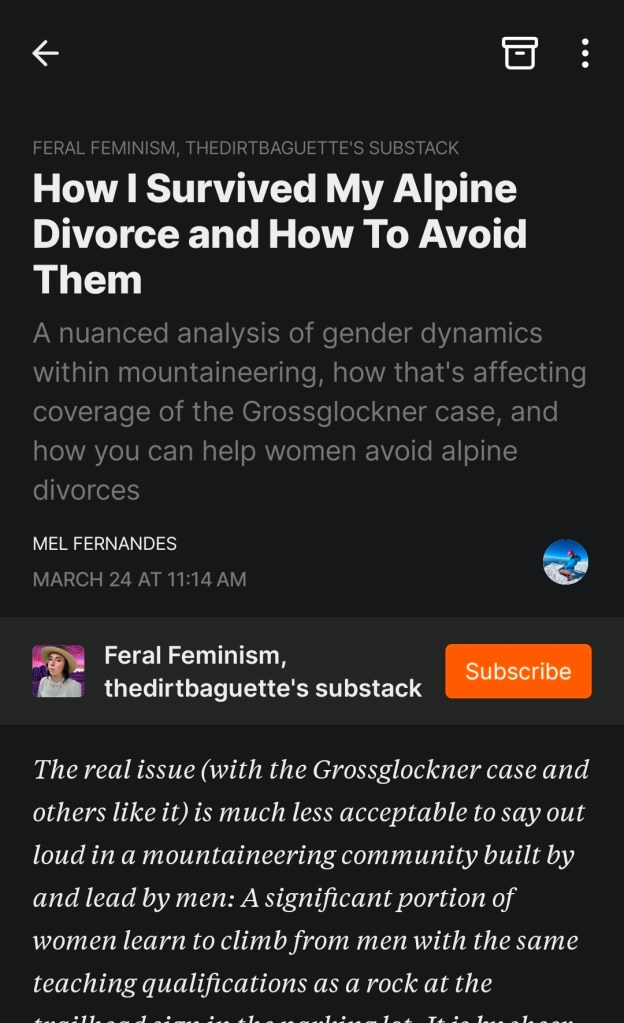
Mel makes a deeper and more prevalent connection to the way media has portrayed this and similar stories. “The media loves a headline like: “MAN LEAVES WOMAN TO DIE ON BIG MOUNTAIN.” It plays beautifully into a long-standing cultural bias wherein women are fragile, helpless creatures who collapse in the cold the moment they break a nail. Women in the mountains are constantly viewed through this lens of assumed fragility. This lack of nuance manufactures their consent within Patriarchy and reinforces the perception that we need male authority…A far less clickable headline for the Grossglockner case would be: “CLIMBING PARTNER HELD LIABLE FOR DECISIONS MADE DURING FAILED SUMMIT ATTEMPT.”23
The scrutiny needs to be on why this keeps happening, and a big part of that story is men’s actions. “It shouldn’t be controversial to teach women how to avoid men who abandon or harm their partners in the mountains. While women have the same agency as any human does in the alpine, unequal access means unequal risk.”24 Articles or studies on the fact that men are doing this to women in the outdoors is not the “gender war” some online have made it out to be. It is a fact that we must face and call out in order to start changing. The change will not come only from women being sufficient at their sport and autonomous in every aspect of our lives; most importantly it will come from men ceasing to continue this unacceptable behavior.
If you feel strongly about Rock Rose Blog bringing you free content about relevant issues and discussions, feel free to show your appreciation by donating my next year’s worth of platform access from WordPress. Click here for more information. Thank you for reading!
Works Cited
- “Not Gon Cry.” Youtube, uploaded by Mary J Blige, 27 Mar 2026, https://www.youtube.com/watch?v=YXHBuIXAiXo&list=RDYXHBuIXAiXo&start_radio=1 ↩︎
- Bell, Bethany. “Austrian climber found guilty after girlfriend froze to death on mountain.” https://www.bbc.com/news/articles/c0k1xkllknmo, 20 Mar 2026 ↩︎
- Tanno, Sophie. “Climber accused of leaving girlfriend to die on Austria’s tallest mountain goes on trial.” https://www.cnn.com/2026/02/19/europe/austria-climber-accused-left-girlfriend-die-latam-intl, 20 Mar 2026 ↩︎
- The Guardian. “Climber convicted of manslaughter after leaving girlfriend on Austria’s highest peak to seek help.”
https://www.theguardian.com/world/2026/feb/20/austria-climber-convicted-manslaughter-girlfriend-kerstin-g-grossglockner-mountain, 20 Mar 2026 ↩︎ - Bell, Bethany. “Austrian climber found guilty after girlfriend froze to death on mountain.” https://www.bbc.com/news/articles/c0k1xkllknmo, 20 Mar 2026 ↩︎
- The Guardian. “Climber convicted of manslaughter after leaving girlfriend on Austria’s highest peak to seek help.”
https://www.theguardian.com/world/2026/feb/20/austria-climber-convicted-manslaughter-girlfriend-kerstin-g-grossglockner-mountain, 20 Mar 2026 ↩︎ - The Guardian. “Climber convicted of manslaughter after leaving girlfriend on Austria’s highest peak to seek help.”
https://www.theguardian.com/world/2026/feb/20/austria-climber-convicted-manslaughter-girlfriend-kerstin-g-grossglockner-mountain, 20 Mar 2026 ↩︎ - Bell, Bethany. “Austrian climber found guilty after girlfriend froze to death on mountain.” https://www.bbc.com/news/articles/c0k1xkllknmo, 20 Mar 2026 ↩︎
- Bell, Bethany. “Austrian climber found guilty after girlfriend froze to death on mountain.” https://www.bbc.com/news/articles/c0k1xkllknmo, 20 Mar 2026 ↩︎
- Dynamic Rescue Systems. “Ask a Pro: What is Suspension Trauma (aka Harness Hang Syndrome)?
https://www.dynamicrescue.com/blogs/news/13262417-ask-a-pro-what-is-suspension-trauma-aka-harness-hang-syndrome, 27 Mar 2026 ↩︎ - Bell, Bethany. “Austrian climber found guilty after girlfriend froze to death on mountain.” https://www.bbc.com/news/articles/c0k1xkllknmo, 20 Mar 2026 ↩︎
- The Guardian. “Climber convicted of manslaughter after leaving girlfriend on Austria’s highest peak to seek help.”
https://www.theguardian.com/world/2026/feb/20/austria-climber-convicted-manslaughter-girlfriend-kerstin-g-grossglockner-mountain, 20 Mar 2026 ↩︎ - The Guardian. “Climber convicted of manslaughter after leaving girlfriend on Austria’s highest peak to seek help.”
https://www.theguardian.com/world/2026/feb/20/austria-climber-convicted-manslaughter-girlfriend-kerstin-g-grossglockner-mountain, 20 Mar 2026 ↩︎ - Balao, Neia. “What is ‘alpine divorce’? The viral TikTok term is bringing up concerns about relationship safety in the wilderness.” https://www.yahoo.com/news/us/article/what-is-alpine-divorce-the-viral-tiktok-term-is-bringing-up-concerns-about-relationship-safety-in-the-wilderness-211350777.html, 20 Mar 2026 ↩︎
- Hudelson, Crystal Rose. “The Reel Deal: Women, Policy, and Autonomy.” https://rockrose.blog/2025/04/14/the-reel-deal-women-policy-and-autonomy/, 27 Mar 2026 ↩︎
- Hudelson, Crystal. “The Reel Deal: Women, Policy, and Autonomy Part V.” https://rockrose.blog/2025/05/02/the-reel-deal-women-policy-and-autonomy-5/, 27 Mar 2026 ↩︎
- Eyal, Maytal. “Self-Silencing Is Making Women Sick.” https://time.com/6319549/silencing-women-sick-essay/, 27 Mar 2026 ↩︎
- Robinson, Cheryl. “Medical Gaslighting Is Real. Women Leaders Are Raising Their Voices.”
https://www.forbes.com/sites/cherylrobinson/2025/06/13/medical-gaslighting-is-real-women-leaders-are-raising-their-voices/, 27 Mar 2026 ↩︎ - Eyal, Maytal. “Self-Silencing Is Making Women Sick.” https://time.com/6319549/silencing-women-sick-essay/, 27 Mar 2026 ↩︎
- Eyal, Maytal. “Self-Silencing Is Making Women Sick.” https://time.com/6319549/silencing-women-sick-essay/, 27 Mar 2026 ↩︎
- Silver, Maya. “The Art of Empowering Yourself Against an Alpine Divorce.”
https://www.climbing.com/skills/empower-yourself-against-alpine-divorce/?utm_medium=climbing&utm_source=instagram, 11 Mar 2026 ↩︎ - Fernandes, Mel. “How I Survived My Alpine Divorce and How To Avoid Them.”
https://open.substack.com/pub/thedirtbaguette/p/how-i-survived-my-alpine-divorce?utm_source=share&utm_medium=android&r=bzere, 28 Mar 2026 ↩︎ - Fernandes, Mel. “How I Survived My Alpine Divorce and How To Avoid Them.”
https://open.substack.com/pub/thedirtbaguette/p/how-i-survived-my-alpine-divorce?utm_source=share&utm_medium=android&r=bzere, 28 Mar 2026 ↩︎ - Fernandes, Mel. “How I Survived My Alpine Divorce and How To Avoid Them.”
https://open.substack.com/pub/thedirtbaguette/p/how-i-survived-my-alpine-divorce?utm_source=share&utm_medium=android&r=bzere, 28 Mar 2026 ↩︎
 Rock Rose Blog, LLC