
For video format, visit my Substack
Part VI of VI: The Digital Guidebook Landscape Shaped by Policy
I want to point out that most of the rhetoric Kaya put out was surrounding compensation. They did not seem to address sending out their employees or contractors to copy information from already existing climbing areas, except when in regards to the Rock Shop where they backed the later author. So let’s look at the information they did decide to highlight starting with compensation and ending with information ownership.
I admit I was not familiar with any other platform like Kaya except for Rakkup. I liked Rakkup to a point, but still relied on paper guide books for the most part with a sprinkling of Mountain Project (which I always took with a grain of salt). So I did a little research on Kaya’s competitors and found a helpful article by Climbing by Outside Magazine written in 20251. And wow was I surprised at the sheer variety of guidebook apps.
The list included: Mountain Project, Gunks App, 27 Crags, Rakkup, Topo Guru, and Kaya. Topo Guru will be omitted from this exploration due to it being only useful in Europe. Let’s talk about these apps in terms of their contributor terms to see if Kaya is as competitive with compensation and transparent about data display as they claim. All the apps appear to use the term contributor for either the author of a page or guidebook they make on their platform, or the route developer (and the two may be one and the same but not always).
Starting with Mountain Project: “Mountain Project is a crowd-sourced guide to climbing areas and routes built by climbers just like you! As part of Adventure Projects, this free digital guidebook that you can use either on the web or on your phone as a mobile app…”2 That is entirely crowd sourced aka like Wikipedia in that anyone may upload climbs, regardless of being the first ascensionist or developer. When I say I take this information from Mountain Project with a grain of salt: I mean that I do not take it too seriously because sometimes the information is inaccurate. I have witnessed this firsthand in a rappel situation in Smith Rock before in which a lovely couple almost walked off the edge of a cliff due to improper information. So I always supplement with another source. Mountain Project is a free database that does not pay their contributors and there are whispers on the wind of new features coming for premium paying members, but as far as I can tell it will continue to follow this base model3.
All other apps appear to pay their contributors. Next up is Gunks App. Not every app’s website I looked at had their Terms of Service readily available. I was not able to find Gunks’ online, however, I did find one statement when it came to publishing on their app and it was as follows: “Authors receive a share of every sale (more than twice what a print publisher would give), a lifetime subscription to all our digital guides, social media promotion, gym banners, and stickers to help promote the guide.”4 No more specifics were given.
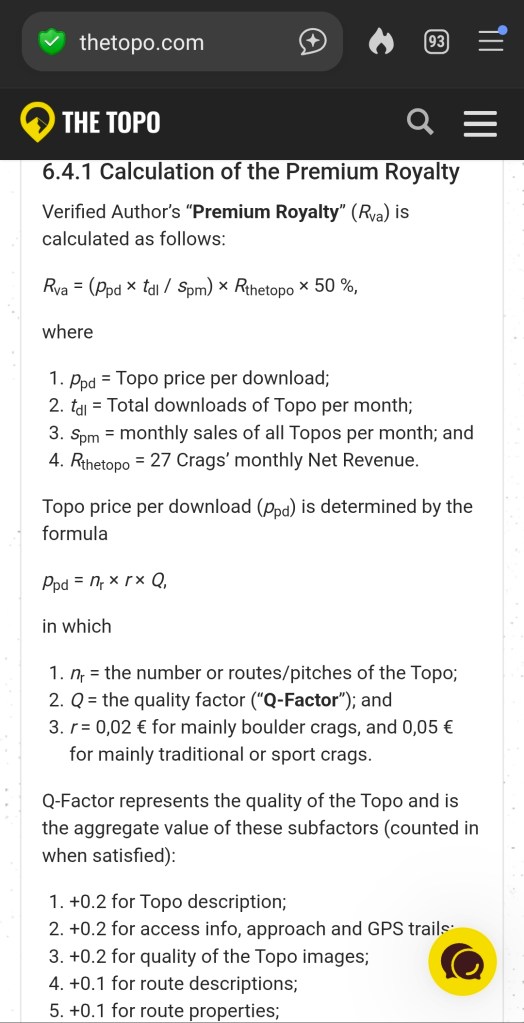
On the opposite end of the spectrum for public observation, 27 Crags also pays contributors and is completely transparent, however, they have boiled it down to a few complicated formulas that build off one another. I am not sure whether they intended it to be so convoluted but they succeeded. It would be impossible to estimate how much a contributor would actually make off a guidebook due to the structure.
Which brings us to Rakkup, which I have mentioned before. The best use I ever got out of Rakkup was to navigate the Mount Erie approach maze in which I found it to be extremely helpful. Rakkup touts no upfront costs and that “…there are no costs other than your time to create the guide. There is also no speculating about what sales might be, and no expense tied up in pallets of print books…You can set the price of your product in our marketplace. We offer sales revenue sharing with fewer middlemen than the print industry.”5 This is a departure completely from both of the aforementioned apps: having the contributor set the price of the guide. Of course then it begs the question of how much of a cut Rakkup takes which I could not find specified in their small terms of use page.
And to my knowledge, Rakkup and the other guidebook apps did not have as strong of a community push back when released, who knows for what reason (maybe not forcibly copying already existing content?). Therefore, Kaya’s Terms of Service are by far the most public and lengthy. So their statement about having the best terms appears to be truthful in terms of compensation (50% they say), but also a bit inflated due to app guidebooks being in their wobbly toddler age still and not that widespread. I do not think a comparison to paper guidebooks is fair due to the overhead cost compared to little cost of digital assets. And the only app to mention taxes still needing to be paid after royalties are distributed was 27 Crags also begging the question of is the 50% Kaya offering to contributors pre or post taxes?
But there are still a lot of questions to be answered about the ethics of digital guidebooks when an existing documented area has an author unwilling to work with Kaya.
The 2025 Outside Magazine article also observed that “[Kaya has] Far fewer areas/routes than a crowd-sourced app, with less written route beta as well.” This doesn’t excuse them for being more aggressive in their tactics to upload guidebooks, but it may put into perspective why they made those choices Kim mentioned about uploading without consent.
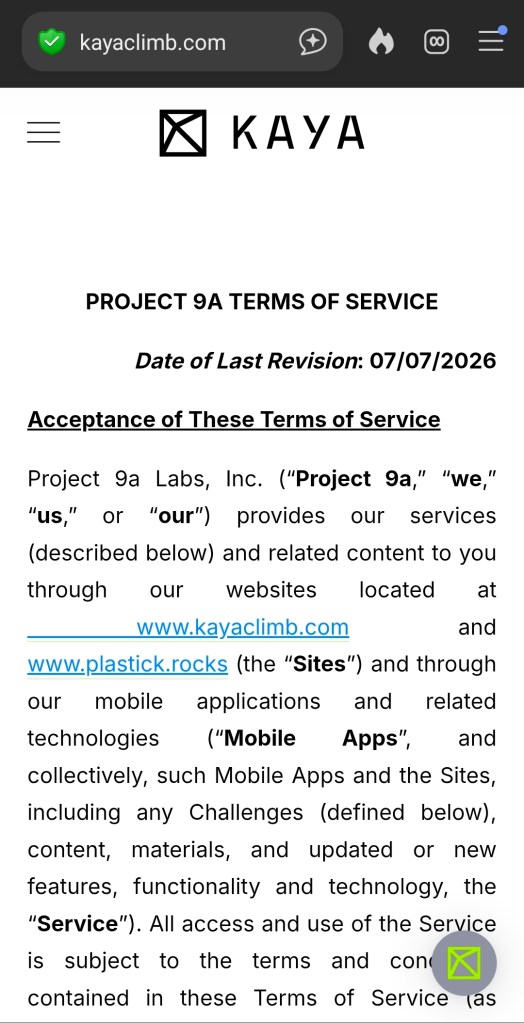
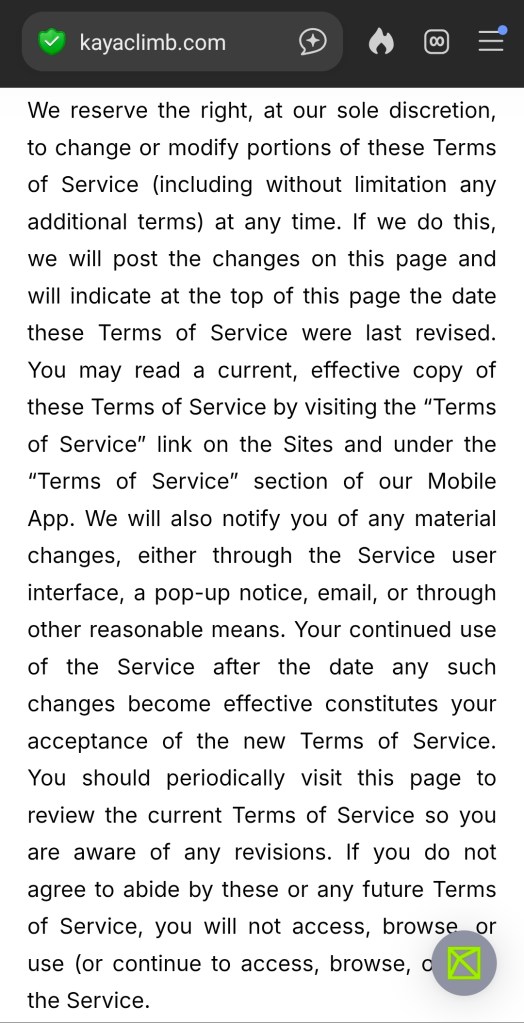
When Kim said in the post I mentioned: “I know that Kaya could click a few buttons and put their copied Yosemite info back on the app. I hope they don’t do this.” He is, in fact, correct. A look at Kaya’s Terms of Service, which state right off the bat “We reserve the right, at our sole discretion, to change or modify portions of these Terms of Service (including without limitation any additional terms) at any time…We will also notify you of any material changes…you should periodically visit this page to review the current Terms of Service so you are aware of any revisions.”6 To ensure the historical accuracy of these terms, I have taken screenshots of any statement I quote here. But they can change this anytime and for any reason at all. Off to a great start.
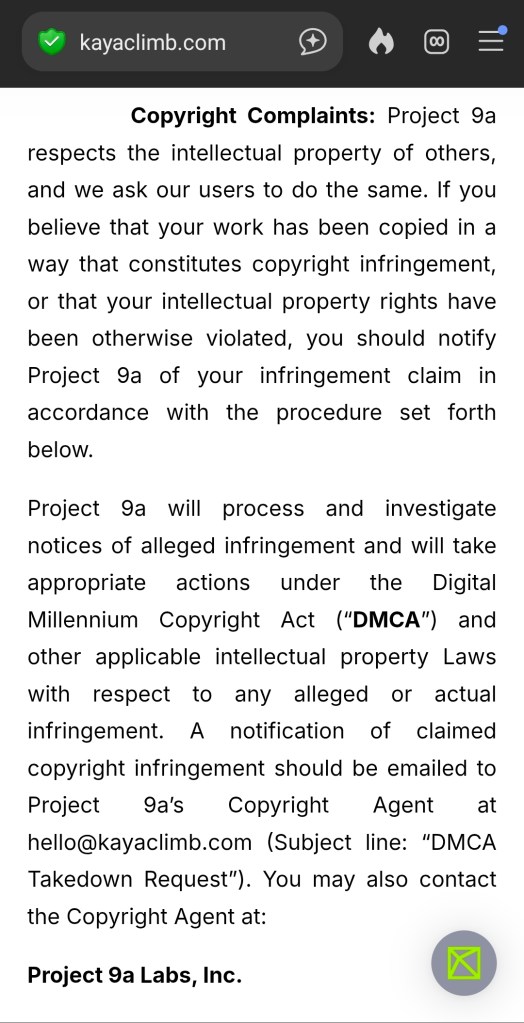
Their Copyright Complaints section later on reads: “Project 9a [which is Kaya] respects the intellectual property of others, and we ask our users to do the same. If you believe that your work has been copied in a way that constitutes copyright infringement, or that your intellectual property rights have been otherwise violated, you should notify Project 9a of your infringement claim…[we] will take appropriate actions under the Digital Millennium Copyright Act (“DMCA”) and other applicable intellectual property Laws…” Here is the obnoxious but legal portion: to my understanding, climbing route information is not intellectual property meaning the company or anyone else may copy and upload this information onto the app, or any app in fact. So they are clearly not talking about this particular topic.
Now here’s where it gets interesting. In the infographic of the email I shared earlier, Kaya states that “Authors [aka contributors] have the right to pull their data from KAYA at any time.” But I see a discerning distinction in the next section of their Terms of Service in regards to something called Reference Data.
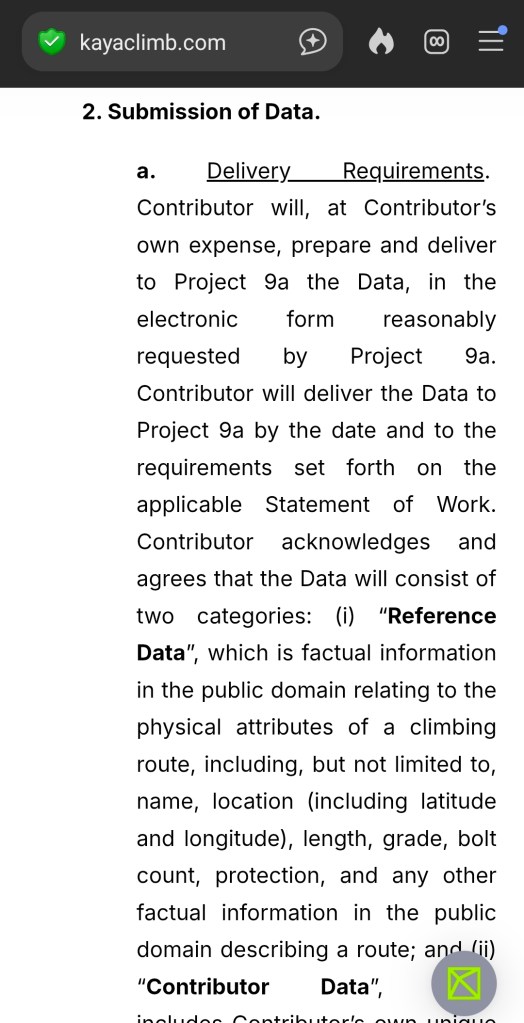
“Contributor acknowledges and agrees that the Data will consist of two categories: (i) “Reference Data”, which is factual information in the public domain relating to the physical attributes of a climbing route, including, but not limited to, name, location (including latitude and longitude), length, grade, bolt count, protection, and any other factual information in the public domain describing a route; and (ii) “Contributor Data”, which includes Contributor’s own unique descriptions, and Contributor’s own photos and videos, as described on the applicable Statement of Work.”
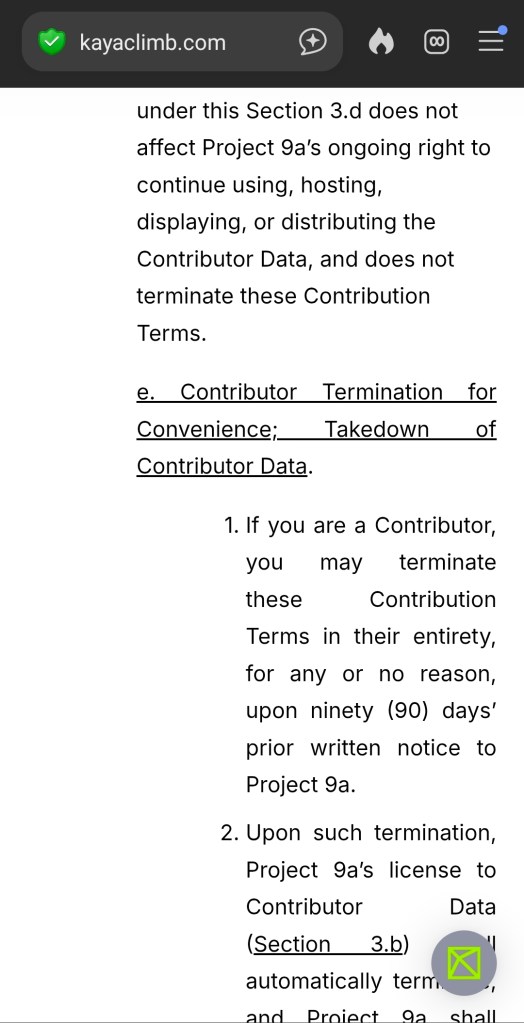
So read this next statement carefully. “If you are a Contributor, you may terminate these Contribution Terms in their entirety, for any or no reason, upon ninety (90) days’ prior written notice to Project 9a. Upon such termination, Project 9a’s license to Contributor Data…shall automatically terminate, and Project 9a shall within ninety (90) days: (i) remove from the Service all of your Contributor Data consisting of unique descriptions, photographs, videos and other Contributor-originated media; and (ii) leave in place only Reference Data.”
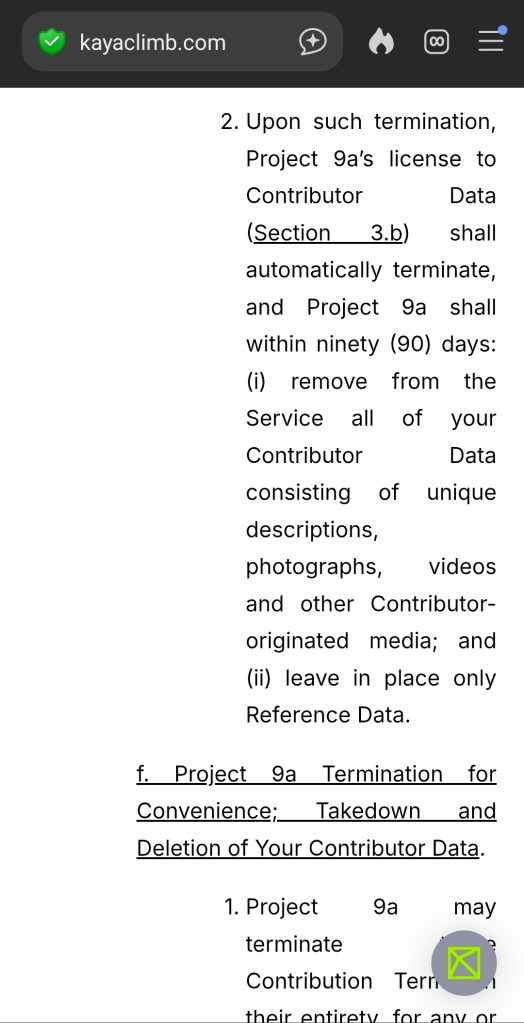
It bears repeating: they can leave in place Reference Data. Reference data which includes “factual information in the public domain relating to the physical attributes of a climbing route, including, but not limited to, name, location (including latitude and longitude), length, grade, bolt count, protection, and any other factual information in the public domain describing a route.” Isn’t that still just all the information of the climb minus the route developer’s particular language? It’s a fine line here and I believe asking to take your contributor data down is not doing much as Kaya can still retain everything except what makes the climb’s description unique to the developer. And possibly still profiting off it by charging admission to access.
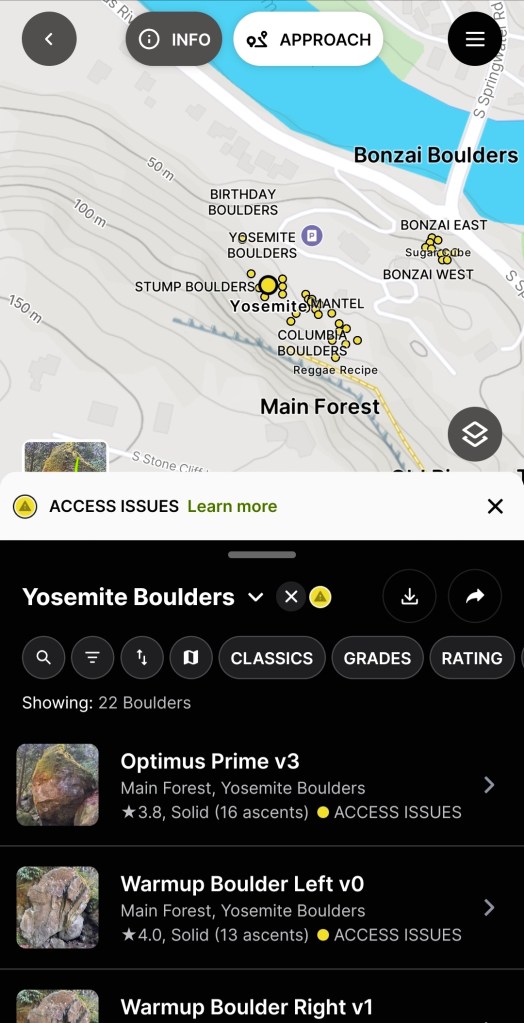
Kim sounded hopeful they would not even keep the data up from Yosemite Bouldering. But yes, even if he was not the contributor (which he was not even though he originally wrote the physical/original guidebook), Kaya is making the case that they can keep reference data up on anything, which they have. When I searched on their app for Yosemite Bouldering, a guide did come up with routes, info, and contributors. There is no mention of Kim or the original guidebook authors. The reference data is also not in a guidebook you have to purchase it seems.
I am guessing Kim was referring to a guidebook one would purchase, but with the strange crossover model Kaya has taken of crowd sourced reference data they call “unverified” and exchanging money for guidebooks, it gets confusing. For example, when I looked at the Kaya guidebook for North Bend, WA it appears you have to be a Pro member in order to access it, which means paying a subscription fee. However, when I open the guidebook on the app and dig into lesser known and unverified areas like bouldering at Deception Crags (a specific area of North Bend), there is no contributor information on there and is unverified. And yet, we have paid a subscription for a book with verified and unverified information? Unverified information appears to be the aforementioned Reference Data. I am a bit confused, myself. I’m also sure I am not alone in that. We could all do with better clarification on the overall ethical stance of app based guidebook services such as Kaya.
Climbing apps have forever changed the climbing landscape, for better or worse. Events like Squamish Rampage are now a fully online challenge with Kaya7. Impact and overcrowding for an event are real concerns and making the competition a 2 week period with whatever you log is unique and alleviates problems. Whether these different impacts appear negative or positive are debatable. And no one will ever all fully agree.

I will agree, however, that accessibility for newer developers to publish on apps is undeniable. Once again I would like to reiterate that just because tools and representation may be the strongest and most currently relevant modern option, does not mean that newer people of color have no choice but to use it (I am specifically talking about Kaya). Yes, this new digital format has made it more cost accessible, which is a positive thing, but how does reputation tangentially tarnish the upcoming rise of developers of color? We already have so much to overcome when it comes to rhetoric of ‘overcrowding’ the sport, then add an app with a poor reputation and we are not off to a great start unfortunately. An extreme example, of course, is Jason Arday from the academic world8. The threat of people’s anger is very much real with the rise of participation from people of color. And any malicious tool (plagiarism accusations, character assassination, violence etc) will be utilized. So we must take caution as we forge ahead to choose our tools wisely.
We have yet to find out. For now, I am excited to see what the future holds for newer developers of color and how they find paths to bring others into the process. People like Gabriel Cisneros are precious and should always have access to the best tools. Whether or not that is Kaya and apps like it is yet to be seen.
- Leibovitch, Zoe. “The Best Climbing Apps.” https://www.climbing.com/gear/6-best-climbing-apps/ 04 Sep 2026 ↩︎
- Mountain Project. “Help Center.” https://www.mountainproject.com/help-hub 04 Sep 2026 ↩︎
- Gresh, Greg. “Mountain Project goes the way of Big Tech and AI.” https://www.mountainproject.com/forum/topic/203710026/mountain-project-goes-the-way-of-big-tech-and-ai 04 Sep 2026 ↩︎
- Gunks App. “Author a Guidebook.” https://gunksapps.com/author.html 04 Sep 2026 ↩︎
- Rakkup. “Publish a Rakkup Guidebook.” https://rakkup.com/publish-a-rakkup-guidebook/ 04 Sep 2026 ↩︎
- Kaya. “Project 9a Terms of Service.” https://kayaclimb.com/terms-of-service 05 Sep 2026 ↩︎
- Walker, Noah. “Squamish’s Biggest Boulder Bash is Back.” https://gripped.com/events/squamish-rampage-returns-for-2022/ 09 Sep 2026 ↩︎
- Bakare, Lanre . “Playbooks, plagiarism and a pig’s head: new claims surrounding a star Cambridge professor
.” https://www.theguardian.com/education/ng-interactive/2026/aug/01/playbooks-plagiarism-pigs-head-new-claims-surrounding-cambridge-professor-jason-arday 10 Sep 2026 ↩︎
 Rock Rose Blog, LLC