
For video format, visit my Substack
Part V of VI: The Kaya Controversy
The Kaya app Robot Blocks was released on has not come without controversy as a company. Let’s start with the history of Kaya.
“Founded in 2019, KAYA began as an app for climbing gyms, allowing users to log climbs and workouts. Over time, it expanded to include information on outdoor climbing areas. In 2022, it published its first digital guidebook to Joe’s Valley, a bouldering area in Utah. According to its website, KAYA’s guidebooks offer “exact GPS locations, detailed navigation, comprehensive topos, and thousands of beta videos — all downloadable for offline use.” These guidebooks are only available with a KAYA PRO subscription…”1 I remember when Kaya first came on the scene. Personally, I only used it to log climbs in gyms and found it to be very useful to see my training V grade pyramid. In about 2022, I was instrumental in having the first fundraising community comp in the area run through Kaya at Seattle Bouldering Project for the affinity group I used to work for. It worked well and it was fun to see results in real time. But I never imagined they would branch out to guidebooks.
Admittedly, I have limited experience using their guidebook feature simply because over the years my household had invested in a number of national guidebooks already. Any gaps in knowledge and Mountain Project is still my go to, or even Rakkup2 (which both pre-date Kaya). But I come from a climbing generation where sometimes bushwacking was part of the journey as was sometimes never even finding the climb. The features of GPS routing/detailed navigation are appealing to me to save time, keep erosion impact at a minimum by keeping people on trail, and having up to date data on access etiquette. But this all comes from the point of view as a user: what are route developers saying?
These days Kaya has approximately 155 guidebooks on its app3. The exponential growth of information on this app has not gone unnoticed or uncommented on by route developers and authors.
Gabriel and Drew willingly published Robot Blocks exclusively on Kaya with a completely new crag: there is no grey area there. A lot of developed areas are already well known as well as published in physical guidebooks. Last year there was a lot of controversy online surrounding Kaya on two topics: 1. Guidebook authors plagiarizing from one another 2. The ethics of Kaya in regards to how they acquire their route information.
Of course, the first thing that came to my mind was white men fighting over intellectual property, if you will, in a sport on stolen Indigenous land. Men who quite often chose to drop out of a society built for them to pursue climbing calling it ‘counterculture.’ In my article Hip Hop in Climbing: Part III, I expressed: “Counter culture of climbing was born from white climbers during the Hippie movement adorned by the notion of escaping mainstream society: a society that was built for them to thrive…This notion of countercultures may in part explain why Hip Hop has been used liberally in climbing videos: the notion of climbing as a counterculture and Hip Hop as a counterculture.The problem is, they are separate countercultures for separate reasons. Full assimilation and code switching of Black behavior and culture has always been a survival technique.”4
Yes we are back at code switching. While Black people are actively trying to survive, even in 2026, white men who have been frolicking around the country free to actively pursue climbing and route development that put shitty climbing names on their routes are angry that an app is taking their ‘intellectual property’. Yea, ok bro. But let’s look at it anyway.
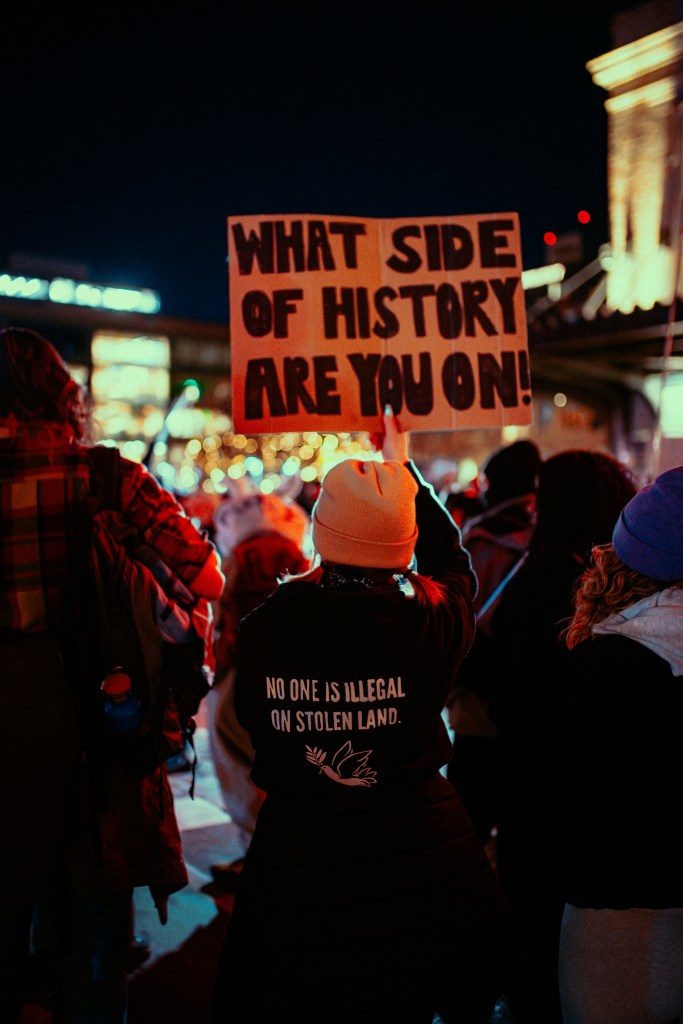
To lightly touch on what the controversy is with guidebook authors “plagiarizing” from one another, there is a specific example from August of 2025 involving a place called the Rock Shop. And for those of us who are newer to developing (which can be mostly people of color, sorry that’s just the way it is right now), this turmoil surrounding already existing documented areas is less of a concern for us. Unless, of course, Kaya hires us to go out and document an area already existing. To further understand this angle of the story if you do find yourself caught in that ask, feel free to visit my google drive document5 outlining the how, what, when and where’s of the story. It is of little concern to the current topic of diverse demographics in route developing.
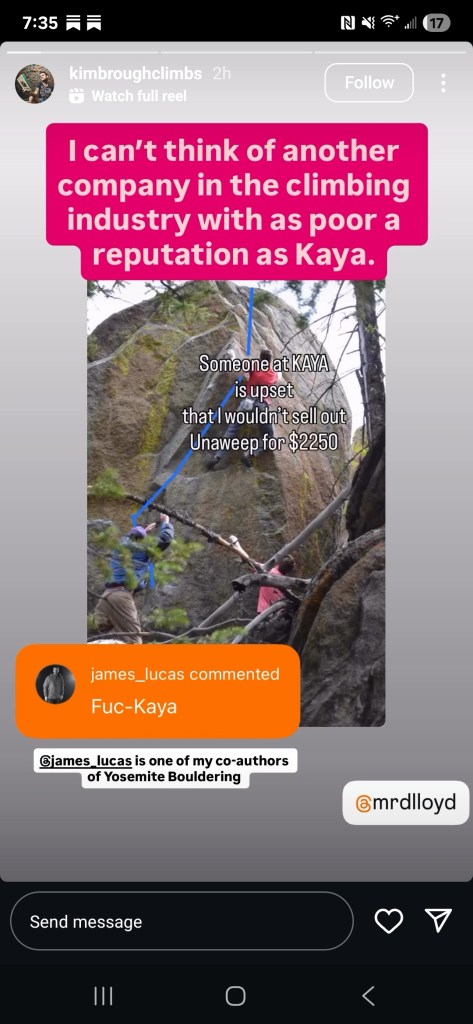
To be fair, not all route developers are entitled twerps who romp the country with no idea of their impact or behavior. The previously mentioned Kimborough Moore who gave us the data sets on guidebook authors, is in fact a guidebook author himself with his own Kaya drama from them plagiarising from his guides. He wrote sections in the Tuolumne Bouldering (forthcoming), Golden State Bouldering, Yosemite Bouldering, and Black Mountain Bouldering6. I have great respect for him and the work he has done in climbing. He weighed in on the Kaya controversy with some details (his Instagram account is public and these were all shared publicly on his story around August of 2025).
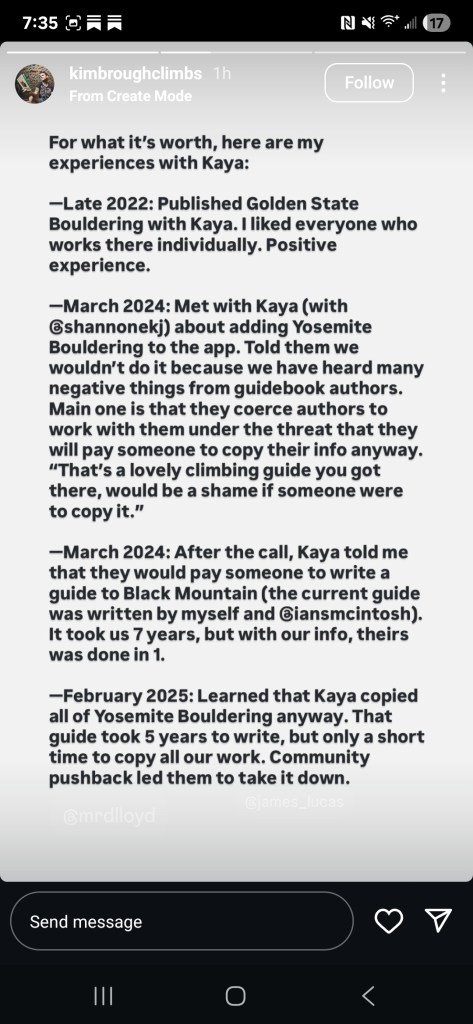
“I can’t think of another company in the climbing industry with as poor a reputation as Kaya. For what it’s worth, here are my experiences with Kaya:
- Late 2022: Published Golden State Bouldering with Kaya. I liked everyone who works there individually. Positive experience.
- March 2024: Met with Kaya (with @shannonekj) about adding YosemiteBouldering to the app. Told them we wouldn’t do it because we have heard many negative things from guidebook authors. Main one is that they coerce authors to work with them under the threat that they will pay someone to copy their info anyway. ‘That’s a lovely climbing guide you got there, would be a shame if someone were to copy it.’
- March 2024: After a call, Kaya told me that they would pay someone to write a guide to Black Mountain (the current guide was written by myself and @ianmcintosh). It took us 7 years, but with our info, theirs was done in 1.
- February 2025: Learned that Kaya copied all of Yosemite Bouldering anyway. That guide took 5 years to write, but only a short time to copy all our work. Community pushback led them to take it down.
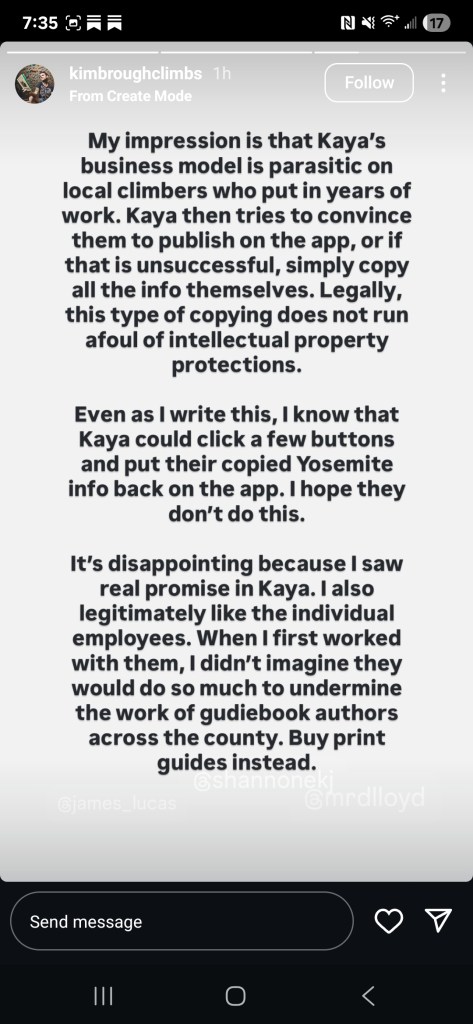
My impression is that Kaya’s business model is parasitic on local climbers who put in years of work. Kaya then tries to convince them to publish on the app, or if that is unsuccessful, simply copy all the info themselves. Legally, this type of copying does not run afoul of intellectual property protections.
Even as I write this, I know that Kaya could click a few buttons and put their copied Yosemite info back on the app. I hope they don’t do this.
It’s disappointing because I saw real promise in Kaya. I also legitimately like the individual employees. When I first worked with them, I didn’t imagine they would do so much to undermine the work of guidebook authors across the county. Buy print guides instead.”
I think my takeaway here is that there are some growing pains with this new grasp of technology with digital guidebooks on an app, but there is one positive. I have always been so very angry when I pay upwards of 40 to $50 for a guidebook, crack it open just to find racial derogatory route climbing names aimed at reminding me that some people do not consider me to be human.
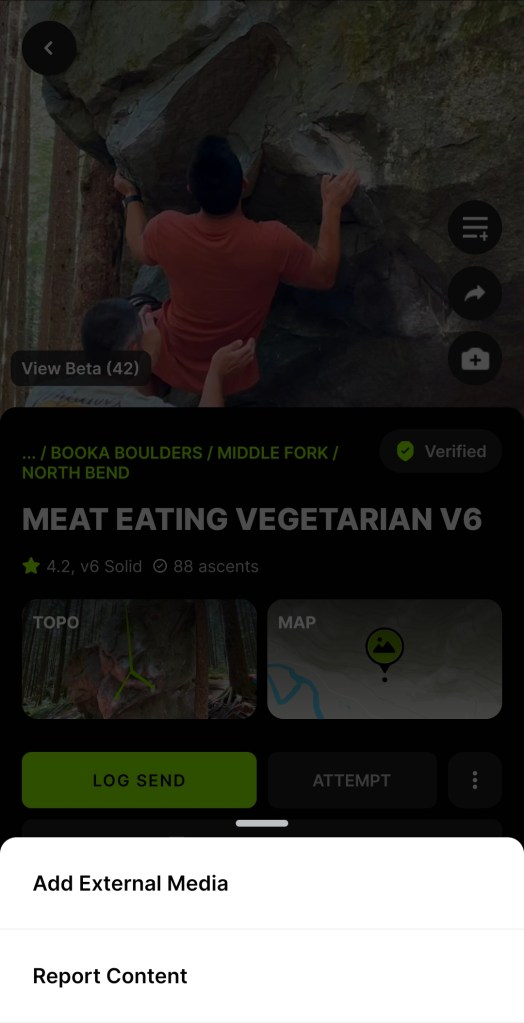
I also wondered what Kaya’s stance on climbing names was. Turns out, they learned from Melissa Utomo’s flagging tool that Mountain Project stole. They have a similar feature of flagging inappropriate route names7 and even member behavior flagging stemming from their community standards8. I think this is great and much needed, even in digital spaces. I appreciate this.
And yet, I also do not want to empower a company to plagiarize information from people like Kim who have put in years of work and dedication to developing. As a consumer looking at classic guidebooks, I feel caught in the middle. The only thing I am certain of is that guidebook authors newly publishing with Kaya (like Gabriel) are not subject to this conundrum of information ownership. Most of this other behavior can be summed up as legal, yet obnoxious behavior.
As more route developers lend their data to Kaya, it brings up many questions of ownership over that data, compensation, and restrictions. All of which Kaya started to make more public after these controversies, which I think are relevant for anyone considering route developing and digital documentation.
This is a quote from an email sent out by Kaya in August 2025 (the entire email can be read in my google drive document of Kaya controversies9): “The upside of the dust-up is that it’s pushed KAYA to do a better job of telling our story, pulling back the curtain on our approach to publishing authors’ guidebooks. The KAYA team will always be grateful for all of you, as the authors who took a leap of faith to publish with KAYA as a new, unproven platform, and who’ve hung in there with us as we’ve made mistakes, learned from them, and continued to improve our processes. Through all that learning, we’re proud that we now have the most author-friendly contributor terms in all of climbing publishing…Last week, we published the below info-graphic of our 2025 author contributor terms, and those terms may or may not be different than the terms in your agreement with us. Over the years, our terms have undergone a lot of changes thanks to feedback from authors, and we want to get things consistent so that all the authors who publish on KAYA have the same rights, regardless of when you signed your agreement.
This slide is accurate for many of your contributor agreements and we’re stoked about that! However, while most agreements prior to May 2025 allow you to terminate the exclusive license and use your data elsewhere, none of them explicitly permit you to remove your data for any reason at any time (the last bullet point in the slide). Under the new terms, authors are allowed to terminate the agreement with KAYA for any reason with 90 days’ notice.
Full text of the new terms can be found here: https://kayaclimb.com/terms-of-service.”
As newer developers, we should be paying attention to the POLICY, which we have not touched on at all yet. And the policy to scrutinize here is Kaya’s Terms of Service, which were summarized in a graphic in the email.
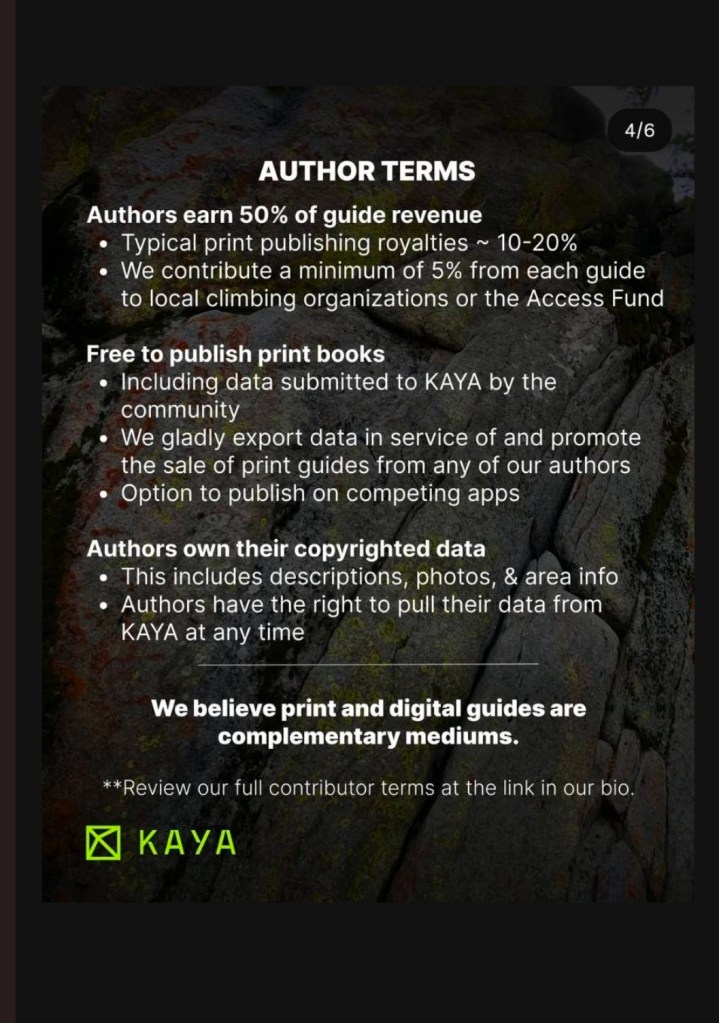
The graphic referred to in the email is as follows:
- “Authors earn 50% of guide revenue
- Typical print publishing royalties ~ 10-20%
- We contribute a minimum of 5% from each guide to local climbing organizations or the Access Fund
- Free to publish print books
- Including data submitted to KAYA by the community
- We gladly export data in service of and promote the sale of print guides from any of our authors
- Option to publish on competing apps
- Authors own their copyrighted data
- This includes descriptions, photos, & area info
- Authors have the right to pull their data from KAYA at any time
- We believe print and digital guides are complementary mediums”
This new transparency is essential. It is interesting to me, however, the wording on print and digital guides are complementary mediums. Yes, it’s great the authors have so much agency but it does not address issues of competing digital guidebooks to printed ones. If an existing guidebook had someone make a copy of it and try to sell it, we would say that’s ridiculous. And it most likely does not happen out of respect, and most importantly, because it is cost prohibitive. Aside from cost being much more relatively low as compared to a print copy, why has Kaya in the past decided to copy existing guidebooks and turn for profit and not see this as a ridiculous part of their business model? I have more to say about this in the Google drive document. But for now, let’s move on to the policy aspect of engaging with digital guidebooks apps as an author in Part VI: The Digital Guidebook Landscape Shaped by Policy
- Andino, Mary. “The Online Debate Roiling the Climbing Community.” https://www.newsbreak.com/gearjunkie-321446723/4268110843082-the-online-debate-roiling-the-climbing-community 14 Aug 2026 ↩︎
- Rakkup. “#findyourguidebook.” https://rakkup.com/ 18 Aug 2026 ↩︎
- Kaya. “THE BEST CLIMBING GUIDEBOOK CATALOG.” https://kayaclimb.com/bouldering-guide-catalog 14 Aug 2026 ↩︎
- Hudelson, Crystal. “Hip Hop in Climbing Part III.” https://rockrose.blog/2021/04/29/hip-hop-in-climbing-part-iii/ 14 Aug 2026 ↩︎
- Hudelson, Crystal. “The Kaya Controversy by Rock Rose Blog, LLC.” https://drive.google.com/drive/folders/1TflvPcaIDcts5EXbNdanBpoMeJ1jm-t-?usp=sharing ↩︎
- Moore, Kimbrough. “Kimbrough Moore.” https://www.kimbroughmoore.com/ 14 Aug 2026 ↩︎
- Kaya. “Reporting Offensive Climbing Names.” https://support.kayaclimb.com/support/solutions/articles/61000300862-reporting-offensive-climb-names 02 Sep 2026 ↩︎
- Kaya. “Kaya Community Standards.” https://kayaclimb.com/community-standards 02 Sep 2026 ↩︎
- Hudelson, Crystal. “The Kaya Controversy by Rock Rose Blog, LLC.” https://drive.google.com/drive/folders/1TflvPcaIDcts5EXbNdanBpoMeJ1jm-t-?usp=sharing ↩︎
 Rock Rose Blog, LLC