
For video format, visit my Substack
Part IV of VI: Route Names
I am all for people of color outdoor routesetting. One of the reasons I like a diverse set of people route developing is to, at the very very least, have better route naming practices. Yes, it’s partially about control. Who has control over these names and the power to change or even stop it in its tracks before being published?
If you have not been paying attention; there have been and still are widely inappropriate climbing route names. Inappropriate standing in for racist, homophobic, sexist, misogynistic, xenophobic…all the ugly misguided beliefs that plague our society. Whatever derogatory name you can think of yes: unfortunately there is a climbing route named after it.
But before we talk about that, I want to share a little story. It still pains me to look at the time I spent at the affinity group I split from so I cannot find it; but I was on a radio show in Seattle (KEXP maybe?) where I did talk about inappropriate climbing names. At the time, I was also the social media content creator for the affinity group. I had been in that position for about six months and later grew the following from a couple thousand people to 10 thousand followers in about a year. Part of that uptick was my relentless posting about climbing issues and people being engaged online more due to the pandemic. So if you ever gave that group a follow between 2020 and about 2022, you were actually following me. Congratulations: you have made it to the source and original philosophical heart of what most of the group was trying to embody.

I had just finished a series on climbing route names around early 2020 before going on the radio show. And the list was brutal. Basically, I googled every slur I could think of with the keyword “Mountain Project” to build a small database. I retained this database and you can view it here1. Content warning: it is disturbing, especially the sheer number of 50 routes I found easily in my small time working on it. And I posted every single one in a long story on the affinity group’s social media.
People were outraged: as they should be. It led to a lot of conversations and engagement. I did it to prove a point because at the time the issue was definitely downplayed by a lot of people in the climbing community. I think the most compelling and comprehensive data compiled was done by Climb the Gap in mid 20202.
The questions of how this happened, why this happened, and where in the process/who was responsible to put a stop to this practice surfaced, yet they were always there for me.
Working backwards from existing names to developing and naming, who is responsible for changing route names that already exist? Are there any paths to change it?
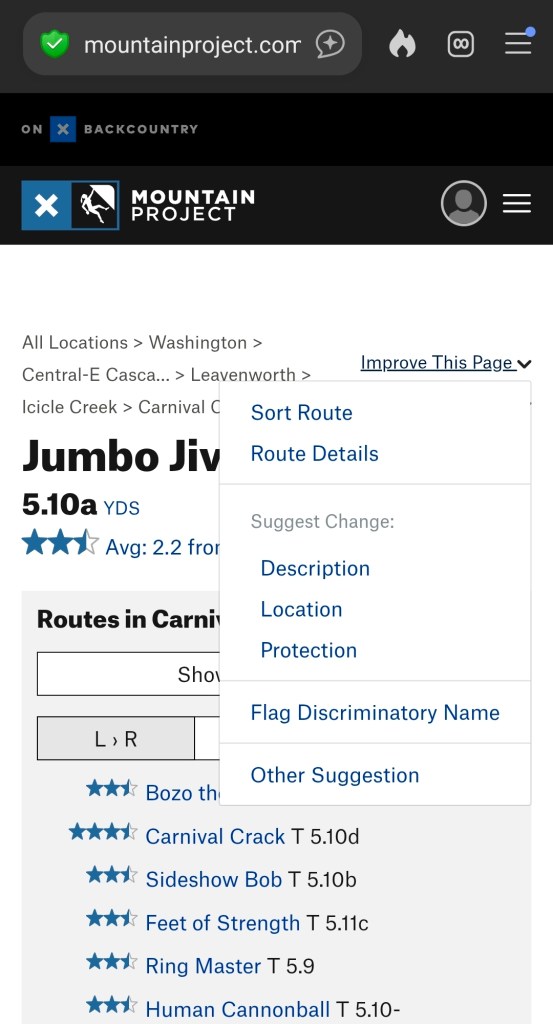
Why yes there are! There is little we can do about previously printed guidebooks (many of which I own and paid good money for that contain slurs specific to my race), but what of digital means of climbing data like Mountain Project? One climber named Melissa Utomo attempted to remedy this for Mountain Project around 20193. Her multiple proposals for a flagging feature were not taken seriously and in the end, they stole her idea by implementing it anyway in 2020. Basically it is a feature that a community member who is signed in to Mountain Project can ‘flag [a] discriminatory name.’ It has been instrumental in changing these names, or at least shielding them from the public internet eye. I am not going to go into the arguments against changing route names: that is a more specific conversation for another time. I will say, however, no matter how prolific or famous the developer is: they have no right to name a climb after something so ugly. And why would they want to when there are so many more interesting and meaningful words to draw inspiration from.
The debate on whether or not to change existing names overlooks how these names came into effect in the first place. My time with Gabriel developing showed me that recordkeeping is a group effort. In this case, all the climbs were tracked using descriptors of the boulder, whose project it was, who sent it, and its name (if it had one yet). Including pictures, GPS pins, and hand drawn topos. It was all very cool to see this put into play. From this I can conclude that the main person who is most involved with the recordkeeping is the first failsafe with route names. Designated with a little crown next to his name in the developing document, it was obvious Gabriel would be that person. I asked him once what he would do if someone named a boulder something inappropriate, and he told me he would definitely go and chat with them.
So what are all the other developers doing?! Sure, if they are developing an area alone and they are the main person then there are less failsafes. However, to my understanding and experience, usually friends get invited to double check grades or just to hang out before release of an area. When the topic of the climb’s name comes up, who in their right mind would say absolutely nothing about the messed up nature of the name? And don’t come at me with ‘maybe they didn’t know.’ Because they do; some of these names are so brazen there is no way to have missed it.
Like it or not, many people make it to a newly developed crag before it is officially released and every single one of them have failed us by not speaking up about these hurtful climbing names. Think about that: not only the route developer, but everyone who touched those rocks before the area was public let those names continue to be released; the blame for letting this happen also lies with them: the climbing community surrounding the route developer.
A big failsafe is people visiting the area so I am going to first say: do better white people and speak up in the first place. But also, having diversity in route setting may inherently make naming climbs more intentional and appropriate. Of course, that is assuming the minority demographic has the capacity to tackle such a topic and feel empowered to do so. Specifically in this instance of Robot Blocks I believe better route naming practices to be true because the pool of people Gabriel was pulling from were gathered seeking connection and an educated space in which to thrive within climbing. Robot Blocks crag doesn’t only have a competent leader who is not afraid of having those hard conversations should it arise; but these routesetters of color had control over the route names from demographics who are usually not in route developing. Amazing.
Of course, Robot Blocks did have its obstacles. The main one being publicization. When a crag is developed, usually people want other people to go and climb it. The traditional way to get the word out about that would be paper guidebooks. And then later on in climbing, websites such as Mountain Project became more mainstream. Unfortunately, word at the approach is that a new edition of Western Washington Climbing is not set to release for some time. Therefore, it gave Gabriel a bit of a dilemma on how to get the word out. Now, a small crag like this could have self published on Mountain Project, however, the reach would still be small because the only way to find it would be if someone was browsing areas in the website and stumbled upon it. Or word or mouth. Another couple of options could be self publicization or with a digital guidebook app.
I recall walking into a climbing gear store in Las Vegas one time and I looked at the famous Southern Nevada Bouldering guidebook (no, it has no roman numeral as this was edition one as edition two was not released until 2016 and now we are up to edition three. Yes, I have been in climbing that long now). The price on this book shocked me: I had been looking at purchasing it online but decided I wanted to support the local store and would purchase it there. But the price difference was so significant that even the store clerk advised me to purchase it online from the author through Amazon. They said that self publishing was mad expensive to begin with but selling it online brought down the cost somehow.
I imagine this decision to not self publish a guidebook with 109 climbs at Robot Blocks was a wise one on Gabriel’s part. The expense would be too great and the book very, very small. Apps like Kaya are perfectly suited to address this conundrum.
But how is Kaya doing in the guidebook app business? See Part V: The Kaya Controversy
- Hudelson, Crystal. “Route Names.” https://drive.google.com/drive/folders/1vuBZVT_rx2EjyqRB_HjVp6j5IJfCLTk9?usp=sharing ↩︎
- Climb the Gap. “Climbing Guidebooks + Publishers.” https://docs.google.com/spreadsheets/u/0/d/1yN9Ekor7Dy8KK6gehkv4T7JyrBMxFxmaS08H9TdCQ00/htmlview 14 Aug 2026 ↩︎
- Saatchi, Anaheed. “How Mountain Project Stole from a Woman of Color & Spent Years Defending Hate Speech in the Climbing Community.” https://www.melaninbasecamp.com/around-the-bonfire/2020/7/6/how-mountain-project-stole-from-a-woman-of-color 14 Aug 2026 ↩︎
 Rock Rose Blog, LLC