For video format, visit my Substack
Part III of VI: Robot Blocks
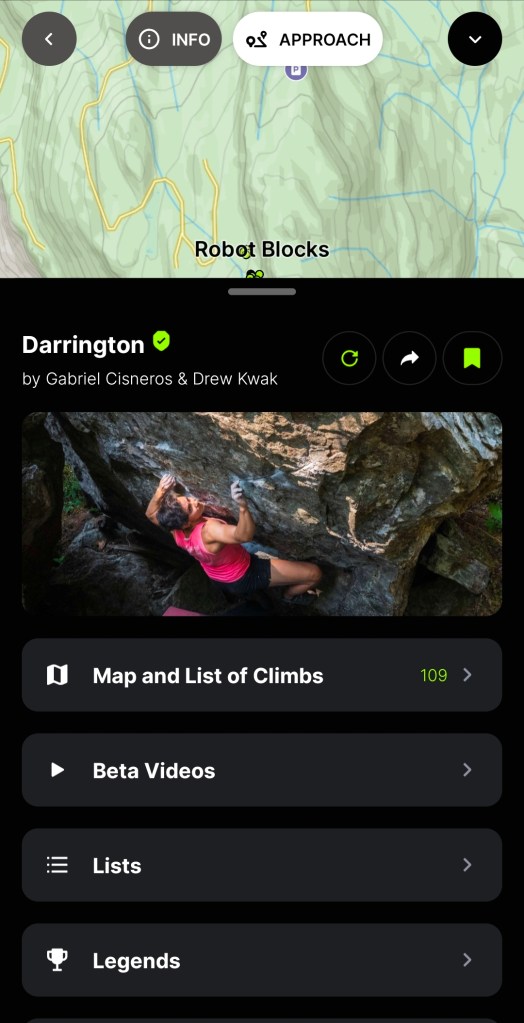
Robot Blocks is a bouldering area near Darrington, Washington. You will not find it on Mountain Project or a paper guidebook at this time as it had an exclusive release on the app Kaya. More on that later.
Let’s talk about the main route developer of Robot Blocks; Gabriel Cisneros. If you are not familiar with him, you may not even realize that you have seen or been influenced by his work. He is in multiple guidebooks for first ascents (or FA’s) as well as having written the geology section of the Western Washington Bouldering guidebook among others. There is a half page bio and pictures of him climbing in this book as well as appearances in other climbing guidebooks. In 2023 he was given the Climbing Advocate Award by Access Fund1. He also has sat on the Washington Climber’s Coalition (WCC) board for about a decade2 involved in climbing management plans, climbing access, and re-bolting efforts. His climbing resume is extensive and about 20 years long with route development as a big part of it.
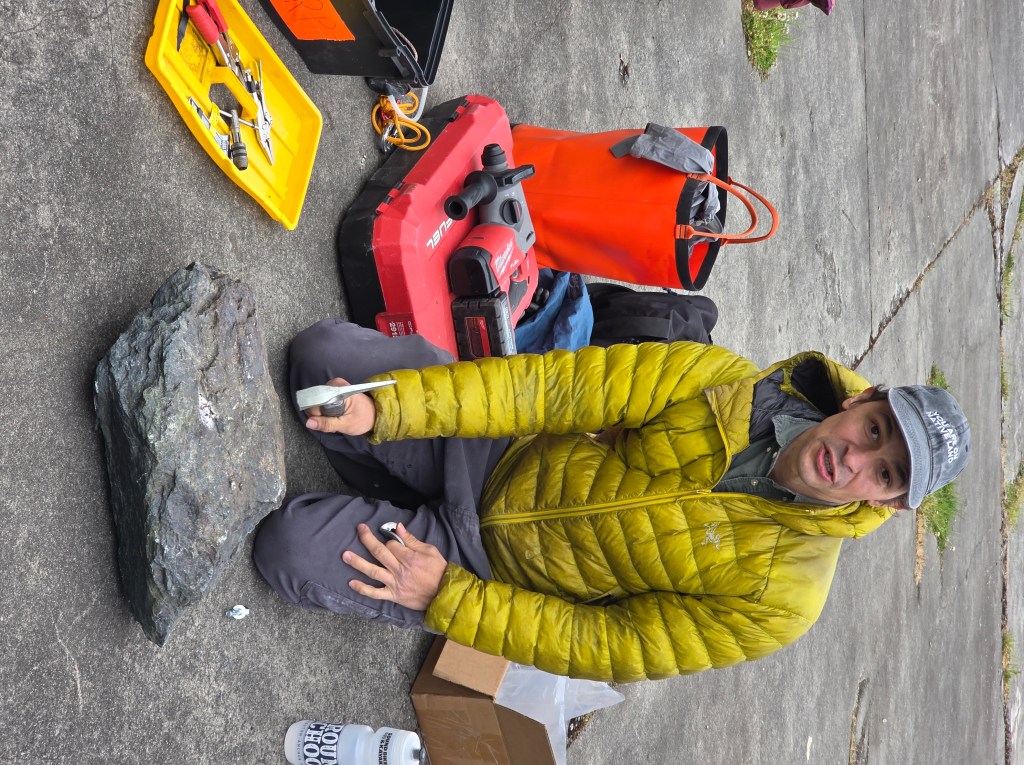
I remember the first time I met Gabriel: he was at a climbing gym attending a WCC board meeting when he spotted my partner Keith. Keith, who has been in climbing almost as long as Gabriel, introduced us. It was here Gabriel expressed his desire to “put on a BIPoC re-bolting course.” At the time this was about 2020 and I had very little understanding of what he meant. I knew what the words meant individually but I had no idea what that meant or looked like. The affinity group I worked with had a ‘people of color teaching people of color’ policy and Gabriel’s Indigenous ancestry3 (particularly Yaqui) lended us a unique opportunity as there are very few prominent modern Indigenous climbers, let alone ones with massive experience excited to teach. I was willing to give it a try as he seemed very keen.
The next season I commissioned him to teach two courses for the affinity group rock programming: Intro to Guidebooks and Re-Bolting. And here is where I realized the width and breadth of his expertise from these two courses. The guidebooks course was not particularly popular (probably due to the way I marketed it; my bad) but when I attended to assist I always learned something about route documentation and development. He taught this for at least 3 seasons and after the implosion of the affinity group, re-bolting for people of color was resumed under the WCC. But the guidebooks course has never resumed.
I have always felt so honored to learn from Gabriel. His style of teaching and depth of knowledge has assisted many people to define new truths about who can do different things. Myself included: I never had anyone suggest to me that re-bolting was something I could so easily engage in. And it’s all because he is willing to share and be that shepherd for everyone.
I would call Robot Blocks an initiative to get marginalized demographics into route developing, but it was so much more than that. Being so involved in affinity programming, Gabriel “…was volunteering at BIPOC climb nights for an organization started by Crystal Hudelson and Keith Murakata. He started inviting other BIPOC climbers, like Drew Kwak, to help develop the area. As a result, the whole area was mainly developed by the BIPOC climbing community. ‘It was kind of a beautiful accident but am so proud of this area and of being able to make this guide with Drew.”4
You heard that right: it was an all natural, grass roots initiative that happened by accident…or was it? The main difference between JEDI Training and Narrow Gauge Slabs is that it was not the majority demographic of white men inviting ‘others’ into the space of route developing; it was an Indigenous leader immersed in a diverse climbing community inviting people to develop at his newfound crag. I myself even took part in this project and set my very first boulder as well. And being able to rely on Gabriel as a guiding light for advice or even just how to do the dang thing was indispensable. I personally believe I could not or would not have done it without him. Thank you, Gabriel.
It begs the question of whether or not this is the first majority BIPoC developed climbing crag in the United States (yes, Black AND Indigenous folk were included so it deserves the entire acronym). As far as I can tell, it may be. Reach out if you know of any more to add to my knowledge. It is still an amazing thing even if it is not the first.
How do activities like this change route developing?
Find out more in Part IV: Route Names
- Access Fund. “Access Fund Announces 2023 Climbing Advocate Awardees.” https://www.accessfund.org/latest-news/access-fund-announces-2023-climbing-advocate-awardees 14 Aug 2026 ↩︎
- Washington Climbers Coalition. “Board.” https://washingtonclimbers.org/index.php/aboutus/the-board/ 14 Aug 2026 ↩︎
- Washington Climbers Coalition. “Board.” https://washingtonclimbers.org/index.php/aboutus/the-board/ 14 Aug 2026 ↩︎
- Kayaclimbing, geros3000, washingtonclimbers, drewtre808. Robot Block Washington Gabriel Cisneros and Drew Kwak. https://www.instagram.com/p/Da05ckMFjSY/ 14 Aug 2026 ↩︎
 Rock Rose Blog, LLC