
For video format, visit my Substack
Part II of VI: Route Development Initiatives
If we look at the sheer small numbers of guidebook authors and the mechanisms to keep out women, and then even more mechanisms to keep Black women and queer people out of the sport (see my Hip Hop in Climbing article, specifically Part II), it’s unfortunately safe to say there are little to few or no route developer guidebook authors or co-authors of color in the US. And I specifically say in the US with a quick mention to crags in Jamaica with development by Kai Lightner1 and Negros Island in the Phillipinnes (yes it is Negros and not Negroes, but unfortunately both stem from the same meaning from colonization)2. Negros Island is a shining example of how development can happen by people of color on their home soil even3. I encourage you to go listen to Rock and Rice’s podcast on this topic4. For the sake of scope here, we will stick with US initiatives to inject diversity into route development.
The 2 main organized initiatives to expand demographics in route developing I am aware of are: 1. JEDI Training5 circa 2020 and 2. The Narrow Gauge Slabs6 circa 2021.
I call both organized initiatives because in both of them, white cis gender men have consciously gone out of their way to invite people of marginalized communities into outdoor route development. In both of these cases, it was an intentional decision for inclusion.
We will start with JEDI Training: a film made by Crux Climbing Center and Black Diamond. This was a film I saw while attending a BLK Out Festival in Chattanooga a few years ago. At the time, I was star struck by it: what an exciting film. A Black woman named Bree Jameson getting out to develop, bag an FA (first ascent) on what she developed, and name said climb. So much time has passed now that they have since released the video for free on Youtube and I decided to re-watch it. I have a few discerning thoughts.
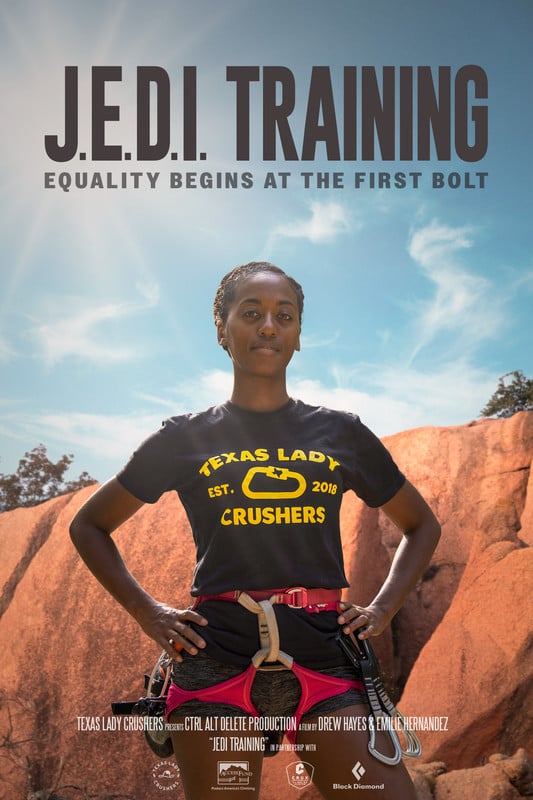
First of all, it’s fantastic that white people decided to look around and include marginalized demographics in route development. I applaud them for that. The issues I have are a bit more nuanced, starting with some of Bree’s philosophies.
Let’s get one thing straight: Bree was very brave to have undertaken the project and had a film made about her journey. That is never an easy thing to do; especially as a minority talking about diversity, equity, and inclusion. I am not here to tear that down in any way, however, just because we have slim to no representation in this particular field does not mean we need to settle for less than equitable rhetoric. And some people may not agree with my take on this, but I have to at least get it off my chest.
In the film, Bree talks about not feeling like she fit in a lot. “Growing up I had a hard time fitting in. So I’ve been used to feeling that there aren’t a whole lot of people around that are like me. That has helped me to go into these spaces and be the only person that looks like me. It’s not lost on me that other minorities may not have that skillset of being comfortable not fitting in. Accessibility challenges us to make sure that everyone feels comfortable and welcome in these spaces.”7 Thank you for expressing your truth, Bree, but I am uncomfortable with this particular concept.
On par with everything the climbing industry has touted for years about assimilation and respectability politics, Bree has tapped into that quite seamlessly. The “skillset” she expressed is called code switching. Code switching is about survival and it is indeed a “skill”. However, the part not said out loud is the heavy burden placed on the ‘other’ to acquire the skill in order to survive or function in an environment in which they may not otherwise, due to all the isms and respectability politics. Especially for Black people. This in and of itself says assimilation to me, which is exactly what the outdoor industry has used as a tool to neatly package ‘others’ into in order to reconcile with its diversity problem. It’s not giving clarity where it is due: that environments are unsafe for certain demographics not because of being that demographic, but because of the people who originally made, shaped, and maintained the environment. For more on respectability politics, I highly suggest Dr. Raquel Martin’s Instagram video on Respectability Politics and the Black Community8.
But the feeling of loneliness Bree’s words described are palpable and relatable. There is no denying that there can be rigid gender and racial constructs in Black communities, especially in relation to activities deemed ‘white.’ And this has always been a problem because sometimes we restrict ourselves to what is possible due to fellow Black peers or Black authorities in our life telling us ‘Black people just don’t do that.’ These restrictions may seem ridiculous to some, but in reality they have traditionally been rooted in the understanding that places are deemed a hazard to our health. See my article Hip Hop in Climbing: Part II for more on this topic. Although these sentiments originally had our best interest at heart: they are also very damaging, especially to a young psyche. I do want to point out that there is “…definitive evidence that racial groupings have no biological basis. In fact, there is more genetic variation within racial groups than between them. Race…is a social construct.”9 Therefore, the glaring reason Black folks have historically not done something is because it was unsafe due to first being harassed, hunted, and killed due to skin color. And if it is any non black demographic claiming maliciously that inherent traits and behaviors keep us from doing certain activities, the underlying argument here is actually based in eugenics10 (which is not a good thing). But, another topic for another time. Also note that diversity in one group does mean there would be a wide berth of interests in one grouping of similar race as well. The chances of someone in a Black community enjoying climbing are quite high.
Of course, I am not surprised the person they chose to give a platform to has this particular view; stories and narratives which make it mainstream are rarely those who have a more radical and realistic view on systems of oppression and how they interact with outdoor sports. The entire video felt like the most radical thing in it was when someone uttered the words “white men.” I wanted more from this video even though I was also fiercely proud a Black woman did route developing.
I do think that Bree did have some valid points in the film too, expressing: “I think that in general that as a Black person, you end up being this involuntary representative of all Black people because there are so few of us in these circles.”11 Really bringing home the loneliness and overwhelming feelings of responsibility put on her by the racist environment we call the United States. And she brought it home with “Anyone who wants to experience nature, should be able to experience nature without any obstacles before them.”12 Well said, Bree. I hope you are doing well and have a long career of route developing ahead.
The next initiative, the Narrow Gauge Slabs, has a lot of the same themes as JEDI Training. The first thing I would like to point out is that they made a sustainable crag from scratch. I think this is very important to note because back in the day, a lot of developers bolted and neglected a sustainable way to access or exit crags. Areas such as Gritscone here in Washington are a perfect example of that. To hear more on that story, you can catch me on the Access Fund Podcast from 202313. Note that I am not with that mentioned affinity group anymore and still do not recommend them.
The similarity with each initiative is the same: white men (the overwhelming majority of routesetters), decide to take out people from marginalized demographics (religiously, ethnically, racially, gender) and teach them route development. It’s a good start for sure.
However, true to the philosophies that I came to develop and embrace during my time working at an affinity group for 5 years, I want more. Assimilation is unacceptable to me, hence me coining the phrase ‘bring your culture into climbing’ years ago. I want women teaching women and people of color teaching people of color. Unfortunately, that may not have been a reality for a long time; until I heard about Robot Blocks in Washington which we will explore in Part III.
- Gripped. “Kai Lightner Opens Jamaica’s Hardest Climb.” https://gripped.com/news/kai-lightner-opens-jamaicas-hardest-climb/ 31 Jul 2026 ↩︎
- Wikipedia. “Negros.” https://en.wikipedia.org/wiki/Negros 10 Sep 2026 ↩︎
- Rock and Rice. “EP25: Bianca & Glenn -Negros Island Rock Climbing & Balancing Climbing with Crag Stewardship.” 2026, Spotify. https://open.spotify.com/episode/56nIgBeHjVU0MWfENfVfRy?si=o5jL1gcXTtSf0yDt77M8zQ&utm_source=copy-link&sci=spotify%3Acard-config%3A31gi8McUQVTkoN9eNQTSXI&nd=1&dlsi=013c7c5323d54ed0 ↩︎
- Rock and Rice. “EP25: Bianca & Glenn -Negros Island Rock Climbing & Balancing Climbing with Crag Stewardship.” 2026, Spotify. https://open.spotify.com/episode/56nIgBeHjVU0MWfENfVfRy?si=o5jL1gcXTtSf0yDt77M8zQ&utm_source=copy-link&sci=spotify%3Acard-config%3A31gi8McUQVTkoN9eNQTSXI&nd=1&dlsi=013c7c5323d54ed0 ↩︎
- “JEDI Training Film – A Climbers Journey to be the FirstBlack Woman to establish an FA.” Youtube, uploaded by J.E.D.I. TrainingFilm. 15 Oct 2025, https://www.youtube.com/watch?v=W_ugmx_EWek ↩︎
- “Beyond the Bolts- Proactively Developing a Sustainable Climbing Area.” Youtube, uploaded by jcosandparks, 26 May 2025, https://www.youtube.com/watch?app=desktop&v=ulT4p2DQHW0 ↩︎
- “JEDI Training Film – A Climbers Journey to be the FirstBlack Woman to establish an FA.” Youtube, uploaded by J.E.D.I. TrainingFilm. 15 Oct 2025, https://www.youtube.com/watch?v=W_ugmx_EWek ↩︎
- Raquelmartinphd. Video of respectability politics is killing black people. https://www.instagram.com/reel/DcCAsLEyvsz/?igsh=MXA3ZHVsNmR0NTE1bQ==&igsi=MXA3ZHVsNmR0NTE1bQ== 20 Aug 2026 ↩︎
- Rutherford, Adam. “’Biological reality’: What genetics has taught us about race.” https://www.bbc.com/future/article/20250417-biological-reality-what-genetics-has-taught-us-about-race 14 Aug 2026 ↩︎
- National Human Genome Research Institute. “Eugenics.” https://www.genome.gov/genetics-glossary/Eugenics 14 Aug 2026 ↩︎
- “JEDI Training Film – A Climbers Journey to be the FirstBlack Woman to establish an FA.” Youtube, uploaded by J.E.D.I. TrainingFilm. 15 Oct 2025, https://www.youtube.com/watch?v=W_ugmx_EWek ↩︎
- “JEDI Training Film – A Climbers Journey to be the FirstBlack Woman to establish an FA.” Youtube, uploaded by J.E.D.I. TrainingFilm. 15 Oct 2025, https://www.youtube.com/watch?v=W_ugmx_EWek ↩︎
- Access Fund. “Episode #57- Dave Thompson, Crystal Hudelson, and Keith Murakata.” https://www.accessfund.org/the-climbing-advocate-podcast/episode-57-dave-thompson-crystal-hudelson-and-keith-murakata 14 Aug 2026 ↩︎
 Rock Rose Blog, LLC